
 By Neng Nana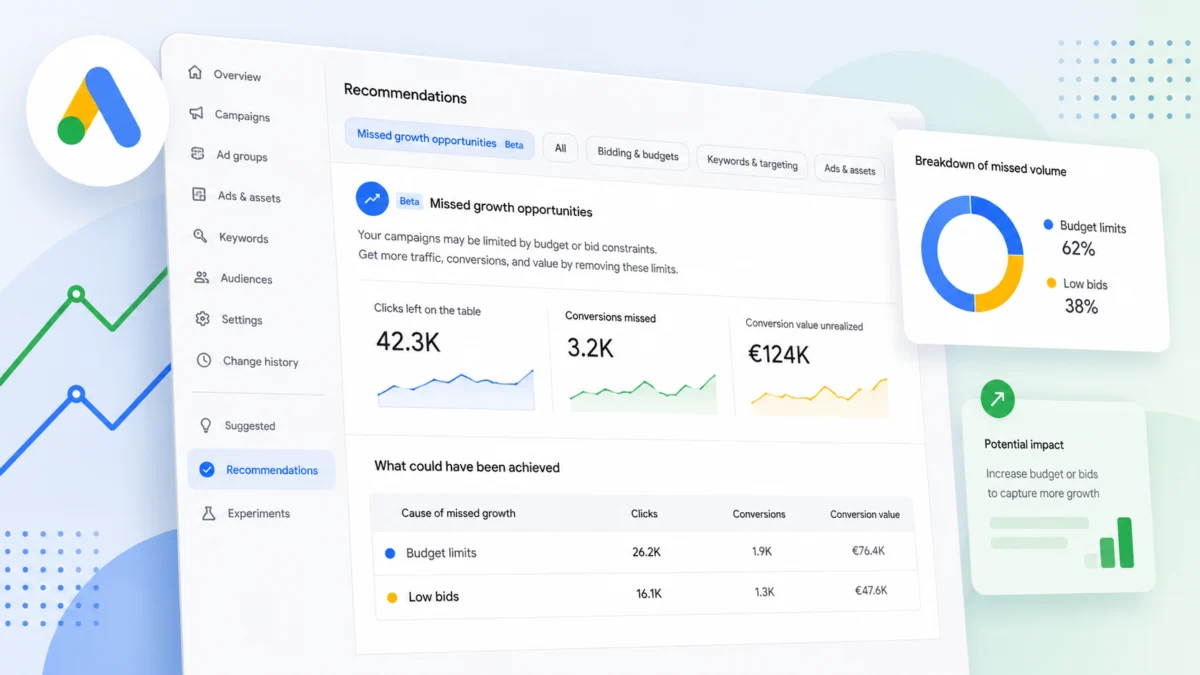
Google has officially transitioned its "Missed Growth Opportunity" insights from the experimental Google Ads Labs environment directly into the primary Recommendations tab. Currently rolling out as a beta feature for eligible advertisers, this integration is designed to provide search marketers with a highly visible, quantified estimate of the traffic, conversions, and revenue they may be leaving on the table due to budget limitations or uncompetitive bidding strategies.
By surfacing these predictive insights alongside its standard optimization recommendations, Google is making a concerted effort to shift the conversation from abstract performance metrics to concrete business outcomes. However, as with all automated recommendations, the digital marketing community is approaching the update with a mix of optimism and characteristic skepticism.
1. Main Facts: What is the ‘Missed Growth Opportunity’ Beta?
The new beta feature integrates predictive forecasting directly into the daily workflow of digital advertisers. Rather than requiring users to seek out experimental tools in Google Ads Labs, the platform now automatically calculates and displays the potential lift an advertiser could achieve by adjusting their financial parameters.
Key Features of the Integration
The consolidated recommendation card estimates the unrealized potential of an active campaign by highlighting three primary metrics:
- Missed Traffic: An estimate of the additional clicks and impressions a campaign could have captured had it not been constrained by budget or bid thresholds.
- Missed Conversions: The projected number of customer actions (purchases, lead forms, sign-ups) lost due to delivery limitations.
- Missed Revenue (Conversion Value): The estimated monetary value of those lost conversions, calculated using the campaign’s historical conversion values.
Budget vs. Bid Constraints
The tool specifically bifurcates these missed opportunities into two distinct root causes:
- Insufficient Budgets: Scenarios where a campaign’s daily budget is exhausted before the end of the day, causing ads to stop showing during active search periods.
- Low Bids: Scenarios where a campaign’s bids (or target CPA/ROAS thresholds) are too low to win placement in high-value auctions, despite remaining daily budget.
By separating these two factors, Google aims to give advertisers a clearer understanding of whether their growth is bottlenecked by total capital allocation (budget) or by tactical competitiveness within individual auctions (bidding).
2. Chronology: The Journey from Google Ads Labs to Core UI
The release of this beta represents the graduation of an experimental tool into a core system feature. Understanding this timeline explains how Google refines its advertiser-facing tools.
[Google Ads Labs Launch]
   │ (Experimental testing of "Missed Growth Opportunity" tool)
   ▼
[Feedback & Iteration]
   │ (Refining prediction models based on user interaction)
   ▼
[Beta Integration]
   │ (Integration into main Recommendations Tab; spotted by Thomas Eccel)
   ▼
[Global Rollout]
   (Phased release to eligible advertiser accounts worldwide)
Phase 1: The Google Ads Labs Sandbox
Google Ads Labs was introduced as a testing ground for experimental features, allowing select advertisers to opt-in and test cutting-edge capabilities before they were fully integrated into the platform. The "Missed Growth Opportunity" tool was initially launched within this sandbox, designed to help Google evaluate how advertisers interacted with high-level growth modeling.
Phase 2: Identification and Discovery
The transition from Labs to the main Recommendations tab was first identified and reported by pay-per-click (PPC) expert Thomas Eccel. Eccel noted on LinkedIn that the feature is a direct, rebranded iteration of the former Labs tool, now positioned prominently where media buyers make daily optimization decisions.
Phase 3: The Beta Rollout
Google has begun rolling out the feature as a beta to eligible accounts globally. Eligibility is largely determined by the volume of historical data available in the account; campaigns require a steady baseline of conversion tracking and auction activity for Google’s machine-learning models to generate reliable predictive estimates.

3. Supporting Data & Technical Framework: How the Estimates Work
To understand the utility of these recommendations, advertisers must look under the hood at how Google generates these forecasts. The system does not simply guess; it relies on complex simulation models.
The Mechanics of Auction Simulation
The calculations behind the "Missed Growth Opportunity" tool are driven by Google’s Auction Simulator. This system analyzes historical auction data from the previous seven days, taking into account:
- The actual search queries that occurred.
- The bids and budgets of competitors in those same auctions.
- The advertiser’s historical Quality Score and ad relevance.
By running thousands of mathematical simulations, the model calculates what would have happened if the advertiser’s budget had been higher or if their target bid had been more aggressive.
| Metric Analyzed | How Google Calculates It | Usefulness to Advertisers |
|---|---|---|
| Lost Impression Share (Budget) | Measures the percentage of time ads did not show because the daily budget was depleted. | Identifies campaigns that are highly profitable but cut short early in the day. |
| Lost Impression Share (Rank) | Measures the percentage of time ads did not show due to poor ad rank (low bid or low quality). | Identifies campaigns where bids are too conservative to compete in premium ad placements. |
| Modeled Conversion Value | Uses historical conversion rates and average order values (AOV) to project the revenue of missed clicks. | Translates technical search metrics into financial return on investment (ROI). |
The Math of Diminishing Returns
A critical technical detail that advertisers must keep in mind is the law of diminishing returns. As budgets and bids scale upward, the marginal cost per acquisition (CPA) typically increases.
For example, while a campaign spending $100 a day might achieve a $10 CPA, doubling the budget to $200 will rarely yield double the conversions at the same $10 rate. The simulator attempts to account for this curve, but the recommendations tab often displays the most optimistic projection of growth rather than the most cost-efficient one.
4. Industry Reactions: The Tension Between Growth and Efficiency
The integration of this tool has sparked a familiar debate within the search engine marketing (SEM) community. While the data is undeniably useful for forecasting, seasoned media buyers caution against taking Google’s recommendations at face value.
The Skeptic’s View: The "Spend More" Bias
The primary criticism from PPC professionals is that Google’s recommendations historically skew toward encouraging higher spend. Features that suggest budget increases are often viewed with skepticism, as they directly benefit Google’s bottom line.
In discussions surrounding the update, practitioners have pointed out that:
- Estimates are not guarantees: Google’s models are based on historical simulations, which cannot predict sudden market shifts, competitor budget changes, or changes in consumer behavior.
- Traffic quality is not uniform: Simply buying more traffic does not guarantee high-intent visitors. Often, the traffic gained by expanding budgets consists of lower-funnel searches that may convert at a lower rate.
The Optimist’s View: A Powerful Client-Facing Tool
Conversely, many agency executives and consultants welcome the integration. The primary benefit lies in client communication and reporting.
Historically, agencies had to explain complex metrics like "Search Lost Impression Share (budget)" to clients who may not understand the technicalities of search auctions. Translating those percentages into estimated lost revenue makes a compelling business case for budget expansion.

Showing a business owner a graph indicating they missed out on an estimated $5,000 in revenue due to a $20-a-day budget cap is a far more effective way to secure additional funding than discussing abstract impression share metrics.
5. Strategic Implications: How Advertisers Should Leverage the Beta
The introduction of the "Missed Growth Opportunity" beta demands a structured approach from digital marketing teams. To maximize the value of this tool without falling into the trap of inefficient spending, advertisers should implement a clear validation process.
[Review Recommendation]
   │ (Identify estimated missed revenue and traffic)
   ▼
[Check Historical Performance]
   │ (Is the campaign currently meeting its Target CPA/ROAS?)
   ▼
[Assess Marginal Profitability]
   │ (Will increased spend maintain acceptable efficiency?)
   ▼
[Deploy Controlled Test] ──► [Option A: Use Google Campaign Experiments]
   │                         [Option B: Apply incremental manual increases]
   ▼
[Evaluate & Scale]
   (Analyze real-world results vs. Google's initial estimates)
Step 1: Establish Performance Baselines
Before acting on any recommendation to increase bids or budgets, verify that the target campaign is already operating at an acceptable level of efficiency. If a campaign is already failing to meet its Target ROAS (Return on Ad Spend), increasing the budget will likely compound the inefficiency rather than resolve it.
Step 2: Utilize Google’s Campaign Experiments
Rather than applying a suggested budget increase directly to a live campaign, advertisers should use Campaign Experiments to split-test the changes. By directing 50% of traffic to the original budget/bid structure and 50% to the proposed higher-spend structure, marketers can empirically prove whether the additional spend yields a profitable return.
Step 3: Monitor Marginal Cost Per Acquisition
When scaling budgets based on "Missed Growth" estimates, monitor the cost of the new conversions generated. If your average CPA is $20, but the additional conversions gained via the budget increase cost $50 each, the expansion may not be economically viable for your business model.
Step 4: Avoid "Auto-Apply" Settings
Google Ads offers "Auto-Apply" options that allow the system to automatically implement budget and bidding recommendations. Industry experts universally recommend disabling auto-apply for budget increases. Financial allocations should always remain under manual human supervision to prevent runaway spend.
Conclusion: A Step Forward in Transparency, with Caveats
The migration of "Missed Growth Opportunity" insights into the main Recommendations tab is a logical step in Google’s ongoing effort to make its advertising platform more accessible and business-centric. By translating complex auction dynamics into tangible projections of lost traffic, conversions, and revenue, Google has provided advertisers with a powerful tool for strategic planning and client reporting.
However, the fundamental rule of digital marketing remains unchanged: all automated recommendations must be validated against real-world business data. Advertisers who treat these new beta insights as directional hypotheses to be tested, rather than absolute truths to be executed blindly, will be best positioned to unlock genuine growth while maintaining optimal efficiency.
 Jia Lissa
  Nana Muazin
  Layla Zulfa