
 By Siti Muinah
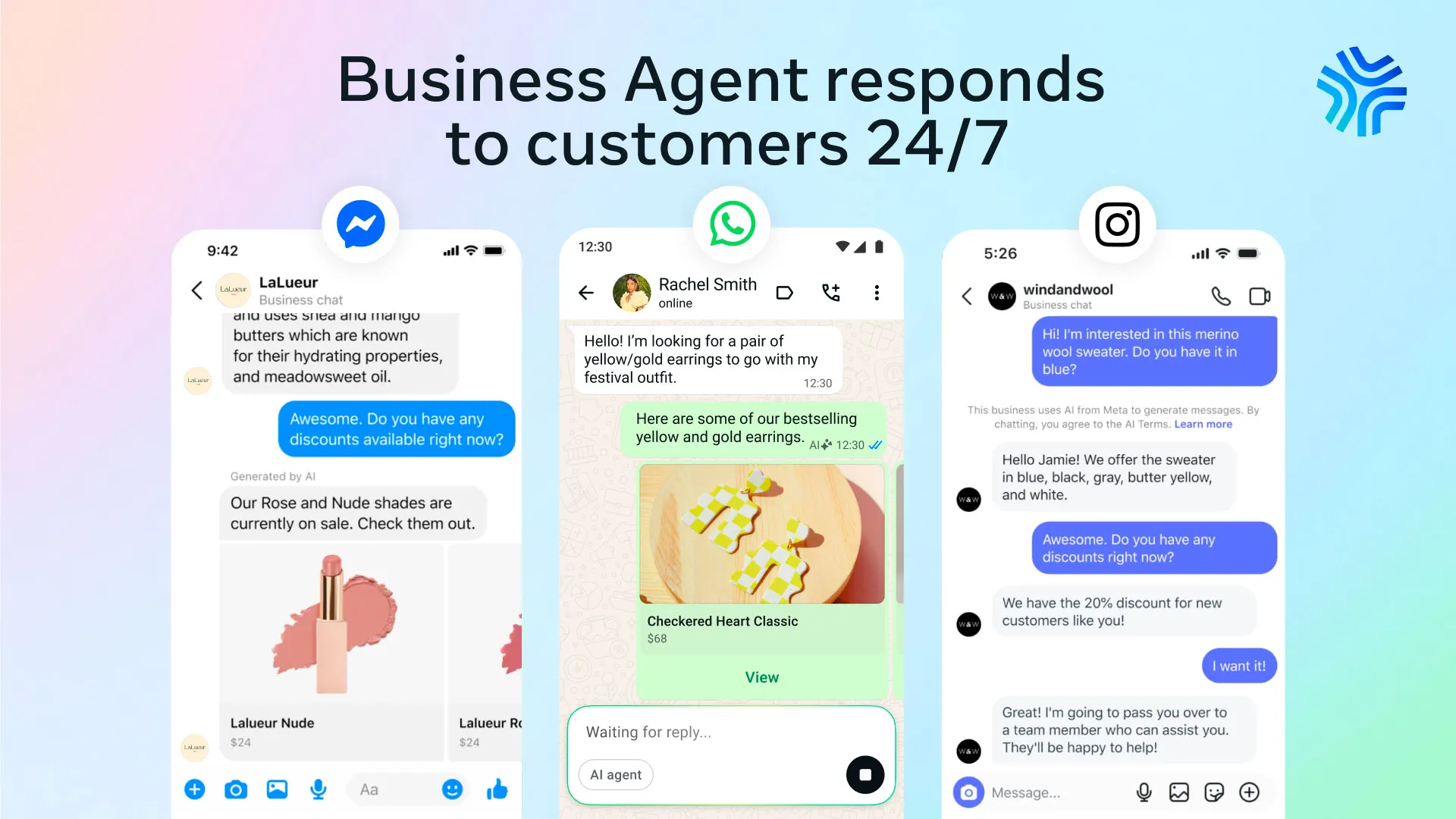
LONDON — At its flagship Conversations 2026 event in London, Meta Platforms Inc. announced a fundamental shift in its commercial messaging strategy. Moving away from traditional, rigid click-to-chat setups, the social media giant unveiled the Meta Business Agent, an enterprise-grade, autonomous artificial intelligence system designed to manage complex, end-to-end business operations directly within WhatsApp, Instagram Direct, and Messenger.
The announcement signals a major milestone in Meta’s long-term strategy to monetize its messaging ecosystem, transforming its chat apps from simple communication tools into high-intent, self-contained transaction engines.
1. Main Facts: The Launch of the Meta Business Agent
The centerpiece of the London keynote was the introduction of the Meta Business Agent. Unlike the rule-based, decision-tree chatbots that have dominated customer service for the past decade, these new agents are powered by advanced, multi-modal large language models (LLMs) capable of understanding nuanced context, maintaining consistent brand voice across multiple languages, and managing complex, multi-turn conversations.
+-----------------------------------------------------------------------+
|                         META BUSINESS AGENT                           |
+-----------------------------------------------------------------------+
|  - Autonomous Multi-Turn Conversations                                |
|  - Real-Time API Integrations (Inventory, CRM, ERP)                   |
|  - Multi-Lingual Brand Voice Alignment                                |
|  - Native Checkout & Lead Generation in Chat                          |
+-----------------------------------------------------------------------+
During live demonstrations at the event, Meta showcased the agents performing several highly sophisticated, real-time tasks within a single WhatsApp thread:
- Dynamic Support & Resolution: Resolving complex customer service tickets by querying internal databases.
- Lead Qualification: Asking contextual qualifying questions to prospective clients and scoring them before booking appointments.
- Real-Time Inventory Queries: Connecting directly to business APIs to check product availability in real time.
- Frictionless Conversational Checkout: Guiding users through product selection, size/color customization, and final payment without requiring them to leave the chat window.
Additionally, Meta announced enhanced native discovery features. Users can now search for businesses directly through the WhatsApp search bar. This transforms the messaging application into a localized, high-intent search engine, presenting a new optimization challenge for digital marketers and search engine optimization (SEO) specialists.

2. Chronology: The Decade-Long Journey to Autonomous Chat
To understand the significance of the 2026 announcement, it is necessary to trace the evolution of Meta’s conversational commerce strategy over the last ten years.
2016: The Messenger Bot Boom
  │  (Rigid, rule-based trees; high friction, low user retention)
  ▼
2018–2022: The Shift to WhatsApp Business
  │  (Focus on customer support, notifications, and manual live-chat handoffs)
  ▼
2023–2025: The Generative AI Revolution
  │  (Integration of Llama models; piloting basic AI responses)
  ▼
2026: The Autonomous Meta Business Agent
     (Fully integrated, API-driven, zero-click native transactions)
2016: The Initial Messenger Bot Wave
Exactly a decade ago, at its F8 developer conference, Facebook (now Meta) heavily promoted Messenger bots. The technology, however, failed to meet expectations. Built on rigid, rule-based frameworks, these early bots easily broke when users strayed from pre-programmed scripts. The user experience was clunky, causing many brands to scale back their automated chat initiatives.
2018–2022: Infrastructure Building and WhatsApp Business Focus
Recognizing the limitations of early automated systems, Meta shifted its focus toward building robust communication infrastructure. It prioritized the WhatsApp Business App and WhatsApp Business Platform (API). During this period, messaging was used primarily for customer support notifications, shipping updates, and facilitating manual conversations between customers and human agents.
2023–2025: The Generative AI Paradigm Shift
With the rapid maturation of generative AI and Meta’s open-source Llama models, the technical barriers of the previous decade began to dissolve. Meta started integrating basic AI tools into its Ads Manager, allowing businesses to generate automated text responses. However, these systems still lacked deep integration with back-end enterprise systems.
2026: The Era of the Autonomous Agent
At Conversations 2026, Meta closed the loop. The Meta Business Agent represents the culmination of ten years of infrastructure development, marrying generative AI with deep API access. It marks the transition from conversational assistance to fully autonomous conversational commerce.

3. Supporting Data and System Capabilities
The deployment of the Meta Business Agent relies on a "garbage in, garbage out" framework, emphasizing that an AI agent is only as effective as the data feeding it. Meta has built a comprehensive control environment designed to balance autonomous capability with brand safety and human oversight.
Data Integration and Customization
Businesses can train their dedicated agents using multiple data streams:
- Native Meta Channel Data: Interaction history, past customer queries, and catalog data.
- External Website Data: Scraping product descriptions, FAQs, and brand guidelines directly from the company’s website.
- Direct Data Feeds: Uploading custom pricing structures, real-time inventory sheets, and specific operational rules.
The Human-in-the-Loop (HITL) Dashboard
To address industry concerns regarding AI "hallucinations" and rogue agent behavior, Meta introduced a logical management environment. This dashboard allows human operators to:
- Monitor Conversations: View active, AI-driven chats in real time.
- Manual Interventions: Instantly take over a chat if the conversation becomes too sensitive or if the AI flags a high-value customer requiring human touch.
- Reinforcement Learning: Provide direct feedback on the agent’s responses, training the model to improve future interactions.
| Feature | Legacy Chatbots (2016–2022) | Meta Business Agents (2026) |
|---|---|---|
| Logic Engine | Rule-based, keyword matching | Generative LLM, contextual understanding |
| User Flow | Linear, script-dependent | Multi-turn, natural conversation |
| Integrations | Limited static links | Live APIs (Inventory, CRM, ERP, Payments) |
| Platform Native | Directs users to external websites | Complete checkout inside the chat thread |
| Discovery | External ads pointing to chat | Native WhatsApp Search Optimization |
4. Official and Industry Responses
The announcement has drawn immediate comparisons to competitive offerings in the ad-tech and search landscapes, notably Google’s recent updates at Google Marketing Live.
Competitive Alignment with Google
Industry analysts note that Meta’s strategy closely mirrors Google’s efforts to keep users on-platform. While Google has introduced features allowing users to purchase items directly from Search and YouTube, Meta is leveraging WhatsApp’s massive global footprint—particularly in markets like Europe, Latin America, and India—to bypass the traditional web browser entirely.
Marketing Industry Reactions
"We are moving toward a headless e-commerce model," said Lars Maat, a pay-per-click (PPC) specialist and contributor to Search Engine Land. "Ten years ago, Messenger bots were a novelty. Today, the scale of Meta’s platforms, combined with mature AI, makes this incredibly easy for businesses to implement. We are looking at a future where a customer discovers a product, asks questions, checks stock, and purchases it in a single WhatsApp thread without ever visiting the merchant’s website."
Marketers are also highlighting the emergence of "WhatsApp SEO." Because users can search natively for businesses within the app, brands must optimize their business profiles and product catalogs to rank for high-intent local queries, establishing a new front in digital discovery.
5. Strategic Implications for Businesses and Marketers
The rollout of Meta Business Agents will have far-reaching implications for digital marketing, customer service, and technical infrastructure.
The Shift from Websites to Chat Threads
For years, the primary goal of digital advertising (social media ads, PPC, SEO) was to drive high-intent traffic to a centralized website. Meta’s new framework challenges this paradigm. By keeping the entire funnel—from discovery to payment—inside WhatsApp or Instagram, businesses can dramatically reduce checkout friction and drop-off rates. However, this also means companies will need to adapt to a landscape where their website is no longer the primary conversion hub.
A New Frontier for PPC and Search Marketers
Paid traffic specialists will need to adapt their strategies to optimize for conversational outcomes rather than landing page views. Ads will increasingly point directly to WhatsApp threads ("Click-to-WhatsApp" ads), where the Meta Business Agent will take over to qualify, nurture, and close the lead. Budget allocation will likely shift toward conversational campaigns, requiring a deeper understanding of conversational design and API integration.

Redefining Customer Support Operations
With autonomous agents capable of handling complex, multilingual support tickets, customer service departments can automate routine inquiries at scale. This allows human agents to focus on high-value accounts and complex technical resolutions, shifting support centers from cost centers to strategic touchpoints.
Ultimately, Meta’s move at Conversations 2026 positions messaging not merely as an alternative support channel, but as a primary operating system for modern commerce. Businesses that integrate their inventory, pricing, and customer data into these autonomous systems stand to capture high-intent users exactly where they are already communicating.
 Jia Lissa
  Nana Muazin
  Layla Zulfa