
 By Iffa Jayyana

As the digital ecosystem evolves, the rules of engagement for online defense have been entirely rewritten. In an era dominated by generative artificial intelligence, hyper-realistic deepfakes, and automated social engineering networks, social media security is no longer an afterthought relegated to marketing departments. Instead, it has transformed into a critical front line of enterprise risk management.
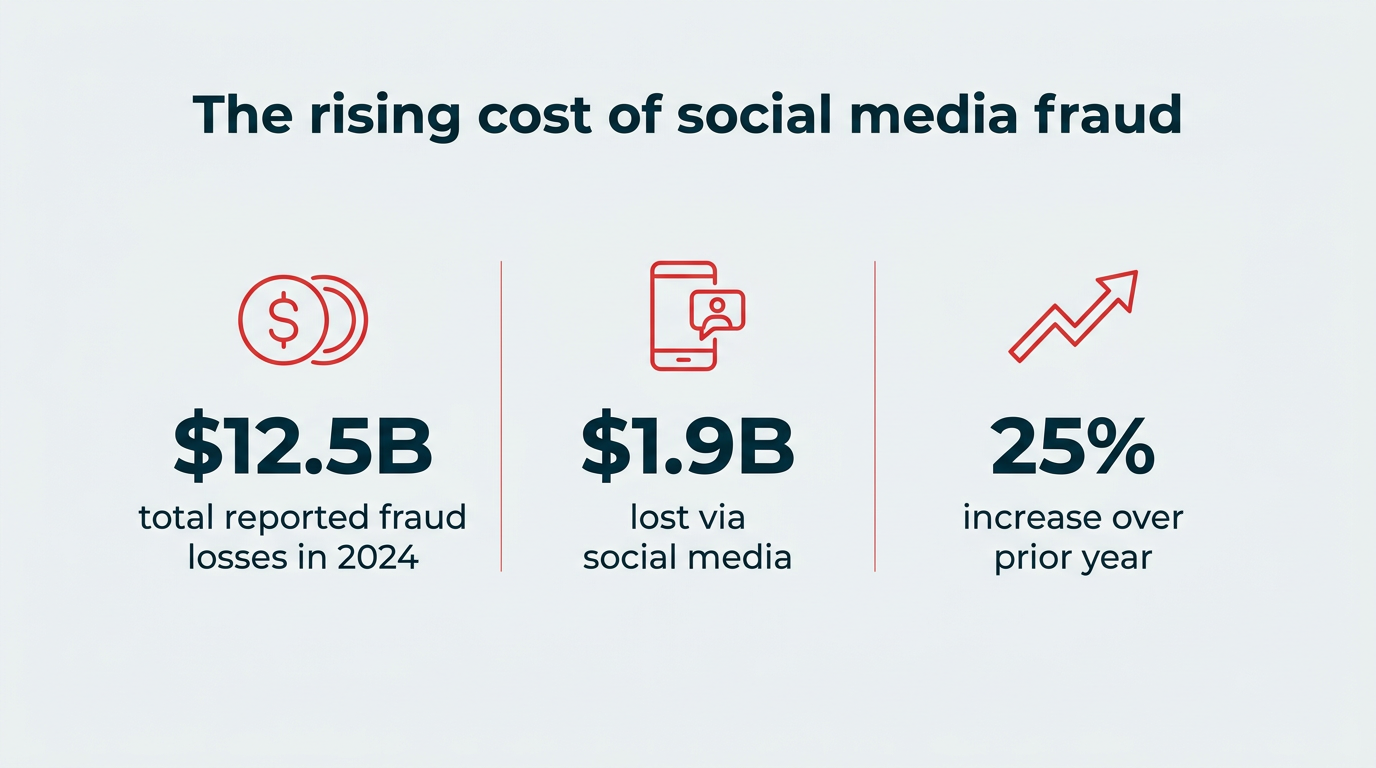
Recent data underscores the urgency of this shift. According to the Federal Trade Commission (FTC), consumer losses to fraud reached a staggering $12.5 billion in 2024—a 25% increase over the previous year. Of those total reported losses, approximately $1.9 billion were traced directly back to social media channels, making platforms like Instagram, Facebook, and LinkedIn primary vectors for digital crime.

For organizations, a single compromised corporate account can translate into devastating financial losses, fractured customer trust, and severe regulatory penalties within a matter of hours. To combat these mounting threats, organizations must transition from reactive damage control to a proactive, comprehensive security posture.
The Evolving Threat Matrix: Understanding 2026’s Digital Risks
The modern threat landscape has shifted drastically from opportunistic, manual scams to organized, highly automated cyber-attacks. Today’s malicious actors leverage advanced technologies to target brands, employees, and consumers alike.

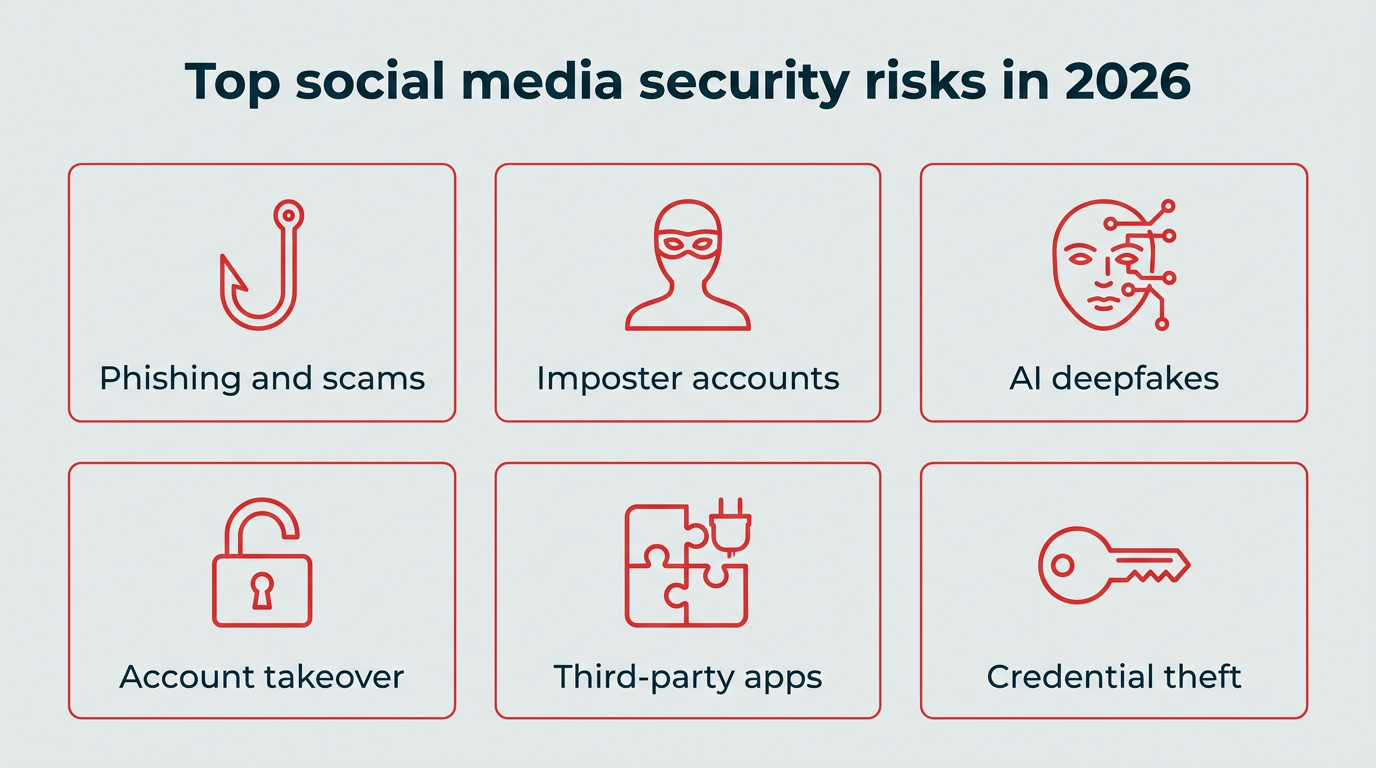
Phishing and Social Media Scams
Phishing remains one of the most persistent threats across digital platforms. Attackers employ sophisticated psychological manipulation and tailored messaging to trick employees and executives into surrendering login credentials, banking details, or proprietary corporate data. Because social media is the primary contact method for scammers targeting working-age adults, brand impersonation has become a shared crisis for marketing and IT security teams alike.
Imposter and Fake Accounts
Creating fake profiles designed to mimic legitimate brands has become alarmingly easy. These imposter accounts target customers, job seekers, and employees, frequently luring victims into divulging confidential information.
The sheer scale of this problem is staggering. LinkedIn’s Community Report reveals that automated defenses block the vast majority of fake accounts at registration, yet a fraction slip through to be caught only after manual user reporting. Similarly, Meta actions hundreds of millions of fake accounts on Facebook each quarter, estimating that roughly 4% to 5% of its monthly active user base is fraudulent.
AI-Powered Phishing and Deepfake Threats
Artificial intelligence has mechanized social engineering, enabling bad actors to harvest fragments of information about corporate executives from public profiles and synthesize them into hyper-personalized, convincing attacks.
Deepfakes are no longer theoretical. A recent Gartner survey revealed that 62% of organizations have experienced a deepfake attack within the past year. High-profile incidents—such as a Hong Kong finance employee transferring $25 million after participating in a video conference where every other "colleague" was an AI-generated deepfake—demonstrate the immediate financial and operational danger these tools pose.
Furthermore, general audiences struggle to distinguish between authentic and synthetic content. Studies show that roughly 20% of Gen X, 15% of Millennials, and 14% of Gen Z find it difficult to determine whether AI-generated social content is real or fake, leaving a massive window of vulnerability for social engineering.

Malware, Ad Account Hijacking, and Credential Theft
Account takeovers occur when attackers seize direct control of a profile via malware or stolen passwords. Beyond standard profiles, cybercriminals increasingly target social media business ad accounts with linked corporate credit cards. By hijacking these ad managers, attackers can quietly funnel corporate advertising budgets into running fraudulent campaigns that direct unsuspecting users toward malware.
Credential reuse remains a primary entry point. Verizon’s Data Breach Investigations Report highlights that stolen credentials factor into over a fifth of all data breaches, emphasizing that a single leaked password can give attackers lateral access across multiple enterprise systems.

Chronology of Modern Social Media Security Challenges
- Pre-2020: Security measures primarily focused on basic password protection and reactive manual monitoring for brand impersonation. Social media was largely treated as a purely marketing-centric domain.
- 2021–2023: The rise of remote work blurred corporate and personal device boundaries. Third-party app integrations and social quizzes became prevalent vectors for harvesting personal data and unlocking corporate systems.
- 2024: Fraud losses on social media surged to $1.9 billion. High-profile incidents, such as the temporary hijacking of the U.S. Securities and Exchange Commission’s X account, underscored the market-moving danger of compromised corporate profiles.
- 2025–2026: Generative AI matured into a mass-market weapon for cybercriminals. Deepfake executive impersonations, automated spear-phishing, and AI-driven customer support fraud forced enterprises to integrate social media into their core cybersecurity frameworks.
Supporting Data and Industry Metrics
- $12.5 Billion: Total reported fraud losses in the United States in 2024, representing a 25% year-over-year increase (FTC).
- $1.9 Billion: The amount lost specifically through social media contact channels in 2024, outpacing all other communication mediums for consumer fraud.
- 62%: The percentage of organizations that experienced a deepfake attack over a twelve-month period (Gartner).
- 5.7 Billion+: The global count of active social media users, creating an unprecedentedly large target pool for malicious actors.
- 16%: The proportion of smartphone owners who fail to use fundamental device-locking features such as passcodes, facial recognition, or fingerprints, leaving mobile social access completely exposed.
Official Responses and Enterprise Governance
Industry leaders and regulatory bodies are aggressively updating compliance frameworks to address these systemic vulnerabilities. Cybersecurity agencies and platforms are pushing for standardized identity verification, mandatory multi-factor authentication, and strict third-party app audits.
For regulated enterprises—particularly those in finance, healthcare, and government—treating social media as an unregulated marketing sandbox is no longer permissible. Compliance officers now mandate comprehensive audit trails, centralized role-based access permissions, and rigorous approval workflows to ensure that every piece of outbound content is properly vetted before publication.

The 2026 Social Media Security Action Checklist
To safeguard organizations against this evolving array of threats, security leaders must implement a structured, multi-layered defense strategy.
1. Implement Strong Authentication (Passkeys and 2FA)
Eliminate weak, recycled passwords. Mandate unique, complex passwords managed through enterprise solutions like 1Password Business. Furthermore, enforce two-factor authentication (2FA) across every corporate account, prioritizing app-based authenticators or cryptographic passkeys over vulnerable SMS-based text codes.

2. Enforce Role-Based Access Control (RBAC)
Apply the principle of least privilege. Employees should only hold the exact level of access required to perform their specific tasks. By utilizing centralized publishing platforms like Hootsuite Social OS, organizations can grant publishing capabilities without sharing raw account passwords, allowing administrators to instantly revoke access the moment an employee changes roles or departs the company.
3. Establish Governed Approval Workflows
Unchecked publishing rights introduce immense reputational risk. Route all social media content through automated approval workflows that require sign-off from designated supervisors, communications teams, or compliance officers before content goes live.
4. Conduct Comprehensive Employee Training
Because human error remains the primary entry point for social engineering, security awareness training must be integrated into onboarding and refreshed at least twice a year. Employees must be trained to recognize AI-generated phishing attempts, deepfake communications, and deceptive social quizzes designed to harvest personal security data.
5. Deploy Real-Time Monitoring and Threat Intelligence
Proactive visibility is vital. Utilize social listening tools and dedicated threat intelligence platforms (such as ZeroFOX or Hootsuite’s integrated Lumen app) to continuously scan the web and social channels for brand impersonation attempts, malicious links, and sudden shifts in audience sentiment.

6. Audit Third-Party Applications Quarterly
Every connected application represents a potential door into your social ecosystem. Conduct quarterly audits to review, restrict, and revoke access for any third-party tools, legacy integrations, or applications tied to former personnel.
7. Secure Mobile Devices and Endpoints
Because a significant portion of social management occurs on mobile devices, enforce strict endpoint security policies. Require screen locks, automatic software updates, remote-wipe capabilities, and mandatory virtual private network (VPN) usage when connecting via untrusted public Wi-Fi networks.

Implications for the Future of Enterprise Communications
The convergence of social media marketing and enterprise cybersecurity is now permanent. As generative AI continues to lower the technical barrier for launching sophisticated cyber-attacks, organizations that fail to secure their social channels invite catastrophic financial loss, regulatory fines, and reputational ruin.
By adopting a disciplined framework combining robust governance tools, continuous threat monitoring, clear internal policies, and ongoing employee education, businesses can successfully protect their brand equity and maintain consumer trust in an increasingly volatile digital landscape.
 Neng Nana
 Ammar Sabilarrohman
 Jia Lissa
