
 By rifanmuazin

SAN FRANCISCO — In an era where billions of digital citizens generate an endless tsunami of global commentary every single second, modern marketing teams face a monumental paradox: while data is more abundant than ever, actionable clarity is increasingly difficult to isolate. Enter artificial intelligence. By transforming unstructured, chaotic social chatter into crisp, predictive intelligence, AI-powered social listening has rapidly evolved from an experimental tech feature into the foundational bedrock of enterprise brand strategy for 2026.

Traditional keyword tracking—relying on exact-match strings, manual exports, and basic positive-or-negative tallies—is officially a relic of the past. Today’s marketing ecosystems demand instantaneous signal detection, multi-format multimedia analysis, and deep contextual interpretation capable of dissecting nuance, cultural slang, and sarcasm in real time.

Main Facts: The Evolution from Chatter to Signals
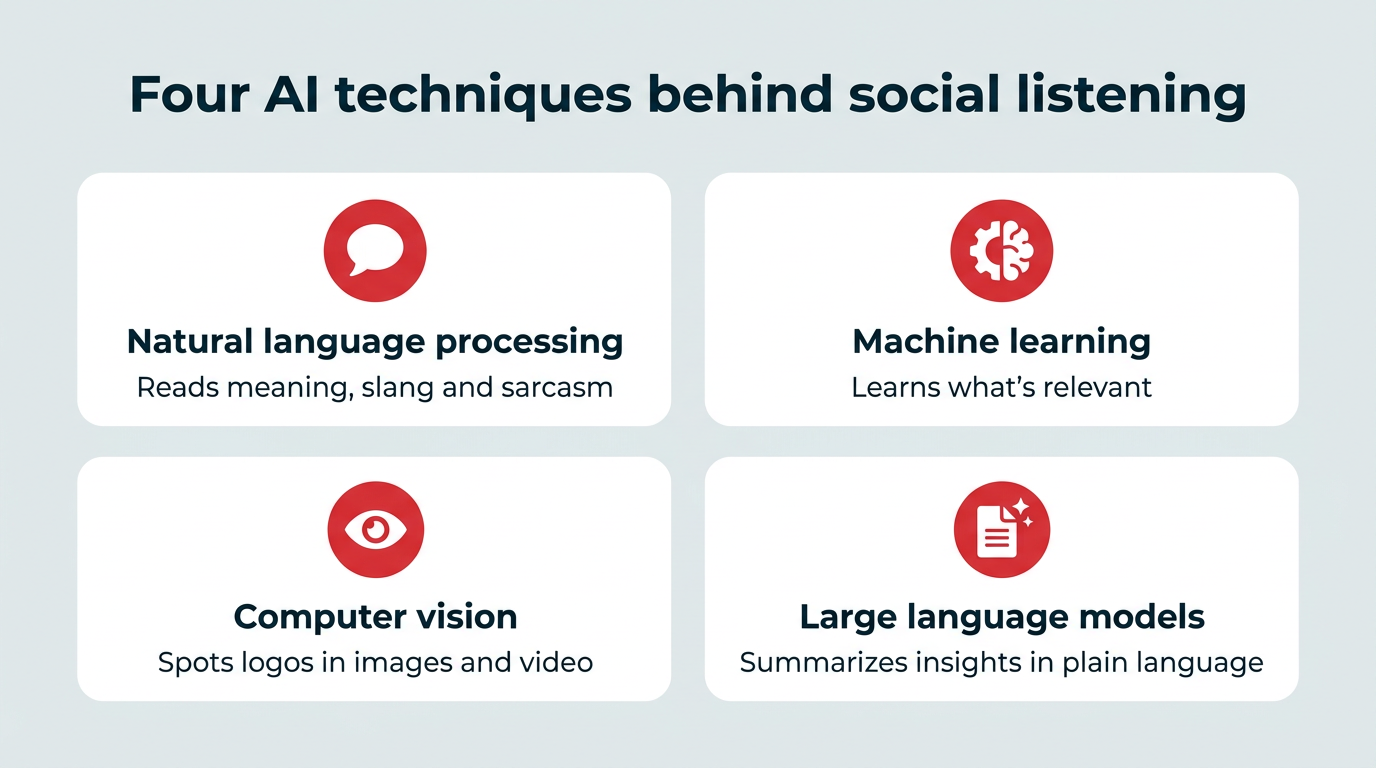
At its core, AI social listening leverages machine learning, natural language processing (NLP), computer vision, and large language models (LLMs) to monitor and decode social media channels, news outlets, forums, and review sites. Rather than forcing human analysts to sift through millions of individual posts manually, modern platforms ingest vast streams of global content, synthesize patterns, and convert them into immediate, strategic insights.
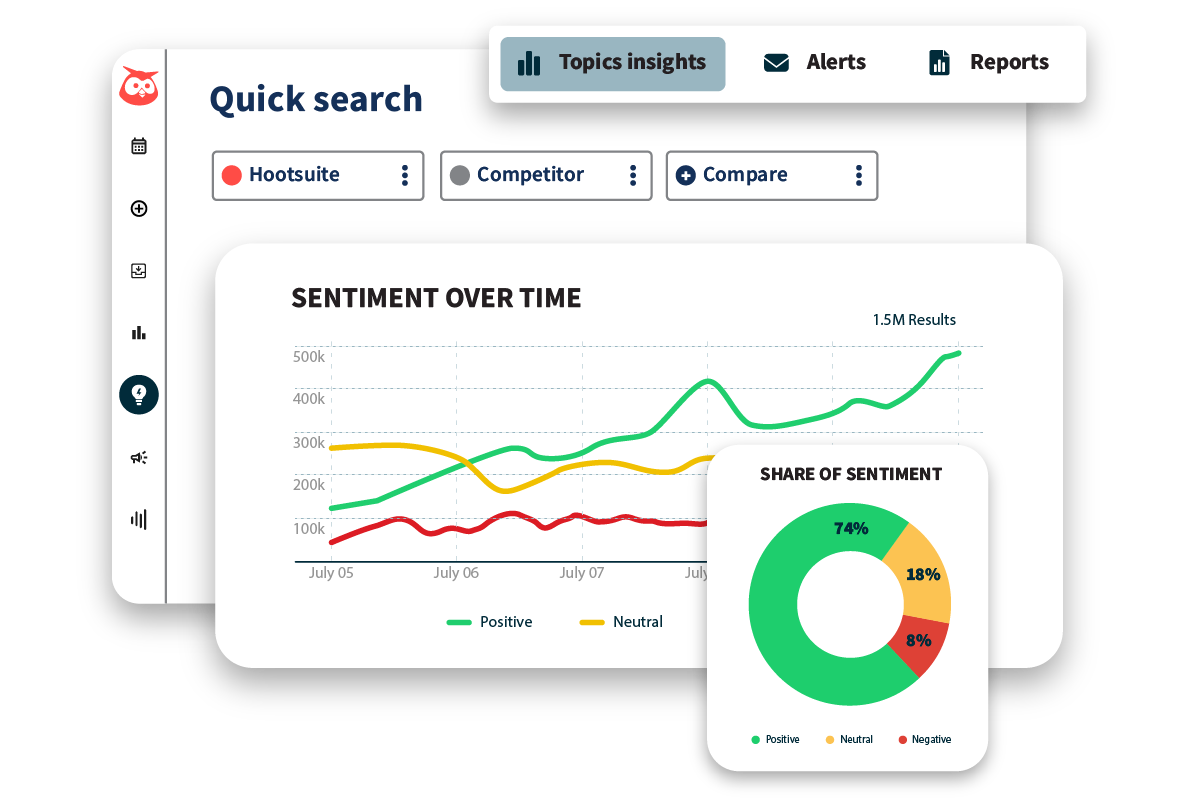
According to recent industry data from Forrester and Gartner, marketing landscapes are shifting dramatically toward full workflow consolidation. Over 83% of US B2C marketing executives are actively pursuing connected software ecosystems that unite social listening, publishing, and analytics under a single roof. Furthermore, Gartner forecasts that the AI automation of marketing work will double to 36% by 2028, underscoring a broader industry migration from reactive tracking to proactive trend forecasting.
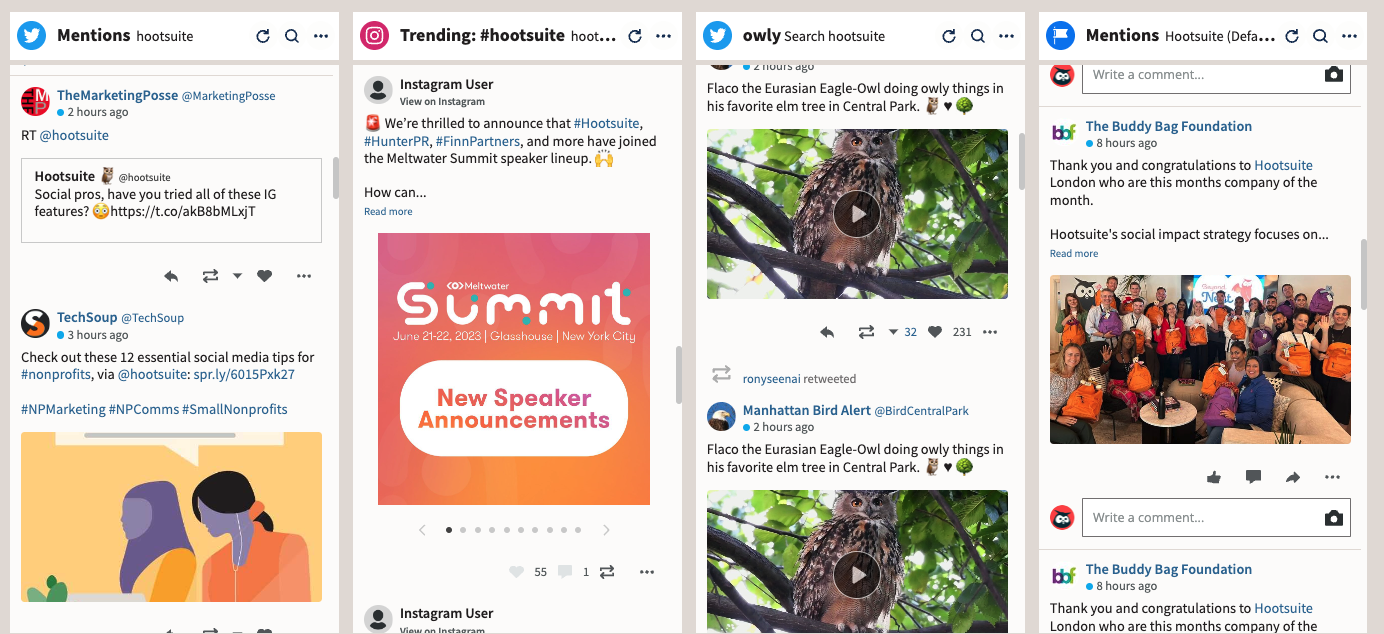
Traditional vs. AI-Powered Social Listening At a Glance
| Feature | Traditional Social Listening | AI-Powered Social Listening |
|---|---|---|
| Query Matching | Relies strictly on exact keyword phrases. | Detects direct, indirect, and contextual brand references. |
| Sentiment Analysis | Binary positive/negative scoring. | Decodes tone shifts, deep emotion, sarcasm, and slang. |
| Trend Identification | Reactive (spots trends long after a viral spike). | Proactive (captures emerging signals before they peak). |
| Media Tracking | Limited almost exclusively to text strings. | Monitors text, images, video, and audio streams. |
| Data Volume & Scale | Handles small samples; struggles across languages. | Processes millions of real-time global posts without sampling. |
Chronology: The Rapid Maturity of Consumer Intelligence Platforms
The trajectory of social listening over the past decade reflects a steady march toward total automation and cognitive synthesis:
- The Keyword Era (Early 2010s): Brands relied on rudimentary boolean search strings to tally exact brand mentions, resulting in massive blind spots driven by human error and incomplete data sampling.
- The Sentiment Integration (Mid-2010s): Platforms began incorporating basic sentiment metrics, attempting to categorize public tone as strictly positive or negative, though nuances like irony frequently broke the algorithms.
- The Rise of Multimodal AI (2020–2024): Computer vision and early NLP models introduced visual listening—tracking logos and products in images—while query builders simplified boolean logic via natural language prompts.
- The Predictive & Connected Era (2025–2026): Modern platforms like Hootsuite Social OS (featuring Lumen and Talkwalker technology), Brandwatch, and Sprinklr have integrated predictive analytics, LLM-generated executive summaries, and fully governed enterprise workflows. Listening is no longer siloed; it directly dictates publishing, crisis response, and executive decision-making.
Supporting Data: Proof in Practice
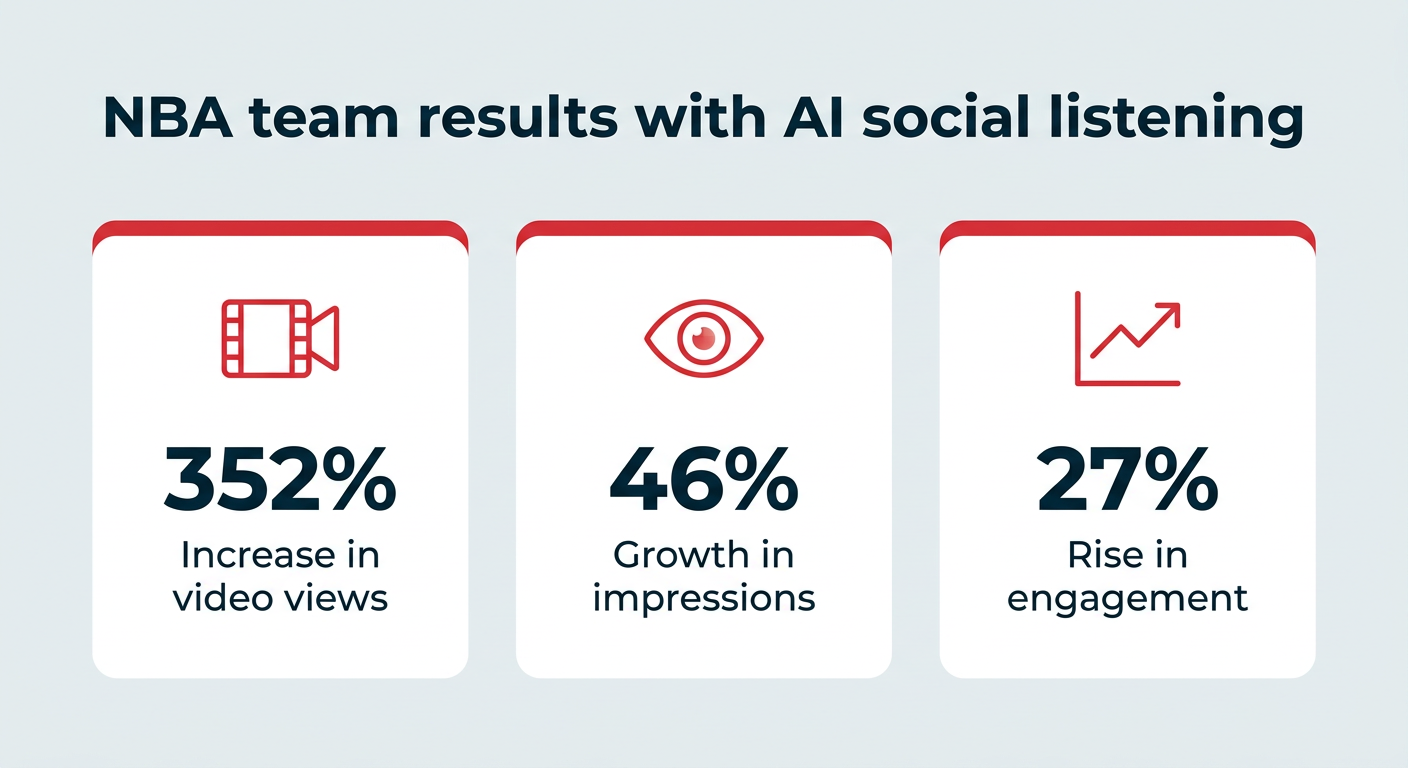
To justify enterprise technology spend to Chief Financial Officers in 2026, marketing leaders can no longer rely on vanity metrics like raw mention volume. Data must connect directly to measurable business outcomes. A compelling case study comes from professional sports: an NBA team recently integrated advanced AI listening into their digital workflow to better understand fan sentiment and content engagement.

By consolidating their social data, the team discovered that fans overwhelmingly preferred authentic, original, behind-the-scenes content (such as unscripted player moments and interactive polls) over repurposed broadcast clips. Armed with these insights, the organization aggressively pivoted its strategy, shifting up to 80% of its Instagram content to original media formats.
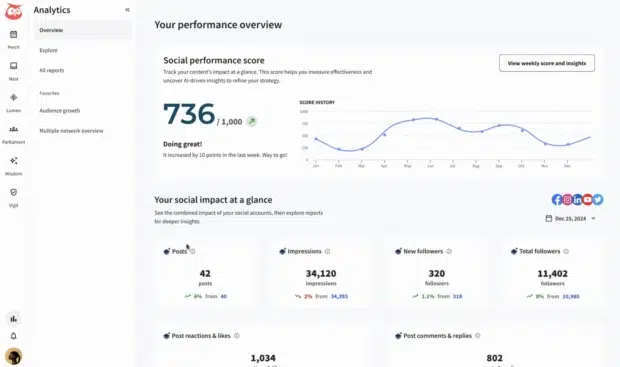
The results were transformative:
- 352% average season-over-season increase in video views across Instagram, X (formerly Twitter), and Facebook.
- 46% overall growth in brand impressions.
- 27% increase in fan engagement achieved through fewer, smarter, data-driven posts.
This real-world example illustrates that AI-driven insights directly optimize content ROI, eliminate wasted creative efforts, and scale audience loyalty.
Official Responses and Industry Perspectives
As artificial intelligence reshapes corporate resource allocation, marketing leadership has embraced efficiency as its primary return on investment. The 2025 CMO Spend Survey conducted by Gartner revealed that 49% of CMOs cite improved time efficiency as Generative AI’s top ROI driver, even as overall marketing budgets flatline at roughly 7% of total company revenue.

Industry analysts emphasize that while the technological capabilities of LLMs and machine learning are staggering, they must be paired with rigorous internal governance.

"As more listening tools layer large language models on top of social data, accuracy becomes a governance question, not just a technical one," notes industry documentation. Organizations utilizing enterprise-grade platforms are increasingly demanding "grounding"—ensuring that every AI-generated trend summary or predictive alert can be clicked through and verified against the raw, underlying consumer posts.

Implications: Strategic Opportunities and Core Challenges
Deploying AI-powered social listening unlocks profound operational advantages, but it also forces organizations to navigate distinct structural challenges.

The Strategic Advantages
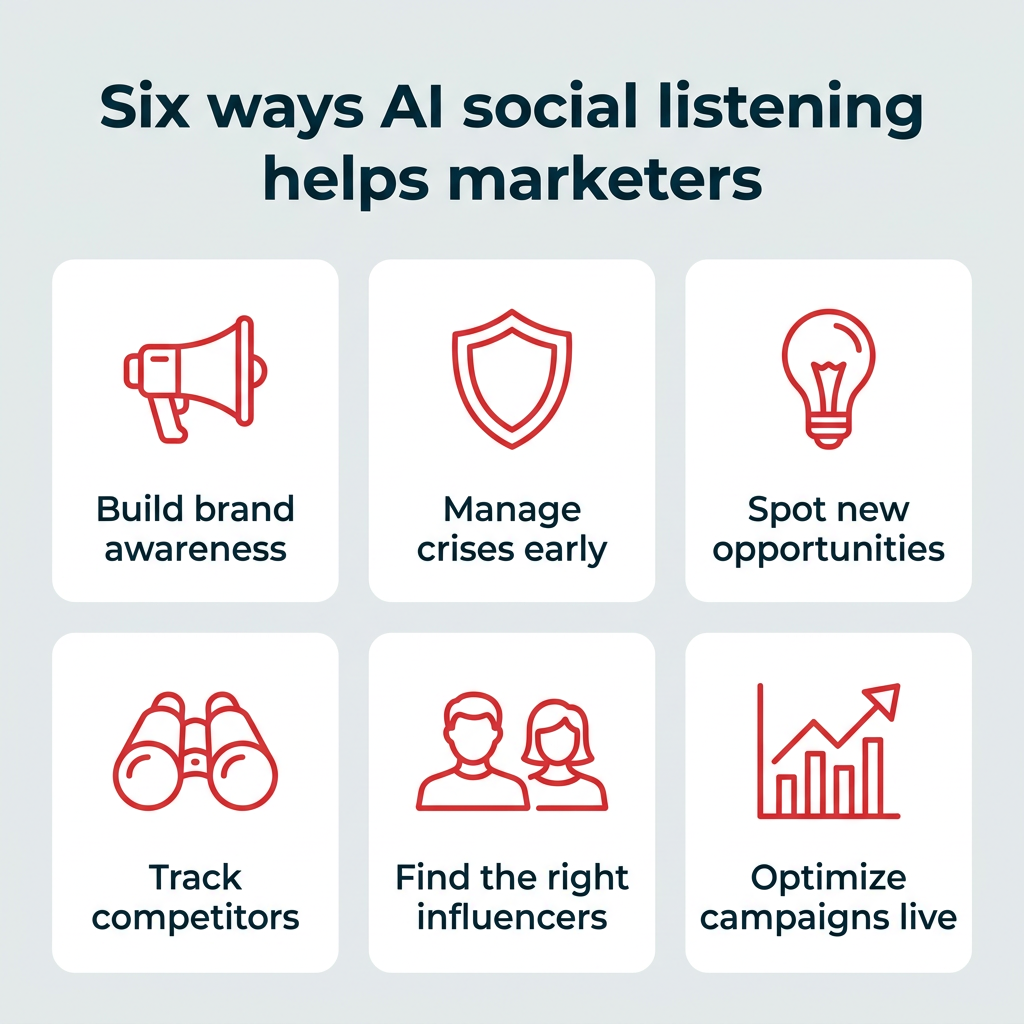
- Brand Awareness: Visual and audio AI catches brand appearances—such as an unbranded product cameo in a viral TikTok video or a spoken mention on a niche podcast—that traditional text-only queries entirely miss.
- Crisis Mitigation: Real-time anomaly alerts pinpoint sudden spikes in negative sentiment, allowing public relations teams to neutralize threats before they dictate the broader news cycle.
- Competitor Benchmarking: Continuous monitoring allows brands to accurately measure their share of voice against industry rivals, exposing emerging messaging shifts instantly.
- Influencer Identification: AI sifts through engagement depth and audience relevance to surface authentic brand ambassadors rather than relying on vanity follower counts.
Overcoming Core Implementation Challenges
- The Data Firehose: With over 5.75 billion global social media users generating oceans of content daily, naive queries (such as searching for "Apple" without context) yield unmanageable noise. Machine learning and intelligent query builders are essential to isolate relevant signals.
- Contextual Ambiguity: Slang, emojis, and sarcasm frequently confuse legacy systems (e.g., interpreting "This is sick!" as a negative critique). Modern NLP trained on diverse cultural lexicons successfully rectifies this ambiguity.
- Data Silos and Normalization: Harmonizing unstructured data streams from Reddit threads, TikTok video comments, and regional news forums requires robust backend architecture to standardize comparisons.
- Trust and Traceability: To prevent algorithmic hallucinations from entering boardroom presentations, teams must rely on governed ecosystems—such as Hootsuite’s Vigil and Wisdom frameworks—which supply fully cited, auditable sources for every AI-derived insight.
Conclusion: Selecting the Right Tool for the Enterprise
As organizations finalize their technology stacks for the remainder of 2026, choosing the correct AI social listening partner is paramount. The market features powerful alternatives tailored to varying organizational scales:

- Hootsuite Social OS (Lumen): The top recommendation for enterprises seeking deep listening capabilities (via Talkwalker technology) natively connected to publishing, engagement, and analytics workflows.
- Brandwatch: Ideal for massive, large-scale consumer research across billions of global web sources.
- Sprinklr: Best suited for brands requiring unified customer experience (CX) management that bridges social listening with call center operations.
- Brand24 & Mention: Excellent, agile options for mid-market teams seeking rapid alerts and broad online coverage.
- YouScan: The premier pick for brands prioritizing visual AI and logo recognition.
Ultimately, transitioning from passive observation to active, predictive intelligence requires a structured framework: defining clear business objectives, establishing clean baseline queries, configuring real-time anomaly alerts, and maintaining weekly review cadences. By treating AI social listening not as a passive monitoring tool, but as a core engine for strategic decision-making, modern enterprises can turn the chaotic roar of the internet into their greatest competitive advantage.
 Ammar Sabilarrohman
 Jia Lissa
 Muslim
