In the high-stakes arena of modern digital marketing, hindsight is no longer just 20/20—it is a liability. For decades, communications, public relations, and social media teams have operated reactively, relying on traditional media monitoring tools to tell them what went viral yesterday, which consumer complaints blew up over the weekend, or how sentiment shifted after a product drop. By the time those reports landed on a desk, the moment had already passed.
Enter predictive media intelligence: an emerging paradigm that merges artificial intelligence, real-time data ingestion, and historical pattern recognition to forecast where consumer conversations, cultural trends, and potential brand crises are headed next.
Unlike traditional monitoring—which answers the question, "What is happening right now?"—predictive media intelligence addresses the far more valuable query: "What is likely to happen next?" By evaluating the velocity, trajectory, and behavioral shape of emerging narratives across millions of global sources, platforms like Hootsuite’s Lumen and Wisdom are giving organizations a vital head start. Rather than relying on guesswork or a metaphorical crystal ball, modern marketing teams can now leverage algorithmic probability to anticipate public sentiment, sidestep brewing PR crises, and capture emerging cultural waves before their competitors even notice the swell.
Chronology and Evolution: From Static Reports to Real-Time Foresight
To understand the weight of this industry shift, one must look at how digital intelligence has evolved over the past twenty years:
The Early 2000s (The Keyword Era): Brands relied on rudimentary web-scraping and manual Google Alerts. The primary goal was simply finding out if your company name was mentioned in a newspaper or blog post. Volume was low, and turnaround times were measured in days or weeks.
The 2010s (The Social Listening Boom): With the explosion of platforms like Twitter (now X), Facebook, and Instagram, real-time social listening tools emerged. Brands could track brand health, measure immediate sentiment, and participate in fast-moving meme culture. However, the approach remained strictly reactive—tracking the wave only after it had broken over the shore.
The Mid-2020s and Beyond (The Predictive Era): The modern media landscape is hyper-fragmented, moving at a blistering pace where a story can incubate on TikTok, cross over to Reddit, and dominate mainstream news cycles within forty-eight hours. To combat this fragmentation, cutting-edge organizations have transitioned to predictive media intelligence. By utilizing machine learning, natural language processing (NLP), and anomaly detection, modern predictive engines establish behavioral baselines, automatically flagging micro-shifts long before they manifest as major public movements.
Supporting Data and Comparative Analysis: Monitoring vs. Predicting
The gap between traditional media monitoring and predictive intelligence is vast, transforming how departments allocate resources and plan campaigns.
Metric / Dimension
Traditional Media Monitoring
Predictive Media Intelligence
Core Objective
Track historical and live mentions.
Anticipate emerging trends, risks, and opportunities.
Primary Question
"What is happening right now?"
"What is likely to happen next?"
Data Scope
Current coverage, sentiment, and volume.
Real-time velocity, historical patterns, and trajectory analysis.
Strategic Value
Measuring post-campaign brand health.
Mitigating fast-moving crises and capturing early trends.
As Ellen Tseng, Director of Social Analytics and Intelligence at Block Inc., notes, the sheer volume of modern data requires an automated approach that was previously impossible.
"Now we can classify across languages, formats, and platforms at a volume and scale far beyond the usual manual workload, and surface small anomalies we might not have noticed before," Tseng explains.
However, data scale alone is not enough. Experts emphasize that predictive intelligence does not replace human oversight; rather, it acts as an advanced warning layer built on top of robust listening data.
Official Perspectives and Industry Insights
Implementing predictive media intelligence requires a fundamental shift in how organizations define workflows and cross-departmental collaboration. Industry leaders are quick to point out that predictive tools are not "Magic 8-Balls" that eliminate business uncertainty. Instead, they narrow down plausible futures, granting teams a crucial buffer zone for decision-making.
According to Tseng, human context remains irreplaceable when evaluating digital signals:
"Human interpretation gives you context, nuance, the ‘why’ behind those upticks and anomalies, and also the ability to discern whether the data is synthetic or authentic."
Furthermore, experts warn that predictive insights are useless without operational ownership. Too many predictive dashboards sit idle because companies fail to answer a fundamental question: Who acts when the alert sounds? Without predefined protocols—such as a comms team stepping in to investigate an escalating complaint, or a social team pivoting the content calendar to capture a rising trend—even the most sophisticated algorithms are reduced to expensive noise.
Implications for Modern Brands and Crisis Management
The adoption of predictive media intelligence carries profound implications across multiple corporate verticals, fundamentally altering risk management, product development, and campaign strategy.
1. Revolutionizing Crisis Management
In a traditional PR scenario, a brand learns of a looming crisis when negative sentiment is already peaking, forcing the communications team into an emergency defensive posture. Predictive media intelligence flips this script. By tracking anomalies—such as a sudden, statistically abnormal acceleration in product complaints or a localized sentiment slide across obscure forums—systems can sound the alarm while there is still time to shape the narrative, correct misinformation, or address underlying product defects proactively.
2. Streamlining Content Strategy and Trendjacking
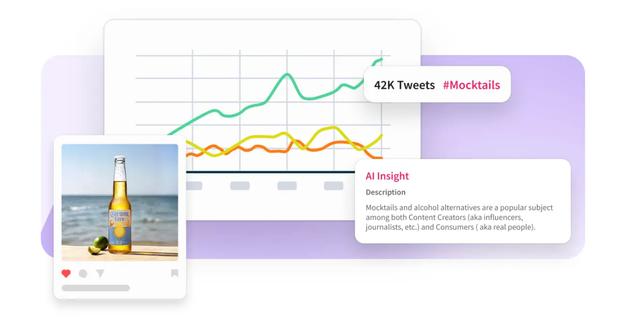
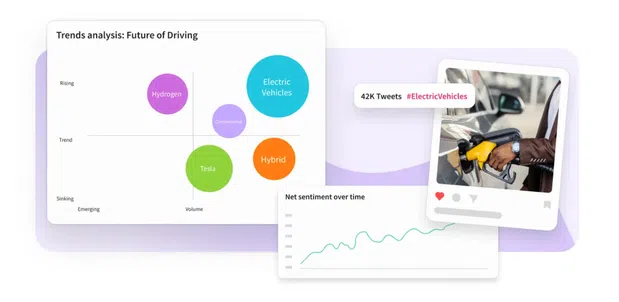
Content calendars are notoriously rigid, often resulting in brands jumping on social trends days after consumers have lost interest. Predictive platforms analyze the velocity of emerging hashtags and cultural moments, estimating whether a topic is a short-lived blip or an avalanche waiting to happen. This allows social media managers to deploy timely content with surgical precision.
3. Harnessing the Power of Integrated Platforms (Lumen and Wisdom)
To address these complex challenges, modern enterprise solutions like Hootsuite’s ecosystem are bridging the gap between data collection and actionable strategy.
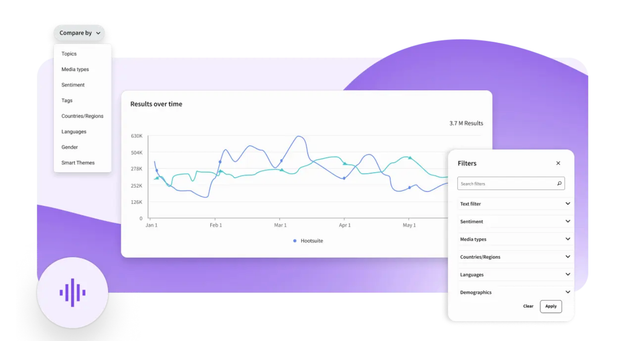
Lumen by Talkwalker continuously monitors more than 150 million sources across 30+ social networks, news outlets, and web properties. By establishing a digital baseline, Lumen detects micro-shifts in language, rising topic categories, and competitor positioning in real time.
Wisdom, Hootsuite’s conversational AI agent, eliminates the need for data science degrees by translating complex analytical trends into plain-language answers. Marketers can simply ask, "What is driving this sentiment shift?" or "Which demographic is fueling this narrative?" and receive immediate, actionable context.
Conclusion: The Future Belongs to the Prepared
Predictive media intelligence is not about seeing the future with absolute certainty; it is about systematically dismantling uncertainty. By cutting through the noise of a fragmented digital universe, modern tools allow brands to shift from a perpetual state of reaction to a position of strategic command.
Whether your goal is to protect your corporate reputation from unforeseen PR storms, capture fleeting cultural trends, or optimize your content calendar with algorithmic precision, the tools are now available to give your team the ultimate competitive edge.
Get ahead of the next trend, story, or crisis with Hootsuite. Use Lumen to spot early signals across 150M+ sources, then ask Wisdom to explain what’s driving the conversation and what your team should do next. Start your free trial today.

 By Asro




 Neng Nana
 Ammar Sabilarrohman
 Jia Lissa
