
 By Raul Delapena Setiawan
By Lifehacker Health Desk
Published October 9, 2026
Executive Summary: Main Facts
For years, the annual ritual of receiving an influenza vaccine meant carving out time during a busy workday, driving to a local pharmacy or a pediatrician’s office, waiting in crowded rooms, and rolling up a sleeve for a needle injection. For many families, these logistical hurdles resulted in postponed or entirely skipped vaccinations, leaving communities vulnerable to seasonal flu strains.
However, the landscape of preventative healthcare has experienced a quiet revolution. Following its landmark approval by the U.S. Food and Drug Administration (FDA) in 2024 and its subsequent market rollout, the direct-to-consumer, at-home mail-order influenza vaccine has established itself as a reliable, mainstream option. Utilizing the needle-free nasal spray vaccine known as FluMist—manufactured by AstraZeneca—eligible individuals can now order, receive, and self-administer or caregiver-administer their annual flu vaccinations from the comfort of their own homes.
The process marries modern telehealth convenience with cold-chain logistics. Through an integrated online portal, patients complete a brief medical questionnaire, receive virtual provider clearance, and coordinate refrigerated home delivery. Insurance policies typically cover the cost of the vaccine itself, leaving consumers responsible only for nominal administrative and shipping fees. As public health officials continuously seek innovative ways to boost declining vaccination rates, the at-home model represents a powerful leap forward in removing barriers to preventative care.
The Evolution of Access: Chronology of At-Home Immunization
The Pre-2024 Paradigm
Historically, vaccine administration was strictly bound to clinical settings. Pharmacies, urgent care clinics, and primary care physicians served as the sole gatekeepers for immunizations. While effective for reaching broad populations, this model placed a disproportionate burden on working parents, individuals with mobility challenges, and those living in medical deserts. FluMist, a live-attenuated influenza vaccine (LAIV) administered nasally, had long been available, but it still required a traditional clinical encounter to be prescribed and administered.
The 2024 FDA Approval Milestone
A major shift occurred when the FDA approved the self- and caregiver-administration of FluMist. This regulatory green light eliminated the mandate that a licensed healthcare professional had to physically dispense the nasal spray. Recognizing the potential to dramatically increase vaccination compliance, AstraZeneca partnered with digital health infrastructure providers to streamline the prescription and delivery workflow.
The 2025 Rollout and 2026 Maturation
The first wave of direct-to-home orders launched in the fall of 2025, allowing early adopters to test the system. By the fall 2026 flu season, the infrastructure had matured significantly. The online ordering process evolved to support multi-person family households, automated insurance verification, and advanced temperature-monitoring logistics. What began as a novel alternative has now solidified into a routine, preferred immunization method for thousands of households seeking to bypass the traditional pharmacy queue.
Seamless Logistics: Supporting Data and User Experience
Navigating the at-home flu vaccine ecosystem is designed to take mere minutes, yet it relies on a sophisticated background network of telehealth validation, insurance algorithms, and cold-chain shipping protocols.
The Ordering Workflow
To initiate an order, patients visit a dedicated telehealth portal managed by the vaccine’s distributors. Because FluMist remains a prescription medical product, users must clear a brief digital evaluation. For an average user, filling out the required intake questionnaire—covering names, ages, and medical histories for each household member—takes approximately five minutes.
Advanced backend data systems frequently verify insurance eligibility automatically upon the entry of basic personal details. For standard households under a single insurance network, the financial friction is remarkably low. For instance, families often encounter a flat administrative and shipping fee (ranging from under $9 to around $18 depending on household size and insurer variations), while the cost of the vaccine doses themselves is absorbed by insurance under preventative care mandates.

Cold-Chain Integrity and Delivery
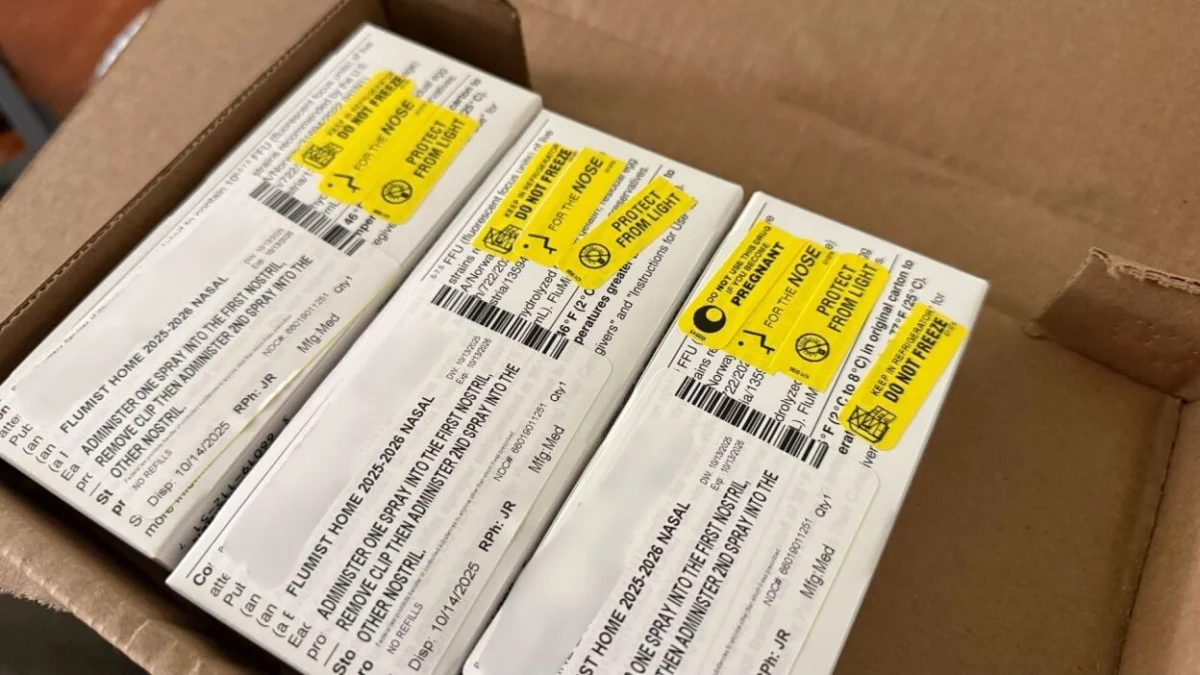
Because biological products are sensitive to temperature fluctuations, the shipping mechanism is critical. Orders arrive via expedited courier services (such as FedEx) in heavily insulated packaging packed with specialized gel cold-packs.
To ensure the vaccine has not been compromised in transit, shipments feature advanced monitoring technology, such as RFID-enabled temperature tags (e.g., TiveTag). Upon delivery, recipients download a companion smartphone application and scan the package. A digital green checkmark confirms instantly that the cold chain remained unbroken throughout transit, providing immediate peace of mind. Furthermore, while immediate refrigeration is ideal, product guidelines indicate that the vaccine can remain unrefrigerated for up to 12 hours prior to administration, adding a layer of logistical flexibility for working adults.
Administration in Practice
The physical administration mirrors what patients would experience in a clinic, stripped of clinical anxiety. The process requires no special preparation:
- Remove the protective rubber tip from the nasal sprayer.
- Insert the tip gently into one nostril and depress the plunger.
- Remove the built-in spacer clip designed to split the dose evenly.
- Insert the tip into the second nostril and administer the remaining liquid.
The volume is minimal, requiring no active inhalation, deep sniffing, or specialized breathing maneuvers. Once completed, users can easily report the vaccination via digital follow-up links, which feed the data back into electronic health ecosystems, though patients are still encouraged to verbally notify their primary pediatricians or physicians during routine check-ups.
Boundaries of Safety: Official Responses and Eligibility
While the at-home model offers unprecedented convenience, medical authorities and manufacturers emphasize that it is not a universal solution. Strict clinical guidelines govern who can safely utilize the nasal spray version of the influenza vaccine.
Age and Health Restrictions
- Approved Demographics: FluMist is officially approved for healthy individuals aged 2 through 49.
- Excluded Populations: Infants under the age of six months and adults aged 50 and older are excluded from using the nasal spray and must continue to receive injectable vaccines administered by a medical professional. Furthermore, children aged 6 months to 2 years must visit a clinic for their shots.
- Immunocompromised Individuals: Because FluMist utilizes a live, weakened (attenuated) influenza virus, it carries specific contraindications. It is not recommended for pregnant individuals, people with certain underlying chronic medical conditions, or anyone who is immunocompromised—nor is it recommended for individuals living in close, direct contact with severely immunocompromised persons who require a protected environment.
For those falling outside the approved parameters, traditional injectable vaccines—which contain inactivated viral components—remain the gold standard and require an in-person clinical visit.
Public Health Implications: The Future of Preventative Care
The normalization of at-home vaccinations marks a pivotal philosophical shift in modern medicine. For decades, public health messaging has focused on driving patients to medical facilities. The success of mail-order flu vaccines suggests that bringing medical interventions to the patient can dramatically alter compliance metrics.
Combating Vaccine Hesitancy and Fatigue
Convenience is one of the most significant determinants of healthcare utilization. By eliminating the friction of appointment scheduling, travel time, and waiting room exposure to other pathogens, at-home options successfully capture a demographic often referred to as "convenience procrastinators"—individuals who fully intend to get vaccinated but continually delay action until the season passes.
Environmental and Administrative Considerations
The rise of home-delivered medicine also introduces new operational responsibilities. Programs have been engineered with sustainability in mind; return envelopes are provided for the disposal of empty sprayers, and the non-toxic water-filled ice packs can be drained and recycled or repurposed domestically. However, the accumulation of insulated foam liners and cardboard packaging underscores the ongoing challenge of balancing medical sterility with environmental consciousness.
Looking Ahead
As digital health frameworks continue to integrate with traditional primary care, the model established by at-home flu immunization serves as a proof-concept for other preventative measures. From routine boosters to chronic disease monitoring, the boundary between the clinic and the living room is blurring. For millions of families preparing for the winter respiratory virus season, the ability to safeguard their health with a few clicks on a screen and a simple spray in the nose has transformed an annual chore into a manageable, frictionless reality.
 rifanmuazin
 Nila Kartika Wati
 Nana
