
 By rifanmuazin
The print-on-demand (POD) industry has evolved from a niche side-hustle market into a sophisticated pillar of modern e-commerce. As entrepreneurs increasingly seek to build sustainable, high-quality fashion labels without the overhead of inventory, the competition between fulfillment giants has intensified. Among the current market leaders, Printful stands as the industry veteran—a global powerhouse known for its massive scale—while Tapstitch has emerged as a disruptive challenger, laser-focused on the premium streetwear and fashion-apparel segment.
For the modern merchant, choosing between these two is not merely a technical decision; it is a strategic one that defines the brand’s identity, quality ceiling, and global scalability. This comprehensive analysis evaluates the two platforms across their operational models, product quality, logistical reach, and long-term business implications.
1. Main Facts: Understanding the Core Philosophies
To understand the difference between Printful and Tapstitch, one must first look at their underlying business models.
Printful operates as a massive, generalist ecosystem. It is a full-service platform that caters to virtually every type of creator, from the solo artist selling posters to the established brand moving thousands of units of custom apparel. Their strategy is built on breadth and ubiquity: they provide a "one-stop-shop" experience with 479+ SKUs, covering everything from wall art and phone cases to sophisticated cut-and-sew apparel.
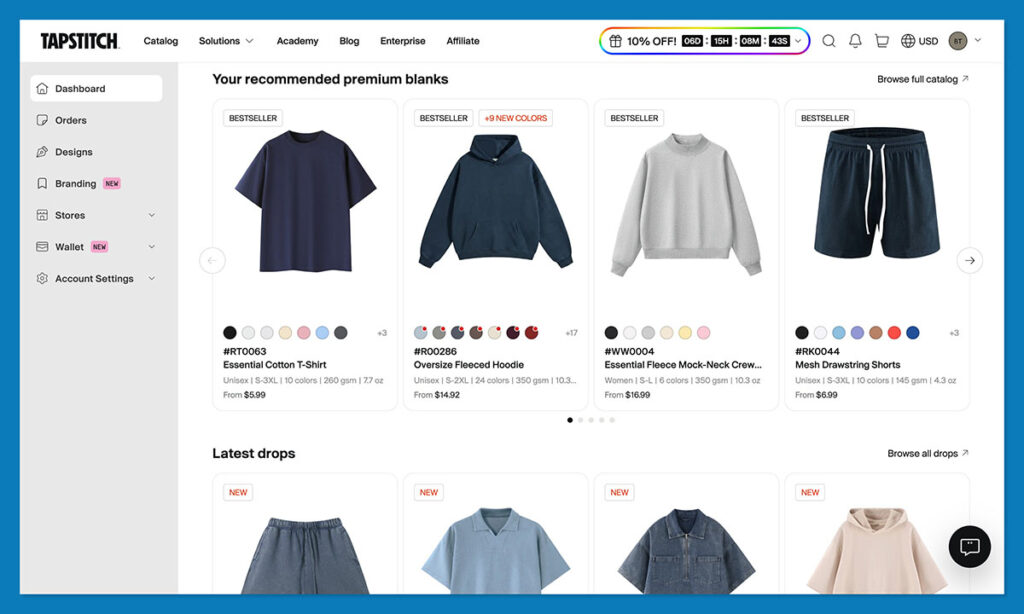
Tapstitch, conversely, is defined by its specialized depth. Rather than attempting to supply a general store, it functions as a dedicated partner for fashion-forward brands. Their catalog is restricted to roughly 400+ apparel-only blanks, but they prioritize the "streetwear aesthetic"—heavyweight fabrics (often exceeding 400 GSM), oversized fits, and expansive print zones. They are not trying to be a warehouse for miscellaneous merchandise; they are trying to be the engine behind the next great clothing brand.
2. Chronology: The Evolution of POD Fulfillment
The maturity of these two platforms reflects different eras of e-commerce.
- The Printful Era (2013–Present): Printful pioneered the modern POD automated workflow. By building a network of 12+ global fulfillment centers, they effectively "solved" the shipping logistics problem that plagued earlier, smaller POD providers. Their chronology is one of constant expansion—adding new print methods like UV and embroidery, integrating with nearly every major marketplace (Amazon, TikTok Shop, etc.), and developing proprietary AI-driven design tools.
- The Tapstitch Emergence (Recent Years): Tapstitch arrived during the "premiumization" wave of POD. As consumers grew tired of thin, boxy, low-quality retail tees, a market gap appeared for high-GSM, boutique-style apparel. Tapstitch positioned itself to fill this void by vertically integrating its manufacturing process. By keeping production in-house in Los Angeles and Guangzhou, they maintain a tighter feedback loop on quality control, allowing them to iterate on garment construction faster than a sprawling global network might allow.
3. Supporting Data: A Side-by-Side Performance Analysis
When we subject these platforms to rigorous testing, the data reveals clear winners based on specific business goals.
The Pricing Equilibrium
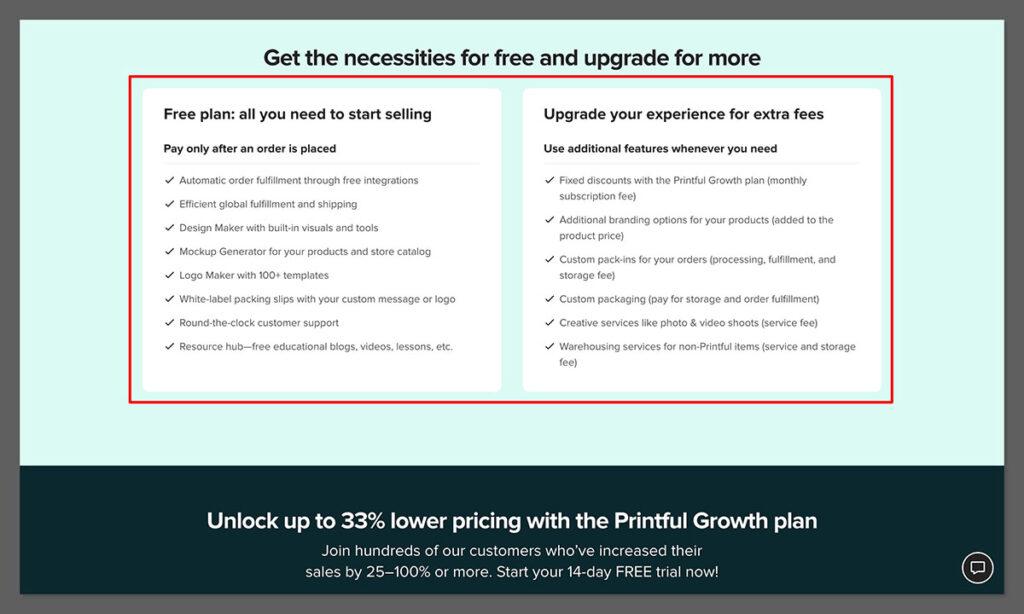
Pricing in the POD space is notoriously complex. Both platforms offer a "free-to-start" model, which lowers the barrier to entry for entrepreneurs.
- Printful maintains a competitive edge for high-volume sellers through its "Growth Plan." For ~$24.99 per month, merchants receive discounts of up to 33% on base costs.
- Tapstitch avoids monthly subscriptions entirely, opting for a transparent pay-per-order model.
- The Reality: At low volumes, the per-unit cost difference is negligible—a typical branded tee with US shipping fluctuates around $21–$23 on both. However, as your monthly order count climbs, the Printful Growth Plan inevitably makes it the more cost-effective choice for scaling.
Quality and Technical Specifications
Our testing indicates that Tapstitch currently holds the crown for garment "hand-feel." Their focus on premium, heavyweight materials and consistent white-ink coverage for dark garments provides a superior unboxing experience. Printful, while exceptionally reliable, occasionally suffers from the "scale tax"—the variability in print placement (often off by 0.5 to 1 inch) that can occur across massive global operations. For a brand that relies on precise, high-end graphic placement, this is a non-trivial factor.
| Feature | Tapstitch | Printful |
|---|---|---|
| Primary Focus | Premium Fashion/Streetwear | Generalist/Merch/Retail |
| Apparel Quality | High (Heavyweight/Oversized) | Consistent (Standard Retail) |
| Global Reach | 2 Facilities (US/CN) | 12+ Global Centers |
| Integrations | Shopify, Etsy, Wix | 21+ (Amazon, TikTok, etc.) |
4. Official Responses and Industry Positioning
Industry analysts note that while Printful has acknowledged the rise of niche competition, their official stance remains focused on the "ecosystem advantage." By offering warehousing, "Quick Stores," and AI-assisted design, they aim to be the operating system for a merchant’s entire business.
Tapstitch’s leadership, conversely, emphasizes the "curated brand" narrative. Their official communication consistently targets designers and clothing line founders who feel that mass-market POD platforms dilute their brand’s prestige. Their investment in custom neck labels and brand-forward packaging is a direct response to the "white-label" problem, where the product feels generic.
5. Strategic Implications: Which Platform Fits Your Business?
Choosing between Tapstitch and Printful is a strategic pivot point.
Why Choose Printful?
Printful is the "Safe Harbor." If your business model relies on:
- Multi-channel selling: You want to be on Amazon, TikTok Shop, and your own website simultaneously.
- Diverse product lines: You intend to sell hats, mugs, posters, and apparel.
- International logistics: You have a customer base that requires local fulfillment in Europe or Asia to avoid exorbitant customs duties and long shipping times.
- Scaling: You anticipate rapid growth and want to leverage volume-based discounts to improve your margins.
Why Choose Tapstitch?
Tapstitch is the "Brand Builder." It is the superior choice if:
- Your brand is fashion-first: You are selling a "look" or a specific "fit" (e.g., oversized streetwear).
- Product quality is your primary differentiator: Your target demographic is sensitive to fabric weight and garment construction.
- You want to minimize complexity: You have a focused, apparel-only catalog and don’t want the noise of managing hundreds of disparate product types.
- Your market is primarily domestic (US): You can leverage their LA-based production for consistent, high-speed fulfillment without the complexity of a global network.
Conclusion: The Final Verdict
The "best" platform is a subjective measurement of your business priorities. Printful remains the industry gold standard for its reliability, massive integration library, and global logistics network. It is the platform of choice for the merchant who values scalability and operational diversity above all else.
Tapstitch, however, is the specialist’s choice. By ignoring the generalist market, they have succeeded in creating a platform that feels tailor-made for the modern clothing label. If you are building a brand where the quality of the garment is the primary marketing tool, Tapstitch offers a level of focus that Printful’s expansive model simply cannot replicate.
Our recommendation: If you are unsure, start by ordering samples from both. Use the same design file and compare the print density, the placement accuracy, and the fabric feel. Because both platforms are free to join, the ultimate "data" is the product in your hand. In the cutthroat world of online retail, your sample is your reality.
 Dwi Wanna
  Lina Irawan
  Basiran