
 By Suro Senen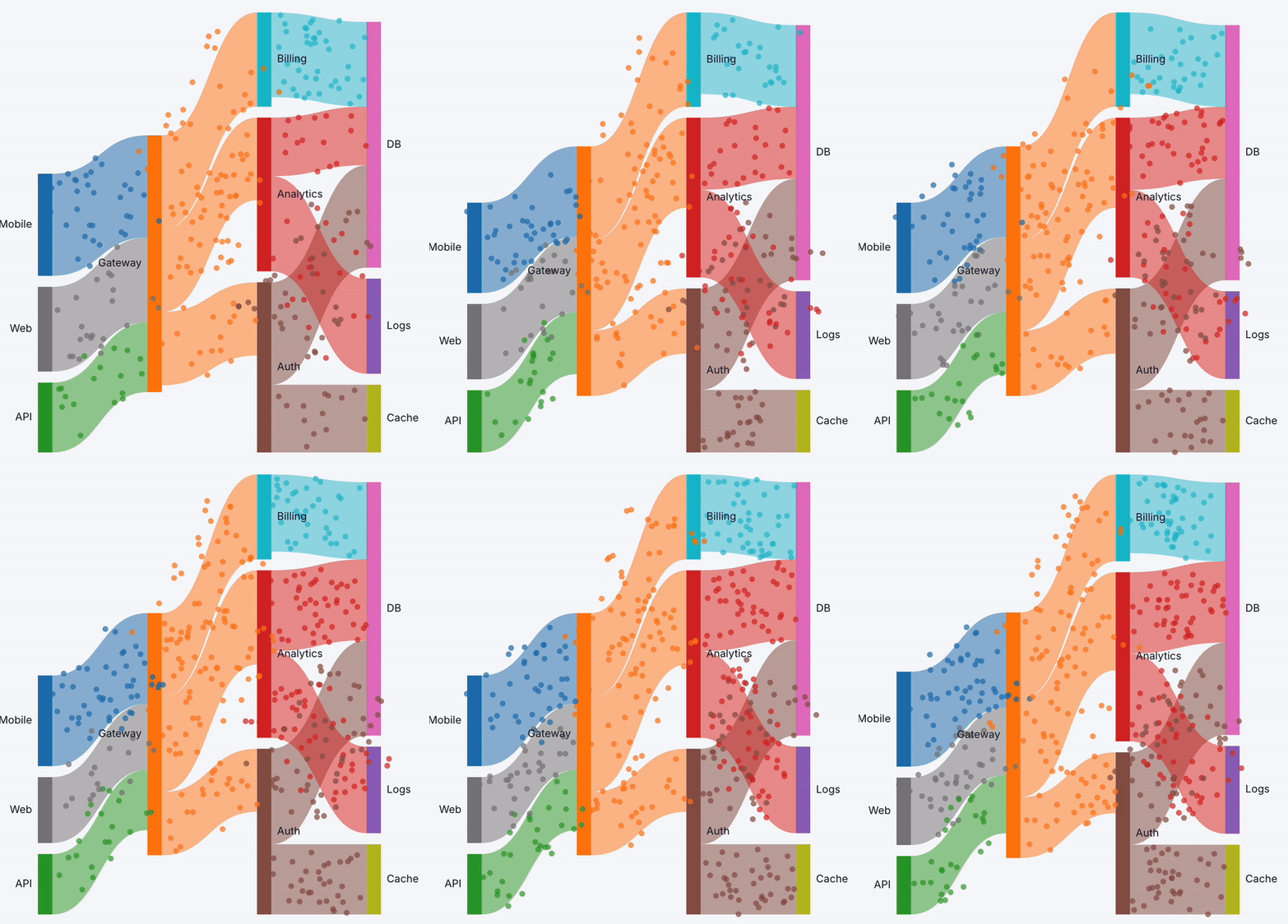
In the rapidly evolving landscape of software engineering, the bridge between an ambitious vision and high-quality implementation is often paved with technical debt. For Elijah Meeks, the veteran data visualization expert and Principal Engineer at Confluent, this gap was a familiar adversary. Today, with the release of Semiotic 3, Meeks is not just launching a library; he is unveiling a new methodology for software development. By leveraging Artificial Intelligence as a "force multiplier," Meeks has successfully modernized a project that once struggled under the weight of its own complexity, transforming it into a high-performance, real-time streaming data visualization engine.
The Evolution of Semiotic: A Chronological Retrospective
To understand the significance of Semiotic 3, one must first look at the lineage of the project. Its origins date back to Meeks’ tenure at Netflix, where it began as the "Abacus Viz Framework." Designed for internal reporting and A/B testing, Abacus was a collaborative effort that thrived on the specific talents of engineers like James Womack and designers like Susie Lu.
However, as the project moved into the open-source domain under the name "Semiotic," it faced the classic pitfalls of developer-driven projects. Despite gaining significant traction—amassing over 2,000 stars on GitHub—it never achieved the widespread adoption of competing libraries.
"I ran afoul of Conway’s Law," Meeks admits. "The organization was essentially just me and my obsessions."
The library was conceptually ahead of its time, offering advanced features like radial violin plots and force-directed word clouds. Yet, it was plagued by performance bottlenecks and a hefty footprint. While Meeks excelled at conceptualizing the "why" of data visualization, the "how"—the nitty-gritty of build systems, web workers, and complex data pipelines—often required the kind of specialized engineering support that is difficult to sustain in a solo open-source project. Over the years, Semiotic settled into a niche status, maintained largely by Meeks himself as he moved through roles at Noteable, Apple, and eventually Confluent.
The "Goldilocks Zone": AI as a Technical Partner
The pivot to Semiotic 3 represents a radical departure from the traditional open-source development model. When faced with the limitations of his own expertise in system architecture, Meeks didn’t seek to hire an army of engineers; instead, he turned to the maturing ecosystem of Large Language Models (LLMs).
Meeks describes this process as operating in the "Goldilocks Zone" of AI-assisted development. He argues that AI is inherently limited when asked to make high-level architectural decisions or define domain-specific abstractions. However, when paired with a veteran engineer who can articulate precisely what needs to happen and why, the AI becomes an unparalleled execution engine.
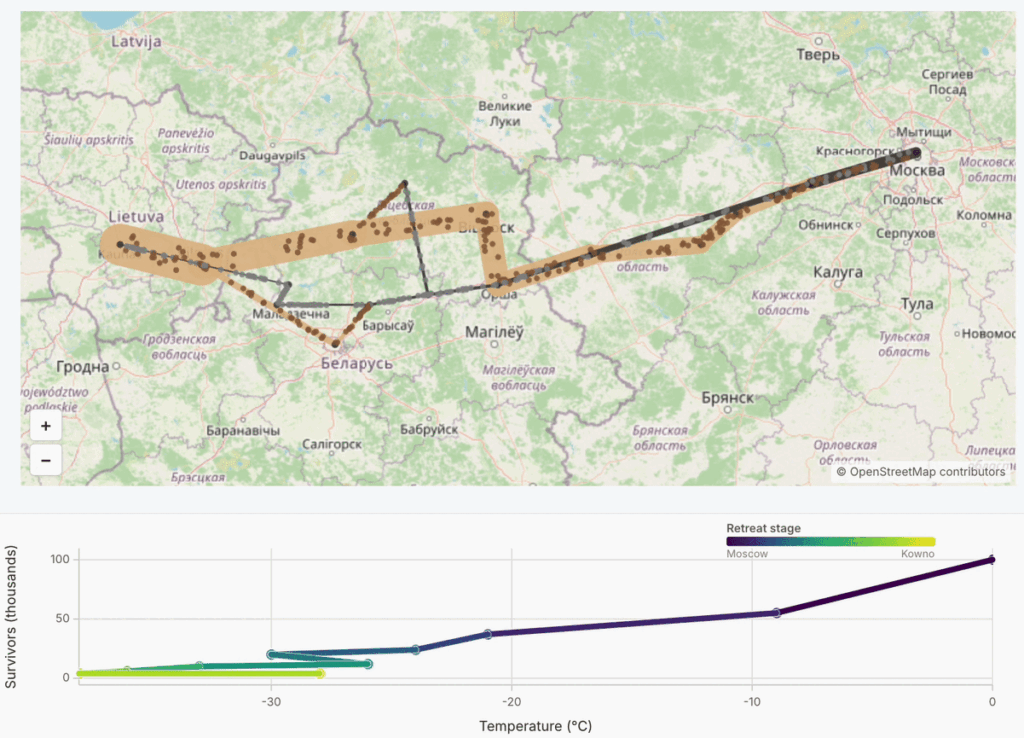
"I wasn’t asking the AI to figure out what a data visualization library should be," Meeks explains. "I’ve spent a decade figuring that out. I knew where the bottlenecks were, I knew which abstractions were load-bearing and which ones were vanity. I just couldn’t always write the code that got there."
By providing specific technical directives—such as instructions to "handle streaming updates by diffing incoming data against a rolling window"—Meeks allowed the AI to handle the performance-heavy lifting. This collaboration resulted in a library that is not only faster but significantly more robust, featuring full test coverage and optimized data pipelines that were previously beyond the scope of a single maintainer.
Technical Implications: From Batch to Real-Time
The most significant shift in Semiotic 3 is its architecture. Heavily influenced by the Apache Flink model—which treats streaming data as a superset of batch data—Meeks has rebuilt the library to be "real-time first."
Key Technical Improvements:
- Streaming-First Paradigms: With the exception of certain hierarchical datasets, every chart in Semiotic 3 now features a native streaming mode. This allows for fluid, real-time updates that are crucial for the modern data stack.
- Server-Side Rendering (SSR): By implementing SSR, the library is now more accessible and performs better in web-heavy environments, addressing one of the most common criticisms of previous iterations.
- Higher-Order Components: The AI assisted in crafting higher-order components, making the library more approachable for everyday developers who may not have the deep D3.js expertise that was once a prerequisite for mastering Semiotic.
- The "Particle" Innovation: In a nod to long-held aesthetic ambitions, Semiotic 3 introduces "Sankey diagrams with particles," a feature that highlights the library’s newfound ability to handle complex, high-frequency visual elements without sacrificing performance.
The Human-AI Hybrid: A New Model for Open Source
Perhaps the most provocative aspect of the Semiotic 3 launch is the acknowledgement of the "vibe coder"—the developer who, like Meeks, may not be a world-class systems programmer but has the vision to lead complex projects.
"AI didn’t replace the best programmers I’ve worked with," Meeks observes. "It replaced the best programmers I couldn’t recruit."
This model challenges the traditional narrative that AI is purely a replacement for low-level labor. Instead, it suggests a future where domain experts—those who understand the nuances of a specific field like data visualization—can use AI to bridge the gap between abstract design and production-ready code.
For the open-source community, this implies a potential renaissance for "niche" projects. Many projects die because their maintainers reach a ceiling in their technical capacity. If those maintainers can now leverage AI to handle the "grunt work" of testing, optimization, and build-system configuration, we may see a wave of legacy tools being revitalized by a single, visionary individual.

Implications for the Data Industry
The release of Semiotic 3 is not just an update; it is a signal to the industry. As companies like Confluent lean harder into streaming data, the tools used to visualize that data must keep pace.
By integrating streaming support directly into the core of the library, Meeks is enabling his stakeholders—and the broader developer community—to build UIs that reflect the transient, dynamic nature of modern information. The ability to visualize data as it flows, rather than as a static snapshot, is becoming a primary requirement for decision-making in sectors ranging from finance to logistics.
Furthermore, by openly admitting his reliance on AI, Meeks is fostering a culture of transparency. He encourages other developers to stop viewing AI as a "cheat" and start viewing it as a teammate. The result, he suggests, is "astounding"—a product that is better than the sum of its parts, created by a human with a vision and an AI with the technical bandwidth to execute it.
Conclusion: The Future of Visualization
As Semiotic 3 hits the public domain, it serves as a testament to the changing nature of the "Senior Engineer." The role is shifting away from being the person who knows the most syntax or the best algorithms, and toward being the person who best understands the system requirements and the desired outcomes.
The "vibe coder" era may be upon us, but if the results are as performant and useful as Semiotic 3, the professional software development community has little to fear. The library stands as a proof-of-concept for a new way of building: one where the bottleneck is no longer the engineer’s hands, but the limitations of their imagination. For now, the particles are moving, the streams are flowing, and the data visualization world has a powerful new tool at its disposal.
 Lina Irawan
  Nana
Nana  Nila Kartika Wati