
 By Jia Lissa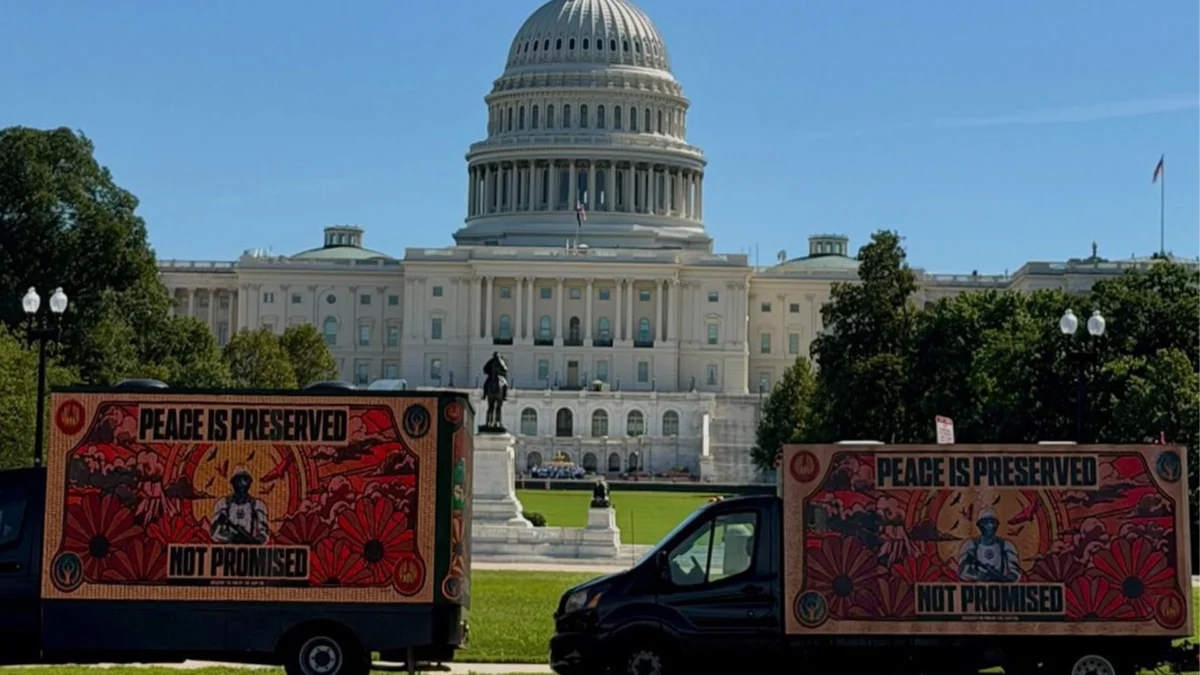
In the realm of cinematic marketing, the goal is often to capture the audience’s attention by breaking the "fourth wall." However, Lionsgate’s latest campaign for The Hunger Games: Sunrise on the Reaping has moved beyond mere promotion, opting for a strategy that is as brilliant as it is unsettling. By installing propaganda-style billboards directly outside major seats of global power, the studio has ignited a firestorm of discussion regarding the intersection of dystopian fiction and contemporary political reality.
The Campaign: A Masterclass in Guerilla Marketing
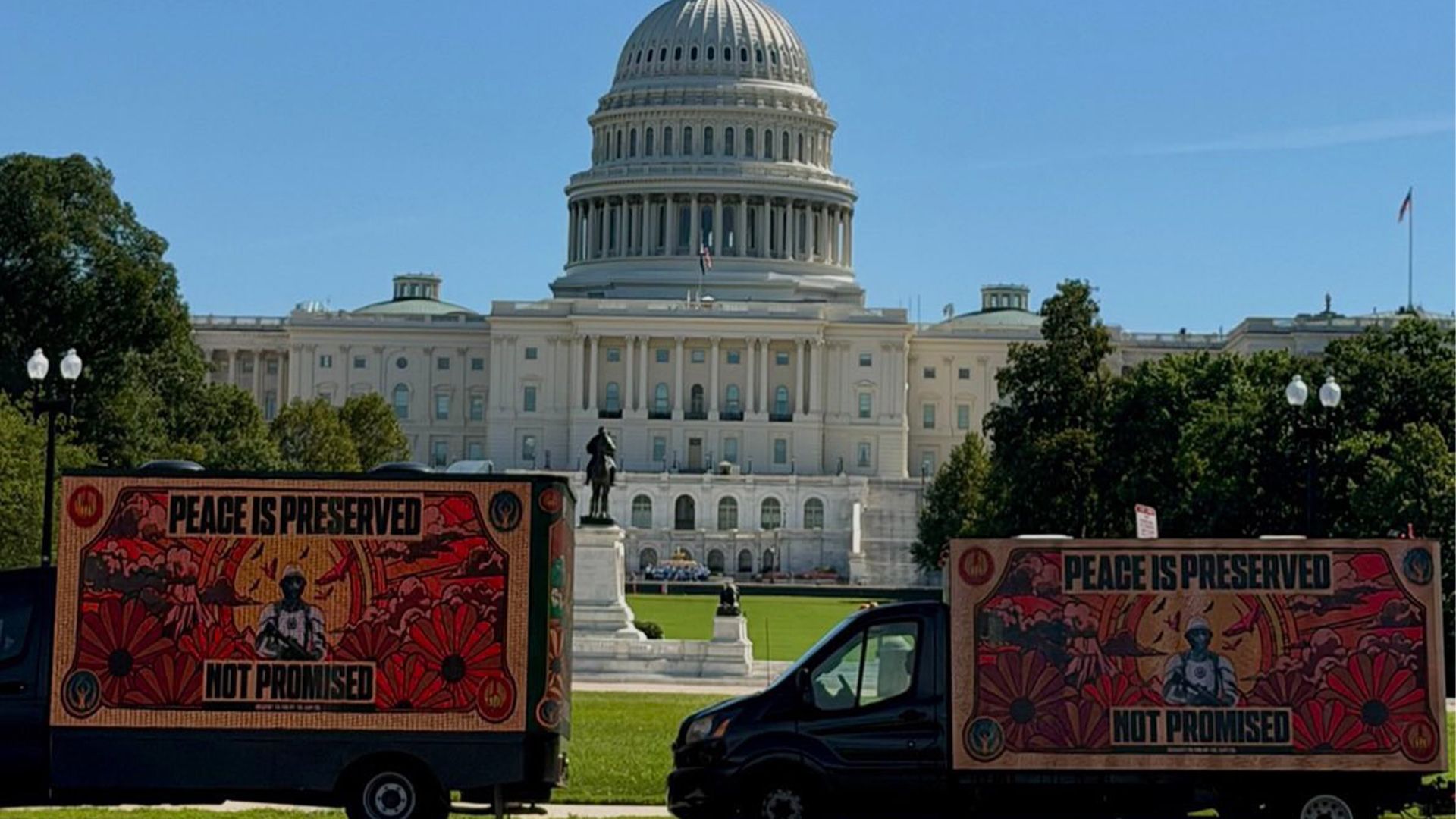
The marketing campaign centers on a series of mobile billboards that have appeared in high-profile locations across the globe. Featuring a stark, Soviet-inspired aesthetic, the posters depict a stern soldier set against a deceptively cheerful floral backdrop. The messaging is chillingly authoritarian, emblazoned with the slogan: "Peace is preserved, not promised."
While the visual language is unmistakably rooted in the oppressive regime of the Capitol—the primary antagonist in Suzanne Collins’ The Hunger Games universe—the context of their placement has turned these advertisements into a social experiment. The posters were spotted at the U.S. Capitol Building in Washington D.C., NATO Headquarters in Belgium, Independence Hall in Philadelphia, and the Democracy Monument in Thailand.
To the casual observer, the juxtaposition of these fictional propaganda pieces against the backdrop of genuine global institutions creates a visceral reaction. It forces the public to confront the thin, often porous line between the democratic ideals these buildings represent and the totalitarian aesthetic of Panem.
Chronology of the Deployment
The rollout of the Sunrise on the Reaping campaign was calculated for maximum impact, utilizing a phased deployment that spanned key geopolitical hubs.
- September 12, 2026: Initial sightings were reported in Washington D.C., where mobile units parked within view of the U.S. Capitol Building. Social media users began circulating images almost immediately, many expressing confusion as to whether the posters were a piece of political art or a government-sanctioned campaign.
- September 13, 2026: The campaign moved to Philadelphia, placing the "Peace is preserved" messaging in front of Independence Hall. The historic nature of the location heightened the irony, as the posters served as a direct antithesis to the values of liberty associated with the site.
- September 14, 2026: International expansion began with the appearance of the posters at the NATO Headquarters in Brussels, Belgium. This marked a shift in the campaign’s scope, positioning the Hunger Games branding as a global commentary rather than a domestic American one.
- September 15, 2026: The campaign reached Southeast Asia, with the Democracy Monument in Thailand serving as the final high-profile site. By this point, the campaign had gone viral, with the term "The Capitol is here" trending across various social media platforms.
Supporting Data: Why This Works
Marketing analysts suggest that this campaign succeeds because it taps into the "uncanny valley" of political communication. By adopting the visual tropes of 20th-century authoritarianism—bold, blocky typography, a central figure of military authority, and a color palette that evokes both danger and stability—Lionsgate has successfully hijacked the viewer’s subconscious.
According to psychological studies on environmental marketing, the impact of an advertisement is increased exponentially when it appears in a setting that aligns with its narrative themes. By placing a "Capitol" poster at the seat of a democratic government, the agency responsible for the campaign is effectively using the environment as an active participant in the storytelling.
Furthermore, the "soft" branding of the campaign—small District badges and the subtle "brought to you by the Capitol" disclaimer—serves as a trap for the viewer. It rewards those who look closer with the realization that they are part of a fictional marketing push, while simultaneously leaving those who only catch a passing glance with a lingering, uncomfortable sensation.
Official Responses and Public Reaction
As of this writing, Lionsgate has not issued a formal press release explaining the specific choice of locations, though the strategy is widely viewed within the advertising industry as a "high-risk, high-reward" move.
The public reaction has been polarized. While fans of the Hunger Games franchise have praised the campaign for its commitment to the lore—noting that the film’s prequel nature necessitates a look at how the Capitol exerts control—others have expressed concern. Critics have argued that in an era of heightened political sensitivity and global instability, placing authoritarian propaganda near sites of genuine democratic importance is "tone-deaf" or "needlessly provocative."
Political commentators have noted that the irony of the campaign is precisely the point. By forcing people to walk past signs that explicitly state "Peace is preserved, not promised" while walking into an institution dedicated to freedom, the campaign highlights the fragility of the very systems we often take for granted.
Implications for Future Cinematic Marketing
The Sunrise on the Reaping campaign marks a potential turning point in how studios approach blockbuster marketing. For decades, the industry relied on traditional trailers, bus stop posters, and late-night talk show appearances. However, as the digital space becomes increasingly cluttered, studios are moving toward "immersive reality" marketing.
1. The Death of Traditional Advertising
Traditional billboards are increasingly viewed as "white noise." By making the advertisement an event that feels like a real-world disruption, Lionsgate has ensured that every person who sees a photo of the poster shares it. The organic social media reach generated by these images likely cost a fraction of a traditional Super Bowl spot while generating significantly more engagement.
2. The Power of "In-World" Marketing
This campaign proves that audiences are hungry for "in-world" experiences. They no longer want to just watch a movie; they want to engage with the world of the movie as if it were a tangible reality. By treating the Capitol as an entity that can actually advertise in our world, Lionsgate has successfully expanded the franchise’s footprint beyond the silver screen.
3. Ethical Boundaries and Global Sensitivity
The backlash in certain quarters serves as a warning for future campaigns. As marketing becomes more immersive, brands must weigh the risks of co-opting real-world political imagery. While the Hunger Games is inherently political, there is a fine line between satire and insensitivity. Future campaigns will need to be even more surgical in their placement to avoid alienating viewers who find the "real-world" implications of these ads to be too close to home.
Conclusion: A Mirror to Our World
Ultimately, the genius of the Sunrise on the Reaping campaign lies in its ability to make us uncomfortable. In a world where the boundary between political theater and reality often feels thinner by the day, the Capitol’s presence in our own public squares acts as a mirror.
We are forced to ask ourselves: are we cheering for a clever piece of marketing, or are we being reminded that the oppressive regimes we watch on screen are not as far removed from our own reality as we would like to believe? As the promotional cycle for Sunrise on the Reaping continues, one thing is certain: Lionsgate has successfully ensured that the film is not just the most anticipated movie of the year, but the most discussed political conversation as well.
Whether this is a stroke of marketing genius or a cautionary tale about the power of imagery in the digital age, the "Capitol" has arrived—and it isn’t going anywhere until the final credit rolls.
 Nila Kartika Wati
  Dwi Wanna
  Asep Darmawan