
 By Nana
In the rapidly evolving landscape of the creator economy, the barrier to entry for launching a brand has never been lower. For influencers, YouTubers, and streamers, the transition from content creation to commerce is often the most significant milestone in their career. Two platforms have consistently emerged as the primary contenders for this transition: Spring (formerly Teespring) and Fourthwall.
While both promise to bridge the gap between audience engagement and revenue, they represent fundamentally different philosophies regarding growth, brand ownership, and scalability. This comprehensive review dissects the nuances of both platforms to help you determine which architecture best supports your long-term goals.
Main Facts: The Core Differences
At a glance, both Spring and Fourthwall offer a path to monetization for creators. However, they diverge significantly in their execution.
Spring is built for speed and simplicity. It operates as a streamlined, hosted social storefront. If your primary objective is to launch a T-shirt design or a digital file to your existing Instagram or YouTube audience with minimal technical friction, Spring is optimized for that "plug-and-play" experience. It manages production, payment processing, tax compliance, and basic customer support, allowing the creator to focus almost entirely on design and promotion.
Fourthwall, by contrast, is a robust ecommerce ecosystem. It is designed for creators who envision themselves as brand owners rather than just merchandise sellers. It provides a fully customizable storefront—including the ability to map a custom domain—and supports a diverse array of revenue streams. Beyond print-on-demand (POD), it accommodates memberships, subscriptions, self-fulfilled products, and direct donations.
Chronological Evolution of the Platforms
The trajectories of these two companies mirror the changing needs of the creator market.
- Spring’s Legacy: Originally launched as Teespring, the platform pioneered the "campaign-based" model of POD. For years, it was the default choice for creators to launch limited-edition merch drops. Following a rebrand to "Spring," the company shifted its focus toward integrating deeply with social platforms, prioritizing "one-click" buying experiences within the apps where creators live, such as YouTube and Twitch.
- Fourthwall’s Rise: Fourthwall entered the market later, specifically to address the limitations of existing POD services. Seeing that creators were being forced to migrate to more complex platforms like Shopify once they achieved success, Fourthwall aimed to provide a "grown-up" version of a creator store. By layering professional ecommerce tools—such as advanced analytics, email marketing integrations, and membership tiers—over a user-friendly interface, Fourthwall positioned itself as the "all-in-one" solution that evolves alongside the creator.
Supporting Data: Feature Comparison
| Feature | Fourthwall | Spring |
|---|---|---|
| Storefront | Custom domain & full design control | Hosted, template-based store |
| Product Range | Premium POD + Self-sourced stock | POD-focused |
| Memberships | Native, full-featured tiers | None |
| Marketing | Integrated Email (Klaviyo/Mailchimp) | Limited; third-party only |
| Merchant of Record | Yes | Yes |
| AI Support | Eli AI Shop Assistant | Limited |
The Cost of Doing Business
Both platforms offer a "free" tier, but the definition of free varies.
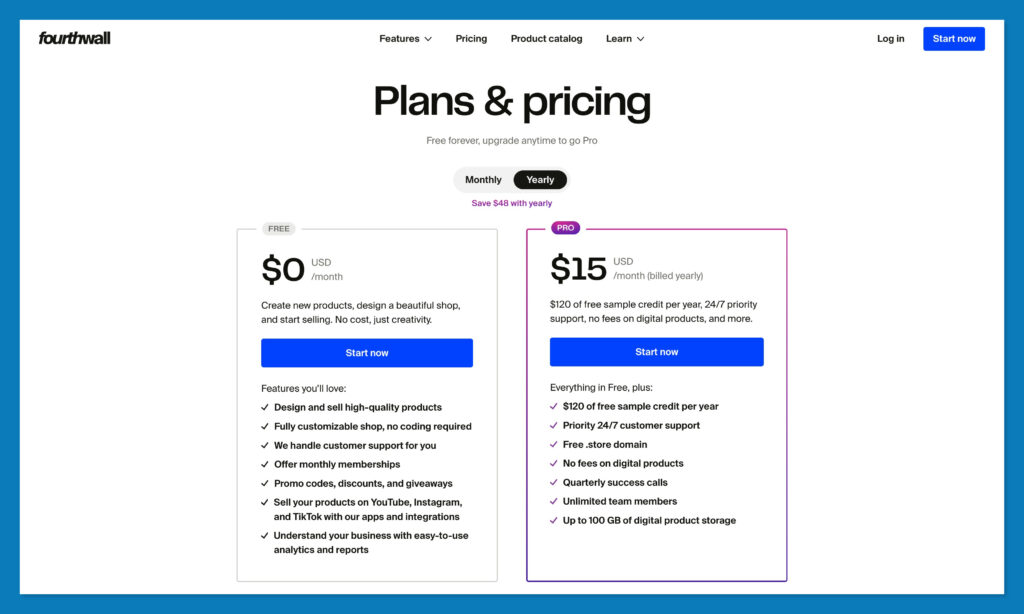
Fourthwall’s free plan covers essential ecommerce needs, with a 5% transaction fee on digital products and memberships. For $19/month, creators gain access to advanced features, including priority support and sample credits.
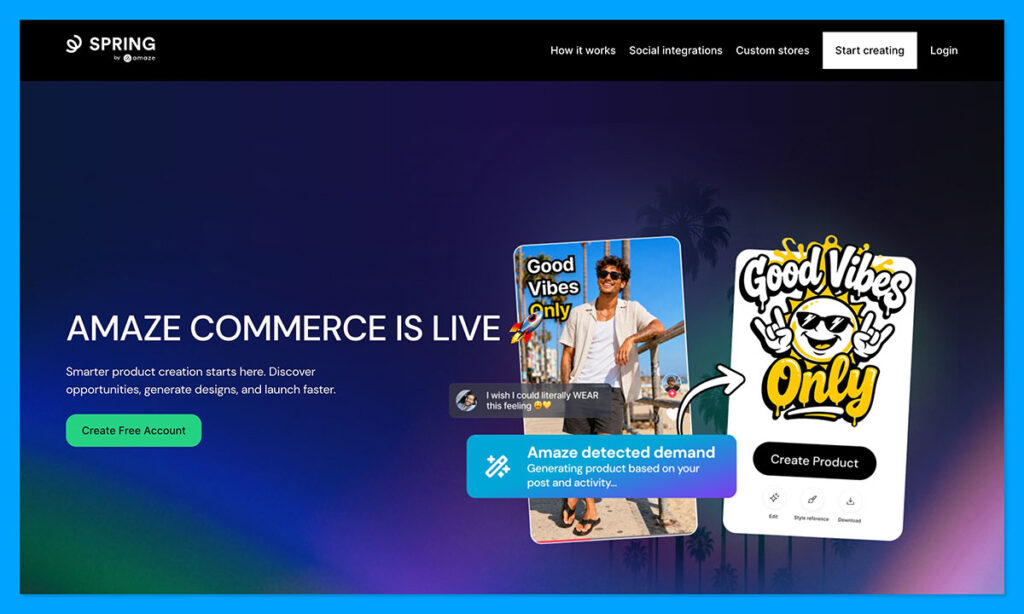
Spring remains free for all users, but its monetization model is baked into the "base cost" of items. Creators set their own prices, and the margin is their profit. However, for digital products, Spring takes a 20% commission plus $1.70 per transaction, which can significantly eat into margins for lower-priced items.
Official Stances and Strategic Direction
Recent updates from both companies highlight their divergent paths.
Spring’s Focus: The Frictionless Experience.
Spring has focused heavily on "Creator Experience" teams. Their recent updates emphasize account security, multi-factor authentication, and bulk-listing management. They are doubling down on the "social-first" approach, ensuring that when a creator posts a link on TikTok or YouTube, the checkout experience is as seamless as possible to minimize drop-off rates.
Fourthwall’s Focus: Customer Retention.
Fourthwall is building machinery to turn one-time buyers into lifetime fans. Their integration with tools like "Kit" allows for sophisticated email automation—triggering welcome sequences based on purchase history or membership status. Their recent addition of an AI assistant, "Eli," helps creators scale their catalog without needing a full-time design team, and their partnership with Karat addresses the financial management side of the creator business.
Print-on-Demand: Quality vs. Volume
A critical differentiator for any creator is the physical quality of the products representing their brand.
- Fourthwall’s Curation: Fourthwall prides itself on a "retail-grade" catalog. They offer premium apparel, including embroidery and cut-and-sew options. The philosophy here is that the creator’s brand is valuable, and the product quality should reflect that. Shipping is consistent, with a global network of partners, and the quality control is markedly high.
- Spring’s Breadth: Spring offers a wider variety of products (roughly 200 types), which is excellent for creators who want to experiment with niche merchandise. While the quality is generally acceptable for standard merch, it lacks the "boutique" feel of Fourthwall’s signature collections. Printing consistency has been a point of contention in user reviews, though their sample-ordering process allows creators to verify quality before a mass rollout.
Implications for Creators: Which Should You Choose?
When to choose Spring:
- You are a beginner: You are just starting to monetize your audience and want to test the waters without any financial commitment or technical complexity.
- Social-only sales: Your entire strategy revolves around selling to your followers on Instagram, TikTok, or YouTube, and you have no interest in building a standalone brand website.
- Low-maintenance: You want a "set it and forget it" solution where the platform handles everything, including customer support for issues.
When to choose Fourthwall:
- You are building a brand, not just merch: You want a custom domain, a professional website, and the ability to sell more than just T-shirts—think digital downloads, exclusive video content, and recurring memberships.
- Scale is the goal: You anticipate needing advanced features like email marketing, CRM integrations, and the ability to source your own inventory in the future.
- High-touch audience: You want to offer your community more value through memberships, donations, and direct engagement, effectively turning your store into a "home base" for your digital life.
Final Verdict
The "tricky" nature of this comparison arises from the fact that both platforms are, in a sense, successful. Spring has mastered the art of the transaction, making it the undisputed king of casual, social-driven sales. If you are a creator who wants to spend 99% of your time making videos and 1% on your store, Spring is the platform for you.
However, Fourthwall has mastered the art of the relationship. It recognizes that for a modern creator, a storefront is not just a point of sale—it is an extension of their digital identity. By providing the tools for memberships, donations, and deep data integration, Fourthwall acknowledges that the future of the creator economy lies in owning the customer relationship rather than simply renting space on a marketplace.
If you are just starting, you may find yourself drawn to Spring. But if you have long-term ambitions to build a sustainable, multi-revenue stream business, Fourthwall is the superior infrastructure. Choosing the right platform is the first step toward moving from a content creator to a sustainable media enterprise. Choose based on where you want to be in three years, not just where you are today.
 Laily UPN
 Neng Nana
 Sagoh
