
 By Iffa Jayyana
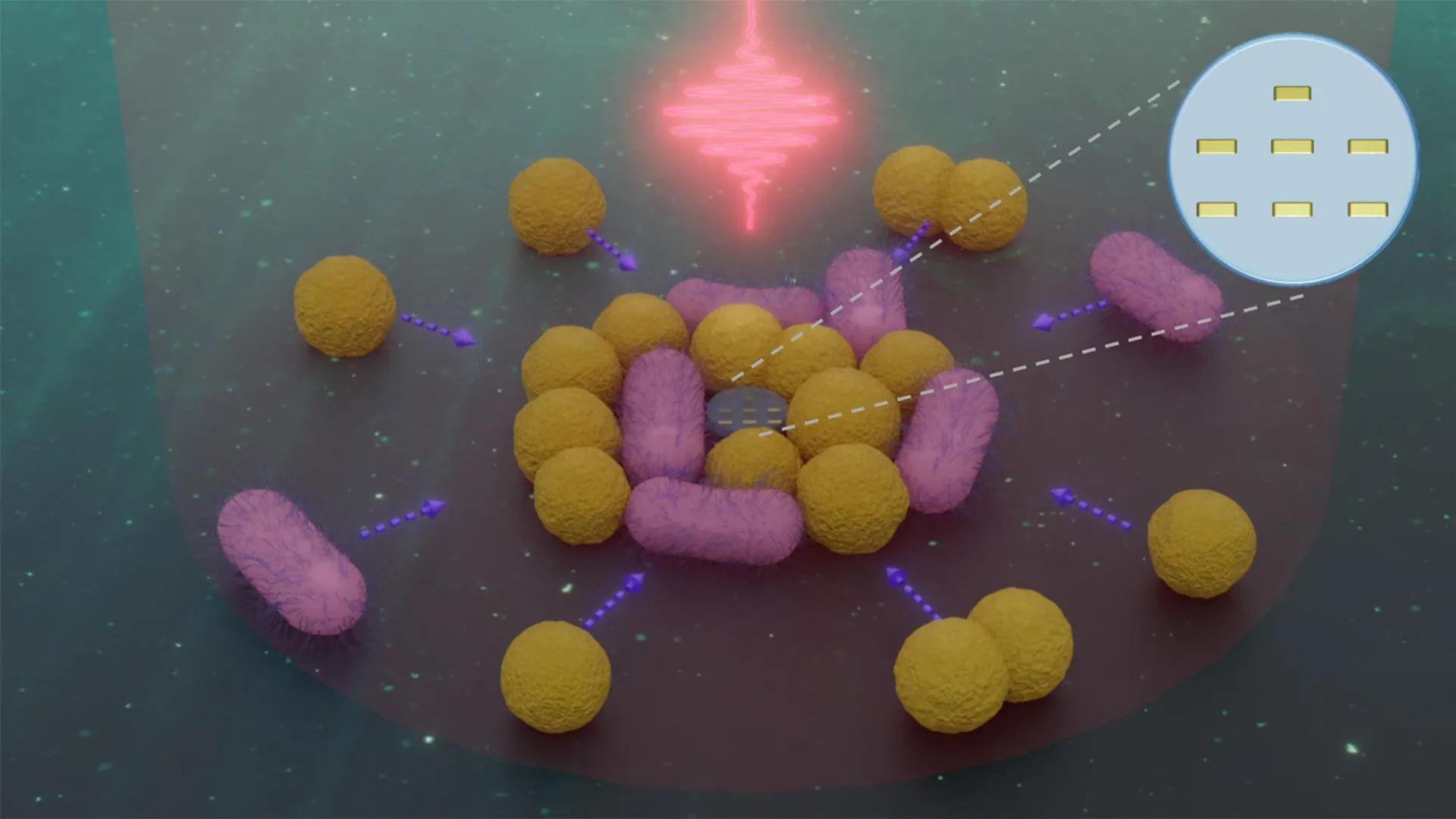
In a breakthrough that bridges the gap between science fiction and tangible engineering, researchers at Julius-Maximilians-Universität Würzburg (JMU) have unveiled a new class of autonomous nanorobots capable of navigating the microbial realm. Measuring less than one micrometer in diameter—roughly 50 times smaller than the width of a single human hair—these devices represent a paradigm shift in our ability to interact with, manipulate, and organize the building blocks of biological life.
By harnessing the subtle but potent forces of light, the JMU team has moved beyond mere observation of the microscopic world, stepping into an era of active manipulation. These "microscopic cleaners" are already demonstrating the ability to track, capture, transport, and release individual bacteria, offering a transformative tool for biomedical research, environmental monitoring, and beyond.
The Technical Foundation: Photon Recoil as Propulsion
The primary hurdle in developing machines at the nanoscale has historically been the "power problem." At scales where conventional motors, batteries, and fuel cells become physically impossible to integrate, researchers have struggled to find a reliable means of propulsion. The JMU team, led by Professor Bert Hecht, has bypassed this limitation by turning to the fundamental physics of light.
The Physics of the Photon
The microdrones developed by the team utilize the principle of photon recoil—a concept analogous to the kickback experienced when firing a firearm. In the quantum world, photons carry momentum. When these particles are absorbed and subsequently emitted by a surface, they exert a force. By integrating as many as four plasmonic nanoantennas into the structure of each drone, the researchers can precisely control this force.
These antennas are engineered to absorb light of specific wavelengths and helicities (the spin of the light wave). Once absorbed, the antenna re-emits the light in a calculated direction. Because the nanorobots possess an incredibly low mass, the cumulative recoil from these photon interactions generates sufficient acceleration to propel the drones through liquid environments with remarkable agility.
Steering via Polarization
Propulsion is only half the battle; without sophisticated steering, a nanorobot is little more than a drifting speck. The JMU researchers addressed this by leveraging the intrinsic properties of nanoscale antenna wires. These wires exhibit a natural tendency to align themselves with the polarization direction of incident light.
By modulating the polarization of the external light source, the researchers can effectively "steer" the nanorobot. As the robot aligns with the light’s polarization, the directional force of the photon recoil maintains its forward trajectory. This elegant dual-purpose system allows for complex maneuvering, including rapid 90-degree turns, without the need for onboard sensors or internal power storage.
A Chronology of Innovation: From Concept to Micro-Cleaner
The development of these devices did not occur in a vacuum; it is the culmination of years of iterative research into plasmonics and micro-scale robotics.
- Phase I: The Theoretical Framework (Early Research): The initial focus of the JMU team was the fundamental study of light-matter interaction. Researchers explored how plasmonic structures could manipulate light, establishing the baseline for using photon recoil as a viable propulsion mechanism.
- Phase II: Scaling Down: Early prototypes were significantly larger. The challenge was to reduce the footprint of the devices to the sub-micrometer level while maintaining structural integrity and propulsion efficiency.
- Phase III: Simplification for Autonomy: The most recent breakthrough involved a radical simplification of the steering mechanism. By relying on the polarization-dependent alignment of the antenna wires, the team eliminated the need for complex, heavy control systems, allowing the drones to shrink to their current, highly efficient form.
- Phase IV: Biological Integration: Once the propulsion and steering were optimized, the team moved to testing the robots in biological environments. Experiments demonstrated that the robots could successfully capture bacteria in a liquid medium—a feat that requires both precise navigation and the ability to overcome the viscous forces present at the microbial scale.
Supporting Data and Performance Metrics
The performance of these nanorobots under laboratory conditions is nothing short of extraordinary. The research team has meticulously documented the capabilities of their microdrones, providing a clear picture of their operational limits.
Agility and Payload Capacity
One of the most surprising findings of the study was the drones’ resilience under load. When tasked with transporting bacterial clusters, the robots maintained full maneuverability. While the added mass of the bacteria resulted in a measurable reduction in top speed—a predictable consequence of increased drag and mass—the steering remained precise and responsive.
Precision Manipulation
The ability to perform sharp, 90-degree turns is critical for scanning microscopic samples. In a controlled environment, these robots can cover broad areas in a highly organized, grid-like fashion, ensuring no part of the sample remains unexamined. This efficiency makes them ideal for tasks involving the sorting of cells or the removal of contaminants from a biological solution.
Scaling and Energy Efficiency
Because the power source is external (the light source), the nanorobots themselves remain lightweight and free of the heat-generating or toxic components found in traditional micro-electronics. This makes them significantly safer for use with sensitive biological materials, as the risk of thermal damage or chemical leaching is effectively nullified.
Official Responses: Insights from the JMU Team
The project has garnered significant attention within the scientific community, particularly for its practical application of quantum-scale physical principles.
Jin Qin, the lead experimental scientist on the study, emphasized the transformative nature of the design. "In essence, we have built a light-driven nanorobot that can track down and collect bacteria," Qin noted. "By simplifying the design, we reached a size at which these robots can operate directly in the microbial world—almost like microscopic cleaning devices."
Professor Bert Hecht, who oversaw the project, views the work as a bridge between observation and active intervention. "This is a striking example of how light can be used not only to observe the microscopic world, but also to actively shape it," Hecht remarked. "The idea of tiny robotic cleaners may sound futuristic, but we are already demonstrating the physical principles that make it possible."
The team’s consensus is that while the current technology is in its "proof-of-concept" stage, the underlying mechanics are robust enough to support a wide range of future development.
The Broader Implications: Where Do We Go From Here?
The implications of this technology extend far beyond the cleaning of bacterial cultures. As we look toward the future, the ability to interact with the microscopic world at this level of precision opens doors to several high-impact fields.
Revolutionizing Biomedical Research
In the field of medicine, the ability to transport cargo at the cellular level could redefine drug delivery. Imagine a nanorobot capable of navigating the bloodstream to deliver a localized dose of medicine directly to a tumor, or a drone designed to clear arterial plaque one microscopic particle at a time. By using light to steer these devices, clinicians could potentially achieve levels of precision currently unattainable by traditional surgical or pharmaceutical methods.
Advances in Microbiology
For microbiologists, the ability to isolate and manipulate individual bacteria without damaging their cellular structure is a game-changer. These robots could be used to create controlled environments for studying bacterial communication, biofilm formation, and genetic mutation in real-time.
Environmental Remediation
The "microscopic cleaner" analogy is particularly apt when considering environmental applications. Water contamination, whether from hazardous bacteria or microscopic pollutants, is a global challenge. If these nanorobots can be scaled for larger-scale water treatment, they could offer a highly efficient method for filtering contaminants at a molecular level, effectively "sweeping" water supplies clean of dangerous pathogens.
Future Challenges and Ethical Considerations
Despite the excitement, the road ahead is not without obstacles. Scaling the production of these nanorobots to "swarms" capable of performing large-scale tasks remains a significant engineering challenge. Furthermore, the use of external light sources requires a line-of-sight or a transparent medium, which may limit the robots’ utility in deep-tissue human applications.
Ethically, the introduction of autonomous, controllable nanorobots into biological or environmental systems necessitates a robust regulatory framework. Scientists must ensure that these devices cannot be repurposed for harmful ends and that their long-term presence in biological systems does not introduce unforeseen ecological imbalances.
Conclusion: A New Frontier
The research conducted at JMU is more than just a clever application of physics; it is a fundamental expansion of our human capabilities. For centuries, we have been limited to studying the microscopic world through the static lens of a microscope. Now, we are learning to reach into that world and exert influence.
By mastering the force of light, the JMU team has provided a blueprint for the next century of robotics. As we continue to refine these machines—increasing their speed, capacity, and autonomy—the line between the macro and micro worlds will continue to blur. We are moving toward a future where our most powerful tools are also our smallest, working silently and efficiently to keep our biological and environmental systems in balance. The era of the nanorobot has arrived, and it is powered, quite literally, by the light of discovery.
 Ali Ikhwan
 Reynand Wu
 Ammar Sabilarrohman
