
 By Pevita Pearce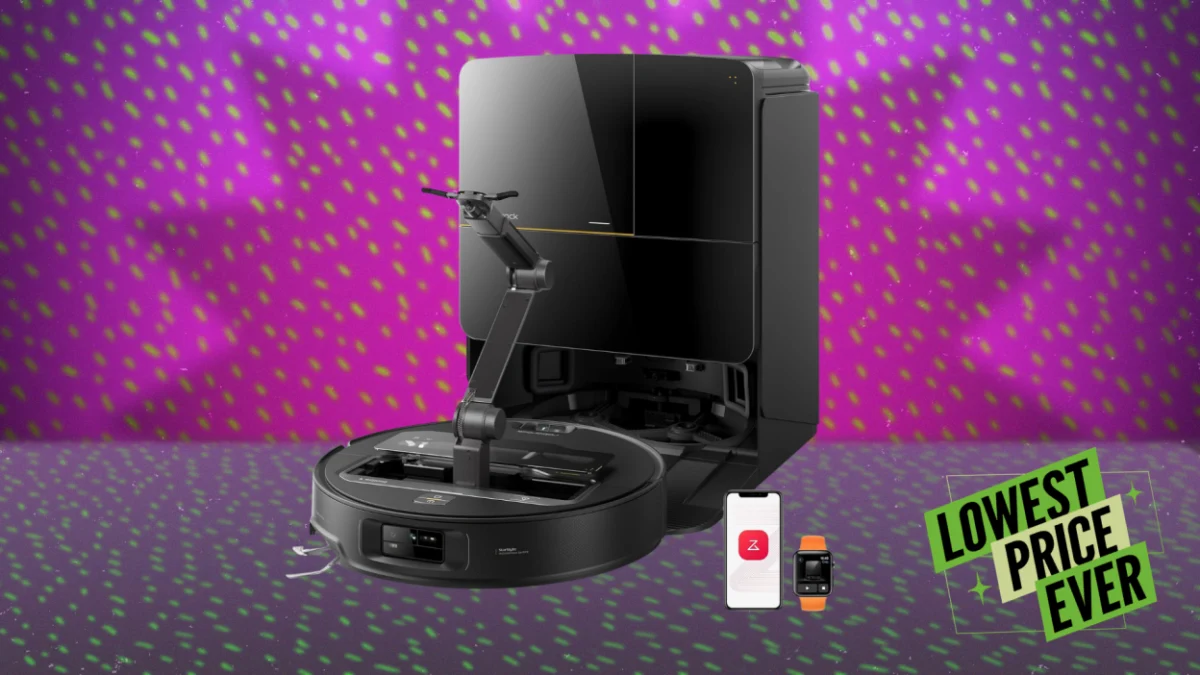
The landscape of domestic robotics has undergone a seismic shift. For years, the robot vacuum industry was defined by "bump-and-go" technology—devices that would dutifully circle a room, occasionally get wedged under a sofa, or find themselves defeated by a stray pair of socks left on the living room floor. Consumers grew accustomed to the "pre-cleaning" ritual: clearing the floor of clutter before the robot could even begin its job.
However, a new flagship from Roborock, the Saros Z70, signals the end of that era. By integrating sophisticated AI and, most notably, a dexterous robotic arm, the Saros Z70 is moving beyond mere suction to become a legitimate "AI-powered housekeeper." With a current market-leading promotion cutting the price in half to $999.99—an all-time low from its $1,999 MSRP—the Z70 is no longer just a luxury experiment; it is a viable, high-performance tool for the modern smart home.
Main Facts: A New Breed of Automation
At its core, the Roborock Saros Z70 is a hybrid vacuum-and-mop system, but the inclusion of the "Omnigrip" robotic arm sets it apart from every other device currently on the market. This appendage allows the vacuum to physically interact with its environment in a way that was previously reserved for science fiction.
When the Z70 encounters obstacles like footwear, cables, or stray garments, it doesn’t simply retreat or navigate around them. Instead, it utilizes its arm to identify, lift, and relocate the obstruction to a designated area, allowing the vacuum to clean the surface that was previously obscured. Once the obstacle is cleared and the area is sanitized, the Z70 continues its patrol. Safety is a primary concern in this design; the device is engineered with weight-sensing protocols, ensuring it ignores heavy objects, pets, or furniture, focusing only on the "clutter" that typically hinders autonomous cleaning.
A Chronology of Innovation: From Bump-and-Go to AI-Driven
To understand the significance of the Saros Z70, one must look back at the trajectory of Roborock’s engineering history.
The Early Years (2014–2018): Roborock’s initial models were praised for their reliable LiDAR navigation, which allowed for systematic cleaning patterns rather than the chaotic, randomized paths of their competitors. However, these machines were essentially "dumb" in their decision-making. They required a perfectly clear floor to operate effectively.
The Era of Object Avoidance (2019–2023): As camera-based AI became more accessible, companies introduced cameras to identify common obstacles. While this prevented the vacuums from chewing on phone chargers or dragging socks through the house, it meant those specific areas remained uncleaned. The robot would simply "see" the sock and stop.
The "Housekeeper" Revolution (2024–Present): The introduction of the Saros Z70 represents the third generation of home cleaning. By moving from "obstacle avoidance" to "obstacle management," Roborock has effectively solved the human-in-the-loop problem. The Z70 represents the culmination of a decade of R&D aimed at making the robot vacuum a truly autonomous entity that requires minimal human intervention.
Technical Specifications and Supporting Data
The hardware packed into the Saros Z70 is as impressive as its software. With a staggering 22,000Pa of suction power, it is designed to handle everything from fine particulate dust to heavier debris on carpets and hard floors alike.

Key Performance Metrics:
- Navigation: Dual-camera visual AI coupled with 3D sensors allow for precise room mapping and obstacle identification.
- Mopping Capabilities: It features hot-water mopping with 30 adjustable water-flow levels, ensuring that different floor types (hardwood vs. tile) receive the appropriate treatment.
- Autonomy: The base station offers a fully hands-free experience, including self-emptying, mop washing, and automatic drying to prevent mildew and odors.
- Physical Specs: The device features a 3.14-inch low-profile chassis, allowing it to navigate under sofas and cabinets where traditional upright vacuums cannot reach.
- Battery Efficiency: The Z70 boasts a runtime of two hours and 15 minutes. When the robotic arm is actively engaged in "tidying mode," the battery can cover approximately 150 square meters, handling up to 10 distinct items per cycle.
The ability to climb thresholds up to 1.5 inches makes this unit particularly robust for older homes or houses with diverse flooring transitions.
Official Responses and Industry Outlook
While CNET and other tech reviewers have labeled the Z70 an "AI-powered housekeeper," the manufacturer remains focused on the "practical utility" of the device. In recent product briefings, Roborock engineers emphasized that the goal of the Z70 is not to replace human organizing entirely, but to bridge the gap between "tidying up" and "deep cleaning."
Industry analysts suggest that the Saros Z70 is the first major step toward "general-purpose" home robots. While the Z70 is limited to light items like slippers and socks, the technology behind the Omnigrip arm is expected to evolve. As AI models become more adept at identifying and manipulating complex objects, we may see future iterations capable of handling a wider range of household tasks, such as clearing toys or sorting laundry.
Implications for the Modern Household
The price reduction of the Saros Z70 from $1,999 to $999.99 is a significant market event. It signals that high-end robotics, which were previously relegated to the ultra-wealthy, are becoming accessible to the average consumer.
The Time-Saving Paradox
The real value of the Saros Z70 is not the suction power or the mopping heat—it is the time saved. For a busy family, the "pre-cleaning" ritual usually consumes 10 to 15 minutes before every vacuuming cycle. By automating this, the Z70 offers the user an hour or more of recovered time per week. In the context of modern professional life, this makes the device a significant quality-of-life investment.
Privacy and Security
As with all AI-integrated cameras, some users may express concerns regarding privacy. Roborock has implemented on-device processing for its visual AI, meaning that map data and object identification are processed locally rather than in the cloud. This is a crucial distinction for consumers who are increasingly wary of "connected" devices entering their private spaces.
Conclusion: Is the Z70 Right for You?
The Roborock Saros Z70 is, without question, the most advanced consumer-grade cleaning robot currently on the market. While its "party trick" of moving a slipper may seem novel, it is a highly functional feature that addresses the primary failure point of all previous robot vacuums.
For those who have held off on purchasing a robot vacuum because they were tired of "babysitting" their machines, the Saros Z70 is the solution. It is no longer a gadget that needs to be managed; it is a tool that manages the environment itself. At its current price point, it represents a rare moment where cutting-edge technology meets a significant "bang for your buck" value proposition. Whether you are looking to reclaim your weekend time or simply want the most advanced cleaning technology available, the Saros Z70 stands at the forefront of the home automation revolution.
As we look toward the next five years of smart home development, the Z70 will likely be remembered as the bridge between the simple vacuums of the 2010s and the truly autonomous, multi-tasking household robots of the future.
 Layla Zulfa
  Asro
Asro  Reynand Wu