
 By Lina Hope
By the Editorial Desk
Published: September 2026
Introduction: Beyond the Labyrinth of Menus
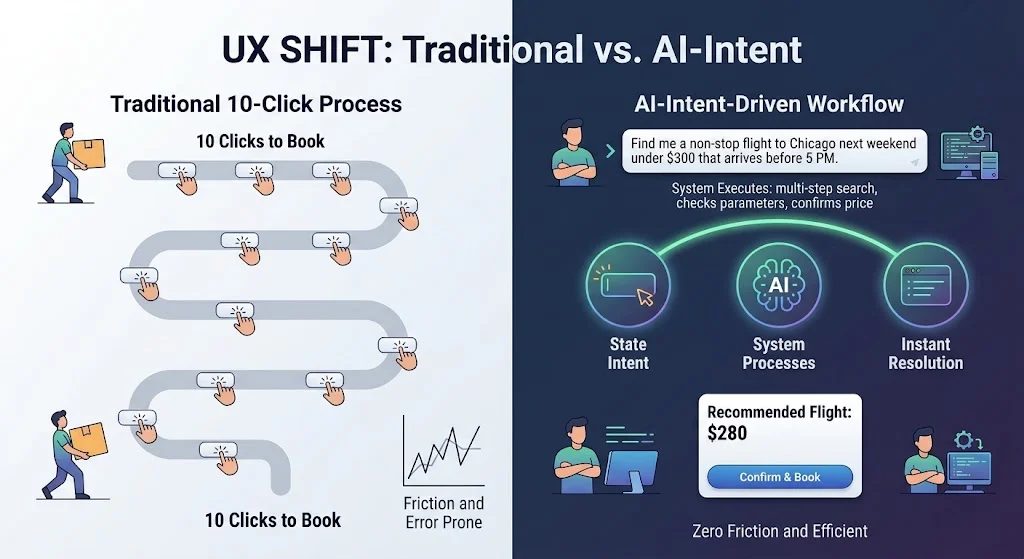
For decades, digital software has relied on a fundamental contract: if a user wants to achieve a goal, they must learn to navigate a labyrinth of user interfaces. Since the commercialization of the Graphical User Interface (GUI) pioneered by systems like the Xerox Star and popularized by the original Apple Macintosh, computer interaction has been defined by point-and-click mechanics.
If a consumer wanted to book a trip, purchase footwear, or research a health symptom, they were expected to manually orchestrate the process. This meant clicking through complex navigation menus, adjusting range sliders, filling out multi-step forms, dismissing persistent cookie pop-ups, and opening dozens of browser tabs simply to cross-reference basic information. Over time, digital users became conditioned to spend more energy managing the software than actually achieving their underlying objectives.
Today, that contract is officially expiring. Driven by rapid advancements in artificial intelligence and large language models (LLMs), a new generation of digital products is pioneering a radical philosophy: Intent-Driven Design.

Rather than expecting users to master intricate sales funnels, button layouts, and application hierarchies, these modern web platforms operate by capturing high-level human goals and silently executing the heavy lifting in the background. As the industry grapples with this paradigm shift, designers, developers, and product architects are being forced to ask a provocative question: What happens to digital design when the ultimate goal of web architecture is to eliminate the interface entirely?
Chronology of an Evolution: From the Xerox Star to Ambient Agents
To understand where the web is heading, it is vital to trace the trajectory of human-computer interaction (HCI) over the past half-century.
1. The Point-and-Click Era (1980s–2010s)
The introduction of the GUI in the 1980s revolutionized computing by replacing abstract command-line inputs with visual metaphors—desktops, folders, and icons. While this made computers accessible to the masses, it established a rigid paradigm: the computer acts as a passive container of data, and the human acts as the manual operator. For nearly 40 years, web design iterations focused almost exclusively on making these visual containers prettier, faster, and more engaging, optimizing metrics like click-through rates and time-on-site.
2. The Rise of Mobile and App-Fatigue (2010s–2020s)
The proliferation of smartphones supercharged the point-and-click model, turning it into a tap-and-swipe reality. However, as digital services expanded, app fatigue set in. Consumers grew exhausted by the sheer volume of notifications, repetitive form-fills, and fragmented workflows required to complete simple tasks across disparate platforms. This friction inspired counter-movements, most notably Golden Krishna’s 2015 manifesto, The Best Interface Is No Interface, which argued that glowing rectangles and flashy buttons were often symptomatic of poor design rather than innovative solutions.
3. The Generative AI Turning Point (2023–Present)
The public maturation of large language models and autonomous agent architectures marked an inflection point. Software transitioned from static containers requiring manual orchestration to dynamic assistants capable of natural language comprehension. Platforms began interpreting intent rather than waiting for discrete button presses. Today in 2026, this shift has moved from a theoretical novelty to a mainstream expectation, fundamentally rewriting how users interact with the browser.
Supporting Data and Real-World Platforms
This transformation is not a distant prediction; it is actively reshaping the digital landscape through accessible web tools that replace traditional workflows with intent-capturing systems.
1. Perplexity AI: Search Without Open Tabs
Traditional search engines like Google were originally built as digital directories. Users typed in isolated keywords, and the interface rewarded them with a list of blue links. The cognitive labor of opening five different tabs, skimming long-form articles, dodging advertisements, and manually synthesizing an answer was entirely the user’s responsibility.
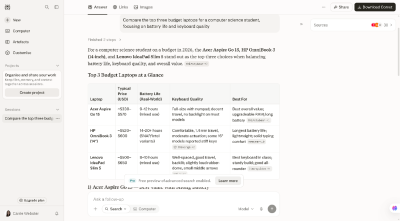
Platforms like Perplexity AI bypass this friction. By allowing users to express complex, multi-layered queries in natural language, the interface instantly synthesizes context-aware answers, presenting structured comparisons (such as side-by-side specs for budget laptops) without forcing the user to navigate away or sort through traditional link-and-tab mazes.
2. Vercel v0: Web Design Without Dragging and Dropping
For years, digital creation required visual builders, wireframing tools like Figma, or manual coding. Designers spent hours drawing rectangles, mapping out grid systems, selecting hexadecimal color codes, and adjusting CSS padding values.
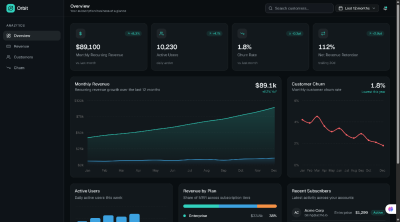
Generative web tools like Vercel v0 allow creators to build functional user interfaces purely through descriptive prompts. By expressing an intent—such as "Create a modern SaaS dashboard with a dark-mode toggle, real-time analytics chart, and a user feedback table"—the platform renders clean, production-ready code components on the fly, transforming abstract ideas into functional interfaces instantly.
3. Goblin.tools: Breaking Down Overwhelming Tasks
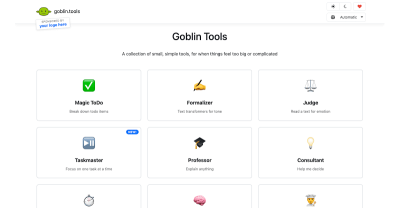
Traditional productivity suites demand heavy administrative overhead: users must manually construct task lists, drag items across Kanban boards, and assign granular micro-deadlines. Tools like Goblin.tools approach productivity from an intent-first perspective. Designed specifically to assist neurodivergent users or anyone facing cognitive overload, the platform takes a single vague input—such as "Plan a job interview"—and autonomously breaks it down into an actionable, step-by-step checklist with zero configuration required.
Official Industry Perspectives and Usability Frameworks
As intent-driven design gains institutional traction, major UX authorities and research groups have updated their evaluation frameworks to address the realities of AI-driven interfaces.
The Nielsen Norman Group on the AI Paradigm
In analytical reports tracking artificial intelligence as a new UX paradigm, the Nielsen Norman Group highlights that computing is shifting definitively from command-based interaction to outcome-specification. Users no longer need to know how a system achieves a result; they only need to declare what outcome they desire. This enables Generative UI, where interface layouts are rendered dynamically based on immediate user context rather than relying on static, one-size-fits-all page templates.
Apple’s Human Interface Guidelines on Contextual & Ambient Design
Apple’s design framework emphasizes that modern systems must read environmental metadata—such as device state, location, and behavioral history—to anticipate needs before a user explicitly asks. This ambient approach reduces cognitive load by letting the interface recede into the background until intervention is genuinely required.
The Google PAIR Guidebook on Transparency
Addressing the risks of automated systems, the Google People + AI Research (PAIR) Guidebook stresses the importance of feedback loops. When an application infers intent rather than executing a direct click, it must explicitly state its interpretation ("Searching for non-stop flights to Chicago under $300…") so users can immediately calibrate trust and correct misinterpretations.
Implications for UX Designers and Product Architecture
The transition from visible interfaces to intent-driven AI experiences forces a profound re-evaluation of the UX profession. For decades, designers have measured success through visual polish, micro-interactions, and engagement metrics like time spent in-app. Intent-driven design inverts these legacy KPIs.
1. Shifting from Static Layouts to Dynamic Orchestration
UX designers can no longer rely solely on designing static buttons, rigid forms, and fixed page templates. Instead, the craft must evolve toward mapping dynamic, generative UI components that adapt on the fly to fluctuating user intent. Designers must become architects of behavior and rules rather than mere painters of screens.
2. Navigating the "Black Box" and the Illusion of Control
Removing interface friction introduces critical ethical and technical challenges. When software acts on inferred intent, users risk feeling a loss of control. To combat this, product designers must establish clear boundaries:
- Automate routine execution, but explicitly prompt users for high-stakes confirmations (such as financial transactions or data privacy changes).
- Prioritize frictionless reversibility over intrusive warning modals. Inspired by Jakob Nielsen’s heuristics on user control, modern systems rely heavily on prominent "Undo" buttons, simple revision prompts ("Make this summary shorter"), and transparent audit logs rather than endless confirmation pop-ups.
Conclusion: The Ultimate Goal is No Design
The philosophy championed by Golden Krishna in The Best Interface Is No Interface, aligned with broader movements like the Center for Humane Technology’s Time Well Sought initiative, fundamentally challenges how the digital economy evaluates software success.
For years, digital products were engineered to maximize engagement volume, keeping users trapped inside complex application loops. The intent-driven era flips this metric entirely. The ultimate test of a modern digital product is no longer how visually captivating its buttons are, but rather: How effectively did this software solve the problem and get out of the user’s way?
As we look toward the future of the web, the measure of great software will not be found in the complexity of its menus, but in its ability to render those complex interfaces completely obsolete through seamless, invisible completion.
 Iffa Jayyana
 Azzam Bilal Chamdy
 Nila Kartika Wati
