
 By Lina Hope
By Hannah Macready
Freelance Digital Marketing Journalist
Executive Summary: The Death of Traditional Lead Gen and the Rise of Intent Intelligence
For decades, enterprise B2B sales and marketing teams have operated on a predictable, albeit friction-heavy, assembly line. Gated whitepapers, cold emails, aggressive outbound phone campaigns, and paid search ads formed the holy trinity of customer acquisition. The core objective of this traditional model was simple: manufacture intent through friction, capturing contact details via web forms before sales could engage.

Today, that playbook is rapidly breaking down. Driven by shifting buyer preferences—where upwards of 73% of B2B buyers now actively prefer a rep-free evaluation process—modern purchasers are conducting extensive independent research out of sight of traditional marketing funnels. They are venting about software limitations on Reddit, asking for peer recommendations in LinkedIn comment threads, and comparing legacy vendor pricing structures on public forums long before filling out a contact form.
To bridge this visibility gap, enterprise organizations are turning en masse to social listening for lead generation. Far more than a passive brand-monitoring safety net, modern social listening leverages advanced artificial intelligence and automated workflows to detect early buying signals in real-time. By transforming unstructured social chatter into prioritized sales opportunities, enterprise teams are moving away from brute-force cold outreach and stepping directly into active customer conversations precisely when intent peaks.

Chronology of a Paradigm Shift: From Brand Monitoring to Real-Time Intent
The maturation of social data did not happen overnight. Understanding how enterprise social listening evolved into a core revenue driver requires tracing its technological and strategic trajectory over the past decade.
Phase 1: The Era of Vanity Metrics and Brand Monitoring (Early 2010s)
In its infancy, social listening was largely synonymous with social monitoring. Enterprise tools were deployed primarily as a defensive shield for PR and customer service teams. Brand managers tracked exact-match brand names, ticker symbols, and campaign hashtags to measure overall sentiment, track share of voice, and stave off potential public relations crises. The insights gathered during this era were retrospective, siloed within marketing departments, and disconnected from the broader revenue engine.
Phase 2: The Shift Toward Competitive Intelligence and Keyword Tracking (Late 2010s)
As social platforms matured into primary communication channels, forward-thinking organizations began expanding their query frameworks. Rather than solely tracking their own names, enterprises started monitoring competitor brands, broad product categories, and recurring industry buzzwords. This allowed marketing teams to understand market positioning and identify feature gaps, though the connection to direct pipeline generation remained loose and difficult to quantify.
Phase 3: The Rise of AI-Powered Intent and CRM Convergence (2020–Present)
The contemporary landscape represents a fundamental leap forward. Fueled by the explosion of unstructured online discussions on professional networks, microblogging sites, and community forums (such as LinkedIn, X, and Reddit), manual social listening became untenable.

Enterprises now rely on sophisticated social operating systems integrated directly with Customer Relationship Management (CRM) platforms like Salesforce. Supported by AI agents—such as Hootsuite’s Lumen and Wisdom, or automated triage tools like Nest—modern listening architectures autonomously scan millions of daily posts. They isolate genuine buying signals, score them based on urgency and authority, and route them to sales professionals in real-time, effectively rewriting the modern B2B buyer’s journey.
Supporting Data & Market Dynamics: Why Budgets Are Shifting
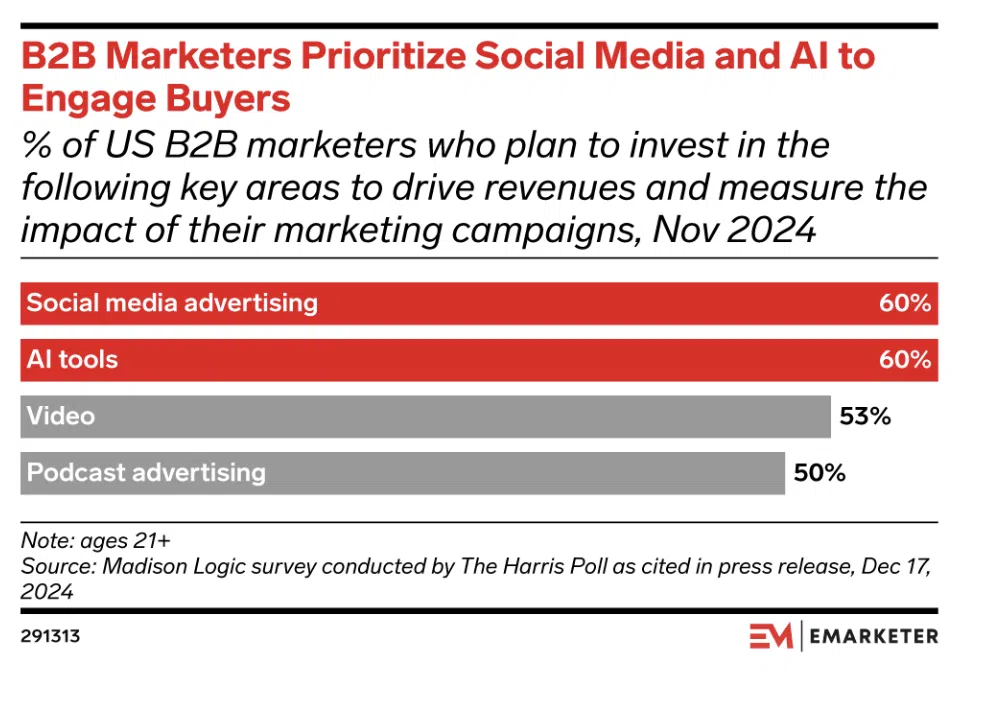
The structural pivot toward social listening is backed by compelling market research and shifting corporate expenditure patterns. According to data from eMarketer, 60% of US B2B marketers planned to increase investments in both social media advertising and AI tools to better engage buyers. This financial commitment reflects a broader acknowledgement by enterprise leadership: social media is no longer just a top-of-funnel brand awareness channel; it is a mission-critical research and discovery environment.
Furthermore, industry analysts highlight the unique advantages of social listening over traditional acquisition models when evaluated across key operational dimensions:
| Method | Signal quality | Speed to lead | Cost efficiency | Scalability |
|---|---|---|---|---|
| Social Listening | High. The buyer states the problem in their own words. | Fast. You can respond the same day. | High. No media spend required. | High with the right tooling, limited if done manually. |
| Cold Outreach & Email | Low. Intent is assumed, not expressed. | Slow. Depends on reply rates. | Moderate. Low cost per contact, low conversion. | High volume, low precision. |
| Paid Social Ads | Moderate. Interest is inferred from targeting. | Fast, but only once budget is live. | Lower. Costs rise as you scale. | High, tied directly to spend. |
| Gated Content & Landing Pages | Moderate to high. A form fill shows some intent. | Slow. The buyer decides when to convert. | Moderate. Content production costs are front-loaded. | Moderate. Depends on traffic. |
As Forrester research underscores, social media has firmly cemented its place as the second most meaningful source of information for B2B buyers—even in the age of generative AI. Organizations deploying structured listening methodologies report significantly higher confidence in measuring social media ROI, proving that qualitative conversations can be successfully converted into quantifiable enterprise pipeline.

Official Perspectives: Industry Leaders on the Art of Intent Listening
To understand how high-performing organizations successfully operationalize social data, industry veterans emphasize that tool adoption alone is insufficient. Success requires a disciplined, human-centric approach to engagement.
Sarah Stephenson on Problem-Centric Listening
Sarah Stephenson, Director of Social Media at TMP, advocates for shifting enterprise focus away from self-referential brand keywords and toward raw, unfiltered consumer friction.

"Brands often focus too heavily on brand keywords, but the real opportunity is in the pain points—the questions, the frustrations, the comparisons, and the ‘how do I…’ moments," Stephenson explains.
According to Stephenson, these vulnerable public discussions offer unmatched audience insight because they occur much earlier in the buying cycle than direct brand interactions. However, she cautions against treating every keyword match as an open invitation for a hard pitch:

"Social listening isn’t a shortcut to leads, it’s more like a shortcut to relevance. The brands that succeed know when to engage, when to add value quietly, and when to simply listen."
Navigating the Human Element in an AI-Driven Era
As artificial intelligence automates the heavy lifting of signal detection and triage, industry experts remind organizations that final human interaction remains paramount. Citing recent Gartner research indicating that 75% of B2B buyers will still prefer human interaction over AI by 2030, enterprise leaders stress that technology must be used to augment—not replace—authentic relationship building.
When a high-intent signal is flagged, the responsibility falls on sales and social care teams to respond with relevant insights, educational resources, or peer perspectives rather than automated sales scripts. Trust must precede conversion.
Methodologies and Best Practices: Building an Enterprise Listening Engine
Establishing an efficient, scalable social listening and lead generation framework requires clear operational choreography. Enterprise teams can implement a robust workflow by following a structured five-step blueprint:

- Define the Ideal Lead Profile (ILP) and Map Signals: Analyze historically closed-won accounts to identify common job titles, industry verticals, company sizes, and specific operational frustrations. Translate those pain points into the colloquial language prospects use online.
- Select High-Signal Platforms: Focus initial listening queries on platforms where target buyers actively research and evaluate solutions in public—predominantly LinkedIn, X, Reddit, and specialized industry forums.
- Configure Advanced Query and Alert Rules: Build comprehensive keyword frameworks encompassing competitor names, category terms, and explicit recommendation queries. Implement negative exclusions to filter out irrelevant chatter, such as job postings or news announcements.
- Establish Tagging and Routing Workflows: Define clear ownership rules across marketing, sales, and customer care. Utilize standardized metadata tags (e.g., product interest, urgency level, competitor frustration) to keep data clean as volume scales.
- Integrate with CRM Infrastructure: Connect social operating systems directly to enterprise CRMs (such as Salesforce). This ensures that social discoveries are instantly logged as tracked opportunities, equipping sales reps with rich contextual history before they initiate contact.
Enterprise Implications and Future Outlook
The integration of social listening into enterprise lead generation represents a permanent maturation of digital sales strategy. As third-party cookies continue to deprecate and traditional outbound channels suffer from diminishing returns, organizations that master intent-based listening will possess a distinct competitive advantage.
By treating social media platforms not merely as broadcast networks, but as vast, real-time focus groups filled with active buyers seeking solutions, enterprises can shorten sales cycles, lower customer acquisition costs, and build authentic trust long before a formal RFP is issued.

Ultimately, social listening proves that the most successful sales strategies do not begin with a pitch—they begin with truly listening to the market.
 Reynand Wu
  Muslim
  Nila Kartika Wati