
 By Raul Delapena Setiawan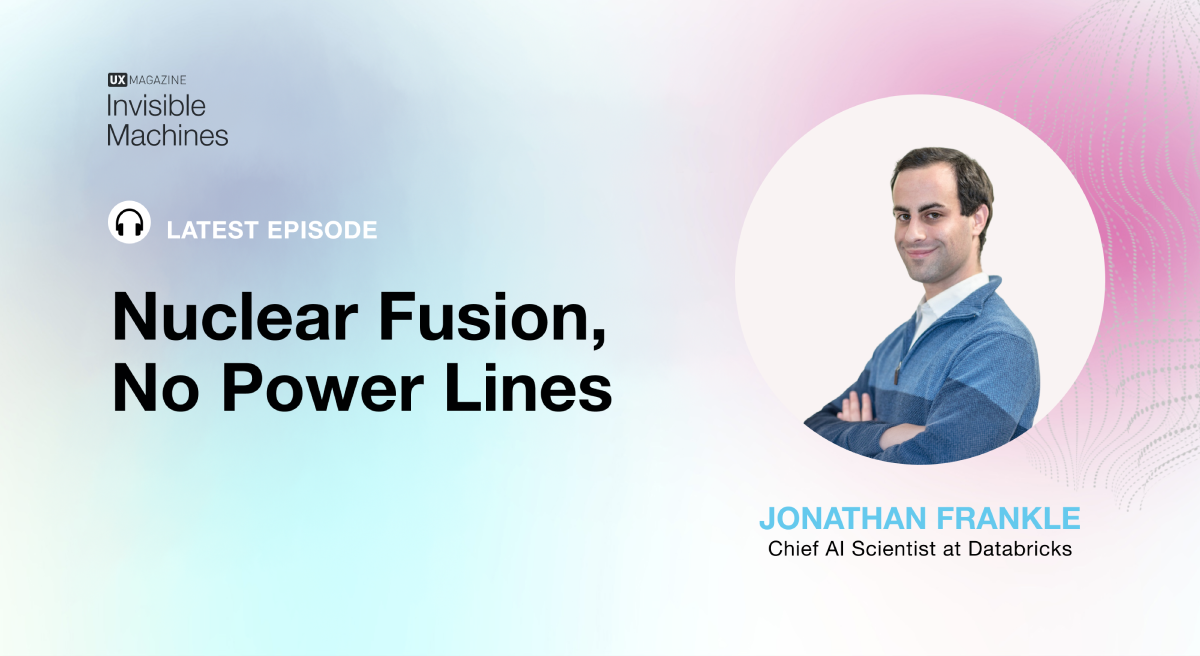
Three years ago, when Jonathan Frankle—then Chief Scientist at MosaicML—appeared on the Invisible Machines podcast, he introduced the world to the "data mixology" concept. He compared the art of training language models to the precision required for baking: you cannot simply dump ingredients into a bowl and hope for a cake. You need a recipe, a process, and a ladder of intermediate testing. At the time, Frankle warned that academic benchmarks like HellaSwag were poor proxies for what real-world users actually demanded from generative AI.
Today, Frankle returns to the conversation as the Chief AI Scientist at Databricks. His message has evolved from a warning about data quality to a sobering diagnosis of the industry’s current state: We have successfully achieved "nuclear fusion" in artificial intelligence—creating raw, transformative power—but we have entirely neglected the "power lines" required to distribute, control, and utilize that energy in a meaningful way.
The Core Thesis: Fusion Without Infrastructure
The central metaphor guiding Frankle’s current outlook is one of electrical engineering. We are currently living in the "Fortran days" of AI. We have created a miracle of raw capability, but we lack the "Java" or "C" equivalent—the robust, standardized programming languages that allow developers to describe intent, edit outputs predictably, and verify system behavior.
The Specification Gap
Frankle argues that the current AI development paradigm suffers from a fundamental design flaw. Most organizations are attempting to build applications on top of Large Language Models (LLMs) without first establishing a clear, human-comprehensible specification of what the system is supposed to do.
"We need to invent the tools that allow practitioners to describe what they want, edit it predictably, and verify that the system did it," Frankle asserts. Currently, the industry relies on "vibe-based" engineering, where developers hope that a well-crafted prompt will yield a consistent result. This is not engineering; it is an exercise in hope.
The Failure of Benchmarks
Frankle is particularly scathing regarding the industry’s reliance on leaderboard benchmarks. He views them as a "cop-out"—a way for researchers to avoid the harder, more tedious work of defining specific requirements. Building an effective evaluation set is not the same as understanding your requirements, and until developers learn to translate intent into testable parameters before they even select a model, the industry will continue to struggle with reliability.
Chronology: From Data Mixology to Enterprise Scale
To understand how we arrived at this "power lines" crisis, we must look at the evolution of AI development over the past 36 months.
- 2021–2022 (The Mixology Era): The focus was on the "Betty Crocker" problem. As Frankle highlighted in his first appearance, the industry realized that data quality was paramount. Training models became an exercise in curating the right "mix" of data, moving away from the "more is better" mentality toward a more scientific approach to training runs.
- 2023 (The Context Window Craze): The industry pivoted toward long-context windows and Retrieval-Augmented Generation (RAG). The prevailing fantasy was that we might never need to fine-tune a model again; if you could stuff enough documents into a million-token context window, the model would simply "know" what you wanted.
- 2024 (The Reality Check): As Frankle notes, the science has not changed, but the scale of the disappointment has. Enterprises are discovering that stuffing documents into a context window is not a panacea. Performance often degrades as retrieval volume increases, bringing in noise, distractors, and irrelevant data. The "garbage-in, garbage-out" lesson from the mixology era remains just as lethal when applied to RAG.
Supporting Data and Technical Realities
The Myth of Infinite Context
The industry’s race toward massive context windows is driven largely by the multimodal nature of modern AI. Video and images are token-heavy, requiring massive context to process. However, the data confirms that model performance is not monotonically increasing with context. As irrelevant information is injected into the model’s working memory, the model struggles to maintain focus on the actual intent of the user.
Prompts as Parameters
One of the most vital shifts in perspective offered by Frankle is the idea that prompt engineering is, in effect, machine learning. When a developer spends hours tweaking a prompt for GPT-4 or Claude, they are effectively training the model. They are optimizing natural-language parameters rather than the underlying neural weights.
This leads to a profound observation: if the "source code" of the future is English, the disciplines of software engineering—unit testing, integration testing, and regression analysis—must be adapted to this new medium. Currently, these disciplines are virtually nonexistent in the AI stack. We are building complex systems without the "blender" even being plugged into a power source.
Official Perspectives: The Enterprise Dilemma
Databricks, under Frankle’s guidance, is observing this struggle across 12,000 enterprise customers. The consensus among these organizations is that while the models are impressive, the "last mile" of implementation remains a chaotic landscape of trillion-parameter uncertainty.
The "SEO" of the Future
Frankle posits that we are entering an era where content creation is no longer just for human readers or search engines; it is for training signals. Every brand, every legal department, and every technical writing team must now treat their internal documentation as the primary training data for their future agents.
The industry is likely to see a "LLM Optimization" cottage industry emerge, mirroring the rise of SEO. Organizations will need to:
- Curate before they ingest: Dumping decades of legacy PDFs into a model is a recipe for hallucination at scale.
- Separate Truth from Draft: Organizations must create a clear, programmatic separation between "canonical facts" and "tentative content."
- Implement Faithful Reasoning: We are still far from a world where we can separate "knowledge" (the data) from "reasoning" (the model). Until that split is clean, businesses are effectively operating in a state of high-risk ambiguity.
Implications: Building the Grid
The path forward, according to Frankle, is not necessarily bigger models, but better software engineering. We must move away from the allure of "AGI tomorrow" and toward the practical, unglamorous work of building the infrastructure that connects human intent to machine execution.
The Value of "Pre-PhD" Thinking
Frankle’s own career trajectory serves as a template for this approach. Before he became a superstar of AI research with his "Lottery Ticket Hypothesis" paper, he worked on a report regarding the use of facial recognition by police. That report changed laws. He continues to value that type of real-world impact over academic citation counts.
For the AI community, this is a clarion call. It is time to stop obsessing over leaderboard scores and start focusing on the "blender." What are we building? How does it connect to the user? Can we verify its output before it hits production?
Toward a New Maturity
The "fusion" is already here. The intelligence models currently available are capable of feats that would have seemed like science fiction a decade ago. But as long as we lack the "power lines"—the specification, testing discipline, and composable tools—that intelligence remains a wild, untamed force.
The future of AI will not be won by those who build the biggest model, but by those who build the most reliable grid. Whether the tools of the future look like a new version of Java, or a new graphical interface that forces rigorous specification, the goal remains the same: transforming the raw, volatile power of LLMs into a predictable, useful, and scalable utility.
As the industry matures, the "mixologist" mindset—measure what success looks like, start small, and prioritize testing over hype—will be the defining factor that separates the companies that successfully deploy AI from those that remain lost in the noise of their own data. The power is there. It is time to plug it in.
 Ammar Sabilarrohman
  Neng Nana
  Sagoh
Sagoh 