
 By Raul Delapena Setiawan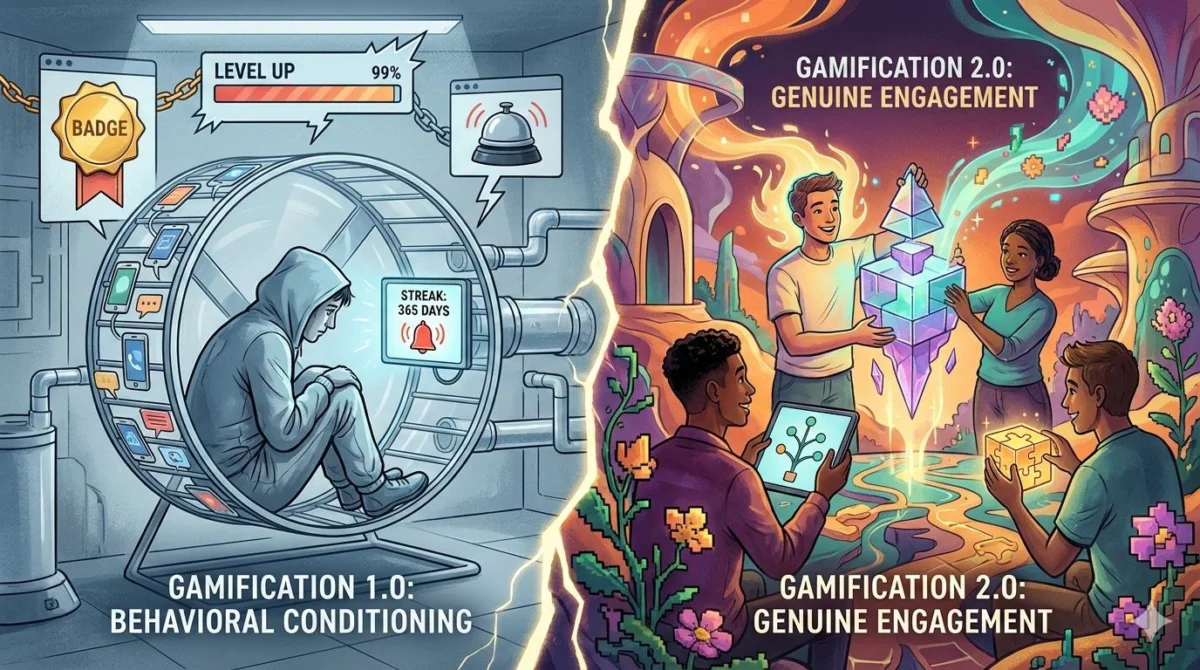
In the digital age, "gamification" has become the industry-standard panacea for the modern product team’s greatest fear: user churn. Walk into any startup boardroom or corporate UX workshop, and you will inevitably find a whiteboard covered in checklists: points, badges, leaderboards, and streaks. It is a formulaic approach to engagement that promises to transform mundane software into addictive experiences.
Yet, there is a glaring, uncomfortable truth that few in the industry are willing to admit: the vast majority of these "gamified" apps are experiences that no actual gamer would tolerate for more than five minutes. From the guilt-tripping notifications of language-learning apps to the hollow, data-harvesting "All-Star" status prompts on professional networking platforms, we are witnessing the rise of a "gamification cargo cult." Much like the island tribes who built bamboo radio towers in hopes of summoning planes, tech companies are building the shells of engagement—points and digital trophies—without understanding the mechanics of flight.
The Anatomy of the Cargo Cult
The term "cargo cult" refers to a phenomenon where followers perform the rituals of a successful culture in the belief that those actions will produce the same outcome, without understanding the underlying mechanisms. In the tech world, this manifests as product managers and UX designers implementing "gamification" because they read a blog post about it, rather than because they understand the psychology of play.
The tell-tale sign of a cargo cult is a feature set that could be commissioned in a single five-dollar Fiverr gig: “Add points, badges, and a leaderboard to my app.” When the gamification is an afterthought—a skin stretched over a boring product—the results are predictable. Users experience a brief spike in curiosity, followed by "gamification theater," and finally, total abandonment. We see this in the Fitbit that ends up in a junk drawer after the initial novelty of step-counting fades, or the Duolingo streak that begins to feel more like a digital prison sentence than a path to fluency.
Chronology of a Failed Paradigm: From Behaviorism to Burnout
The shift toward "extrinsic" motivation began in earnest during the late 2000s, as companies sought to apply the principles of B.F. Skinner’s behaviorist psychology—the "rat in the box" model—to software design.
- 2010–2014: The Badge Explosion. Companies like Foursquare turned "checking in" into a competitive sport. For a brief window, it worked, but as the novelty evaporated, it became clear that users were chasing meaningless digital stickers rather than engaging with the service’s core utility.
- 2015–2019: The Streak Economy. The industry pivoted toward "retention mechanics." Apps weaponized guilt. If you didn’t log in, you lost your "streak." This created a compliance-based relationship where users performed daily tasks not because they valued the learning or the output, but to avoid the psychological sting of a broken number.
- 2020–Present: The Engagement Trap. We have reached a point where nearly every enterprise SaaS tool and consumer app features some form of "gamified" progress bar or status achievement. However, data suggests that these systems are now actively detrimental to long-term trust, as users increasingly recognize these tactics as manipulative dark patterns.
Supporting Data: The Failure of the Extrinsic Model
The fatal flaw of modern gamification is the assumption that humans are motivated by simple, transactional rewards. Product teams treat their user base as laboratory subjects; they push a button (send a notification), and they expect a pellet (a click-through).
The industry ignores a mounting body of evidence suggesting that extrinsic rewards—rewards external to the task itself—often undermine intrinsic motivation. When you pay a child to draw, they stop drawing for the joy of the art and start drawing for the money. When you remove the money, the drawing stops.
In the software industry, this manifests as "gaming the system." Users click through tutorials without reading them to clear a "100% complete" progress bar. They check in to apps they don’t use just to maintain a streak. They exploit mechanics to gain rewards while actively avoiding the actual value the app is designed to provide. Once the novelty of the reward wears off—and it always does—the user leaves, often with a lingering sense of resentment toward the product.
A Veteran’s Perspective: 39 Years of Designing for Humans
To understand why these systems fail, one must look to the masters of the craft: the game designers who have spent decades building environments where people voluntarily spend thousands of hours.
True game design is not about points or badges; it is about human agency, mastery, and belonging. Consider Elden Ring, a game notorious for its difficulty. Players do not endure its brutal challenges for a badge or a leaderboard spot. They play because the game respects their intelligence, offers a deep sense of progression through mastery, and provides an environment where their actions have tangible, meaningful consequences.
The "gamification experts" of Silicon Valley have never shipped a game. They have never had to solve the problem of how to make a player feel powerful without resorting to cheap, superficial bribes. They have spent their careers studying metrics, not human motivation. As a result, they have built "gamified" systems that are technically functional but spiritually empty.
Official Responses and Industry Shifts
While the corporate world remains tethered to its dashboards of KPIs and retention metrics, there is a quiet, emerging movement toward "Gamification 2.0." This approach shifts the focus from extrinsic rewards to intrinsic satisfaction.
Leading design thinkers are beginning to advocate for a return to "Self-Determination Theory," which posits that humans are motivated by three core needs:
- Autonomy: The desire to be the causal agent of one’s own life.
- Competence: The desire to control outcomes and experience mastery.
- Relatedness: The desire to interact, be connected to, and experience caring for others.
The most successful products of the next decade will be those that facilitate these feelings, rather than those that treat users like Pavlovian dogs. Companies that shift their focus from "How can we trick them into coming back?" to "How can we make their experience more rewarding in a way that aligns with their personal goals?" will be the ones that survive the coming backlash against manipulative design.
The Implications: Moving Toward Gamification 2.0
The implications of the current "cargo cult" approach are severe. Brands are losing the trust of their users. By treating users as metrics to be moved rather than people to be served, companies are effectively commoditizing their own value propositions.
If your app’s primary hook is a leaderboard, you aren’t building a product; you are building a Skinner box. And in a marketplace that is increasingly saturated with digital noise, the products that respect the user’s time and provide genuine, intrinsic value will win.
This is not a dismissal of gamification; it is a call for a rescue mission. Gamification, when designed by those who understand the fundamental mechanics of human joy and progress, can be transformative. It can help people learn, grow, and connect. But to reach that potential, we must stop the performative rituals. We must stop building the bamboo towers and start understanding the physics of flight.
The path forward is clear: we must stop copying mechanics and start studying why people play. We must transition from treating our users as metrics to treating them as players. Only then will we stop the cycle of abandonment and build products that people don’t just "engage with," but truly value.
The era of the cargo cult is ending. The era of intentional, human-centric design must begin.
 Ammar Sabilarrohman
  Neng Nana
  Sagoh
Sagoh 