
 By Ammar Sabilarrohman
In the rapidly evolving landscape of artificial intelligence, a new research project has emerged that challenges the status quo of "bigger is better." Known as GVS5H (Gorilla vs. 5 Humans), this novel approach to software engineering tasks suggests that we may not need massive, monolithic frontier models to achieve peak performance. Instead, by leveraging a technique called "ledger-based zero-shot self-orchestration," researchers have demonstrated that smaller, cost-effective models can coordinate to outperform industry-leading benchmarks.
The Core Concept: Orchestration Over Monoliths
The central premise of GVS5H is simple yet profound: complex coding problems, which are typically solved by a single, massive proprietary model, can be decomposed and solved by a team of smaller, specialized agents. The researchers draw an evocative comparison—much like five humans standing on each other’s shoulders to reach the height of a single, powerful gorilla, multiple smaller AI instances can combine their efforts to match or exceed the capabilities of a single "frontier" model.
This is achieved through a training-free framework where multiple instances of a single model work in concert. These agents share a filesystem, which acts as a "ledger." This ledger stores a evolving project plan, detailed notes, and the current state of the solution. By allowing these agents to communicate and iterate on a shared set of instructions, the system creates a collaborative environment that mimics professional software engineering workflows.
Chronology: From Concept to Benchmark Dominance
The development of the GVS5H framework represents a significant pivot in AI research, moving away from purely increasing parameter counts toward optimizing agentic workflows.
Phase 1: Identifying the Bottleneck
The researchers observed that frontier-level coding performance—the ability of an AI to write, debug, and optimize complex software—was historically gated behind massive, high-cost proprietary models. For businesses and developers, the "cost per task" was becoming a major friction point.
Phase 2: The Invention of the Ledger-Based Scaffold
The team developed a scaffold that allows fresh instances of a model to act as a coordinated team. By assigning specific roles within the orchestration—such as planning, coding, and reviewing—the system ensures that no single model instance is overwhelmed. The use of a persistent filesystem allowed for long-term memory, enabling the agents to avoid the common pitfalls of context-window limitations.
Phase 3: Benchmarking and Validation
To validate the hypothesis, the researchers tested the framework against the 100 most recent "hard" problems from the LiveCodeBench (LCB) dataset. The results were startling. By applying the GVS5H orchestration method, models that were previously considered mid-tier or specialized suddenly displayed "frontier-level" accuracy.
Supporting Data: The Economics of Performance
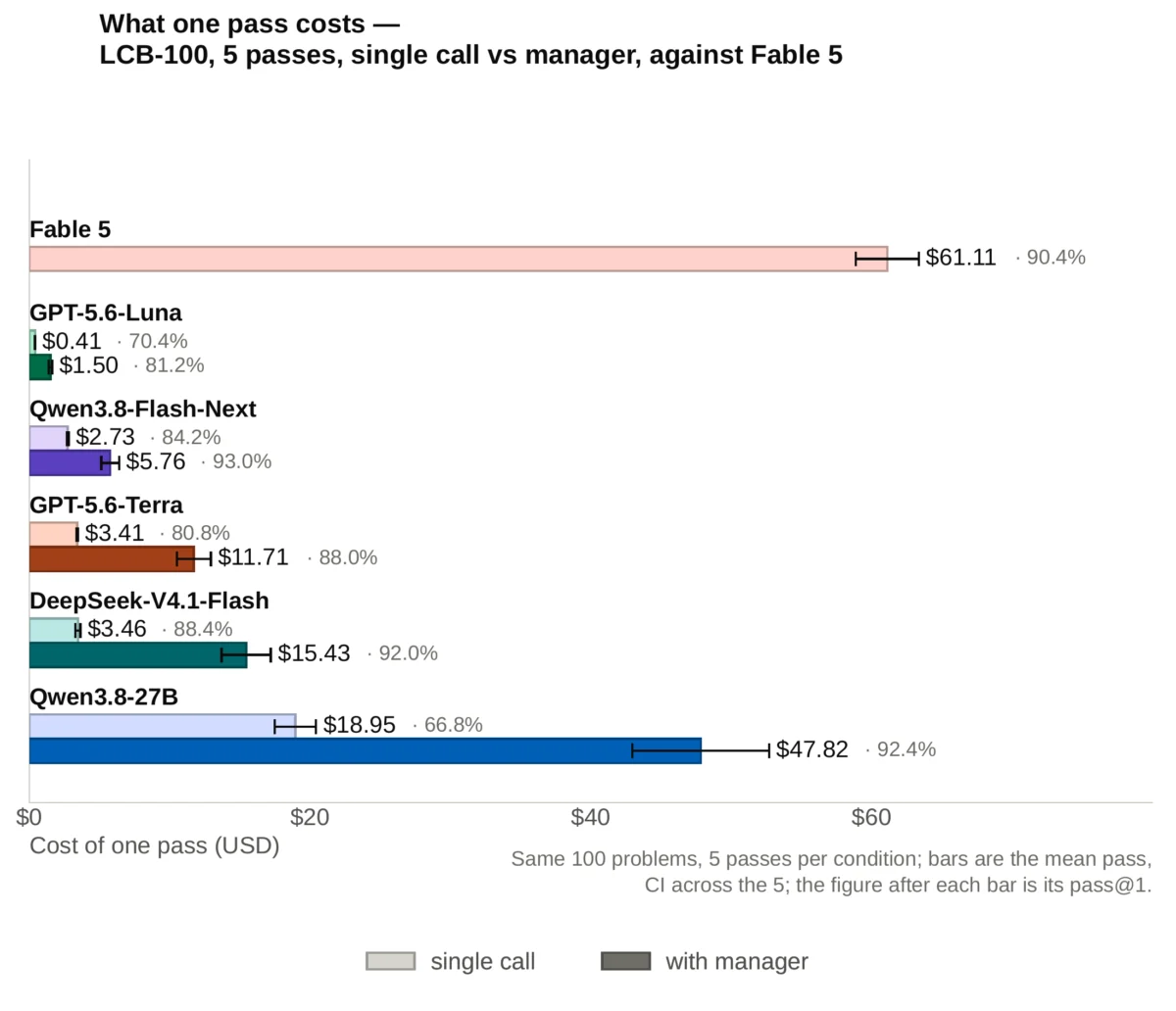
The data provided by the GVS5H project paints a compelling picture of economic efficiency. When evaluating models on the LCB-100 benchmark, the researchers compared "single-call" performance against "manager-orchestrated" performance.

Comparative Metrics
The gains were not merely incremental; they were transformative. For instance, the Qwen3.8 Flash Next model, when orchestrated, achieved a 93.0% pass@1 rate. This performance actually exceeded that of the benchmark model (Fable 5), which reached 90.4%. Perhaps most importantly, this was achieved at just 9% of the cost.
For developers and enterprises concerned with self-hosting or data sovereignty, the results for open-weight models were even more striking. The Qwen3.8-27B model, when deployed locally, saw its pass rate jump from a mediocre 66.8% to a competitive 92.4% using the orchestration scaffold.
The Cost-to-Accuracy Ratio
The researchers utilized log-scale cost analysis to demonstrate that GVS5H allows for a "two-route" strategy:
- The Cost-Efficiency Route: Using cheaper, smaller models to achieve performance parity with expensive frontier models, drastically reducing cloud infrastructure spend.
- The Frontier-Excellence Route: Using slightly more capable open-weight models to actually exceed the performance of the most expensive proprietary models currently available on the market.
Implications for the AI Industry
The GVS5H project has profound implications for how AI software engineering will evolve over the next five years.
The Death of the "Black Box" Frontier Model
For years, the industry has operated under the assumption that the "smartest" model must be the largest model. GVS5H challenges this by proving that process and orchestration are as important as raw parameter size. By democratizing access to high-level coding abilities, this research lowers the barrier to entry for smaller firms to compete with tech giants.
Sustainability and Self-Hosting
As concerns over data privacy and the carbon footprint of training large models grow, the GVS5H framework offers a sustainable alternative. By proving that smaller, locally-run models can perform at elite levels, the research encourages a shift toward decentralized AI infrastructure. Enterprises no longer need to send their proprietary codebases to third-party APIs; they can instead deploy a cluster of orchestrated, open-weight models behind their own firewalls.
The Role of Human Oversight
The framework is not a "magic bullet" that removes the need for human developers. Rather, it transforms the human role from a writer of code to a "manager of agents." The ledger-based system allows humans to inspect the plan and the notes, providing a transparent view into how the AI reached its conclusion. This level of interpretability is a massive step forward for mission-critical software engineering.
Official Responses and Limitations
While the results are overwhelmingly positive, the researchers have been transparent about the limitations. Not every model benefits from the GVS5H scaffold. In their analysis, they noted that some models remained unchanged in their performance, and a minority actually performed worse when forced into an orchestration loop.

This suggests that the effectiveness of the method is partially dependent on the model’s inherent ability to reason through decomposition. Models that are not trained to follow complex, multi-step instructions may struggle to utilize the shared filesystem effectively, leading to "orchestration overhead" that outweighs the benefits of collaboration.
Furthermore, the team acknowledges that the performance gains are highly dependent on the quality of the "manager" prompts used in the orchestration. As the researchers refine their code (available under the MIT License on GitHub), they are looking for community contributions to optimize the prompts and the filesystem handling for a wider array of model architectures.
Future Directions: Where Do We Go From Here?
The GVS5H project has opened a new front in the war for AI efficiency. Future research will likely focus on:
- Dynamic Team Sizes: Can we optimize the number of agents based on the difficulty of the coding problem?
- Cross-Model Orchestration: Could a "manager" model coordinate a team of different, heterogeneous models (e.g., using one model for logic and another for syntax correction)?
- Real-World Integration: Moving beyond competitive coding benchmarks to production-grade repository management.
The release of the GVS5H code, including the escalation benchmarking suite, allows the community to verify these findings and build upon them. By utilizing uv for environment management and providing clear instructions for execution, the researchers have ensured that the GVS5H method is accessible to any developer with an API key or local hardware.

Conclusion
The "Gorilla vs. 5 Humans" paradigm marks a shift in how we perceive intelligence in software development. By proving that orchestration can bridge the gap between mid-tier efficiency and frontier-level performance, the project provides a blueprint for a more cost-effective, transparent, and capable AI future. As the industry moves forward, the focus will likely remain on how we organize these digital "agents" to solve the complex problems of tomorrow, rather than simply building larger, more expensive brains.
The GVS5H methodology stands as a testament to the idea that with the right framework, the collective intelligence of small, nimble systems can outpace the solitary, brute-force strength of monolithic models. In the world of coding, it appears that five humans—or at least, five AI instances—are indeed stronger than one.
For those interested in exploring the framework, the project repository is available for download and audit, with the primary research paper providing a deep dive into the mathematical and empirical basis of the orchestration techniques. The project is licensed under a mix of MIT and CC BY 4.0, ensuring that the findings remain a public good for the research community.
 Sagoh
 Pevita Pearce
 Layla Zulfa
