
 By Siti Muinah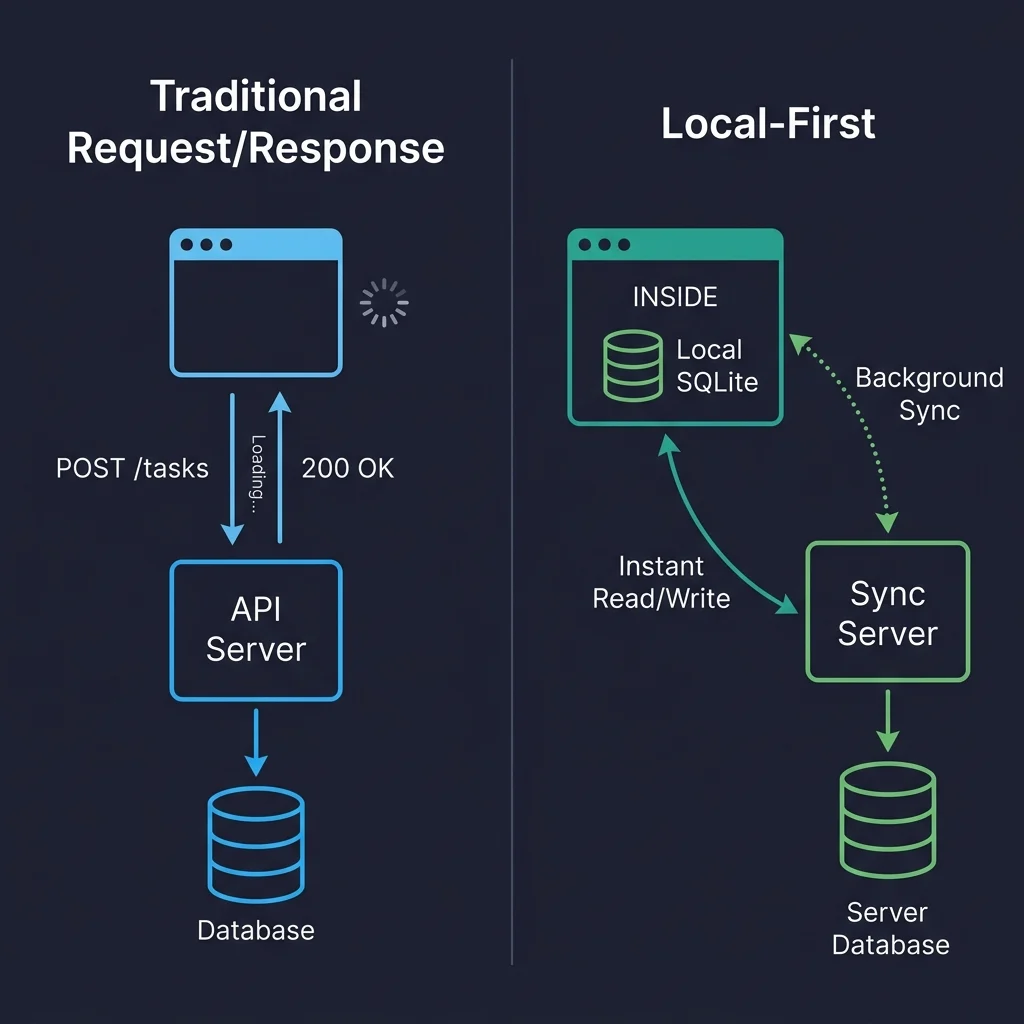
Main Facts: The End of the "Thin Client" Era
By mid-2026, a fundamental shift has occurred in the way high-performance web applications are engineered. For over two decades, the industry operated on a "cloud-first" model, where the client—the browser or mobile app—acted as a thin view requesting permission from a central server to display or modify data. However, the inherent limitations of this model, primarily latency and reliance on stable connectivity, have led to the rise of Local-First Architecture.
Local-first is not merely a rebranding of "offline-first" or Progressive Web Apps (PWAs). It represents a total inversion of data ownership. In this paradigm, the user’s device holds the primary copy of the data. The application reads and writes to a local, high-performance database, rendering changes instantly. Synchronization with a central server or other peer devices happens in the background. The server has transitioned from being a "gatekeeper" to a "sync peer" with specialized authority over authentication and backups.
According to industry lead developers, the shift was driven by "latency embarrassment"—the realization that even with 5G and fiber optics, the round-trip time to a server thousands of miles away remains the primary bottleneck for user experience. Today, the most successful collaborative tools, ranging from project management suites to document editors, have abandoned the traditional REST and GraphQL request-response cycles in favor of local replicas.
Chronology: From Academic Theory to Production Reality
The journey to the local-first standard of 2026 was marked by several critical milestones:
- 2019: The Conceptual Spark. The research lab Ink & Switch published the seminal paper "Local-First Software," outlining seven ideals: fast performance, multi-device support, offline capability, collaboration, longevity, privacy, and user ownership. At the time, the tooling was considered insufficient for mainstream commercial use.
- 2022–2024: The Tooling Explosion. The emergence of high-performance SQLite builds for the browser via WebAssembly (WASM) and the maturation of Conflict-Free Replicated Data Types (CRDTs) like Yjs and Automerge began to bridge the gap between theory and practice.
- 2025: The "Complexity Tipping Point." Developers began to realize that the traditional "optimistic update" logic required for cloud-first apps (managing loading states, spinners, and cache invalidation) was actually more complex and error-prone than maintaining a local database.
- 2026: Maturity and Standardization. As of this year, local-first is no longer a niche research project. Frameworks such as PowerSync, ElectricSQL, and Triplit have reached production stability, allowing teams to deploy local-first features without building sync engines from scratch.
Supporting Data: The Technical Pillars of 2026 Development
The viability of local-first in 2026 rests on three technical pillars: client-side storage, background synchronization, and conflict resolution.
The Storage Revolution: SQLite and OPFS
The era of localStorage and the often-maligned IndexedDB has been largely superseded by SQLite running in the browser. Using WebAssembly, SQLite provides a full relational database with SQL support, transactions, and indexing directly on the client.
This is made performant by the Origin Private File System (OPFS), a high-performance file system API that allows web apps to access a sandboxed storage area with synchronous-like speed. Technical benchmarks show that querying a local SQLite database for 500 records takes approximately 2 milliseconds on modern hardware—a 100x improvement over traditional API-based fetching which typically exceeds 200 milliseconds due to network overhead.
Replicas vs. Requests
In 2026, the dominant mental model is "Git for application data." In a traditional architecture, every interaction is a request. In a local-first architecture, every interaction is a local write to a replica.
| Feature | Traditional Cloud-First | Local-First (2026) |
|---|---|---|
| Primary Data Store | Remote Server (Postgres/NoSQL) | Local Device (SQLite/WASM) |
| UI Latency | Network Dependent (100ms+) | Instantaneous (<5ms) |
| Offline Mode | Limited/Read-only Cache | Fully Functional |
| Sync Strategy | Explicit API Calls | Background Peer-to-Peer/Server Sync |
The Conflict Resolution Landscape
To handle the inevitable reality of concurrent edits, two main strategies have emerged:
- CRDTs (Conflict-Free Replicated Data Types): Ideal for real-time text editing (e.g., Google Docs style). Libraries like Yjs allow characters to be merged mathematically without a central arbiter.
- LWW (Last-Write-Wins) Row Replication: Used for structured data like task lists or CRM entries. This approach, utilized by engines like PowerSync, resolves conflicts at the field level using timestamps and deterministic tie-breakers.
Official Responses: Expert Perspectives on the Shift
Industry veterans have offered a grounded perspective on this architectural transition, warning that while the benefits are immense, the "complexity budget" must be managed.
Sarah Jenkins, Senior Systems Architect:
"We have to be honest about where this belongs. Local-first is a poor fit for server-generated data like analytics dashboards or social media feeds. However, for user-generated data—notes, designs, project plans—it is the only way to respect the user’s time and privacy."
Kevin Aris, Infrastructure Lead:
"The best architecture is the one your team can debug at 2 AM. Local-first adds moving parts: sync engines, client-side migrations, and auth at the sync boundary. It pays for itself in user satisfaction, but only if the team understands that the client is now a node in a distributed system, not just a UI layer."
Expert Sentiment on Security:
Security analysts note that local-first requires a fundamental shift in authorization. Since the client is not a trust boundary, servers must implement "Sync Rules" or "Shapes" to ensure only authorized rows are replicated to specific devices. The server remains the ultimate validator during the "write-back" phase of synchronization.
Implications: Privacy, AI, and the Future of the Web
The adoption of local-first architecture carries broad implications for the next decade of software.

1. The Privacy Dividend
Because data lives on the client, local-first is the natural partner for End-to-End Encryption (E2EE). Apps can now offer "Zero-Knowledge" architectures where the server relays encrypted blobs it cannot read. This is becoming a major product differentiator in an era of increasing data breaches and privacy concerns.
2. AI at the Edge
The 2026 landscape is heavily influenced by the convergence of local-first and Local AI. Small Language Models (SLMs) running in the browser can now process data stored in the local SQLite database without the data ever leaving the device. This allows for personalized, instant AI features that function entirely offline.
3. The Challenge of Fragmentation
Despite the progress, a significant hurdle remains: the lack of standardization. Every sync engine (ElectricSQL, PowerSync, Zero) currently uses its own proprietary protocol. Industry observers worry that this could lead to "sync engine lock-in," where migrating from one provider to another requires a total overhaul of the data layer.
4. Schema Migration Complexity
One of the most significant operational hurdles in 2026 is managing "migrations on a thousand devices." Unlike server-side development where a developer controls the database, local-first requires applications to handle hundreds of different schema versions simultaneously, as users may not update their apps at the same time. The industry has adopted "additive-only" migration patterns to mitigate the risk of data loss during sync.
Conclusion
Building local-first web apps in 2026 is no longer an academic exercise but a competitive necessity for high-quality software. By moving the source of truth to the user’s device, developers have finally broken the "latency wall" that has plagued the web since its inception. While the architectural complexity is higher, the result is software that is faster, more resilient, and more private—a standard that users in 2026 have come to expect as the bare minimum.
 Nana Wu
  Nana
Nana 