
 By Neng Nana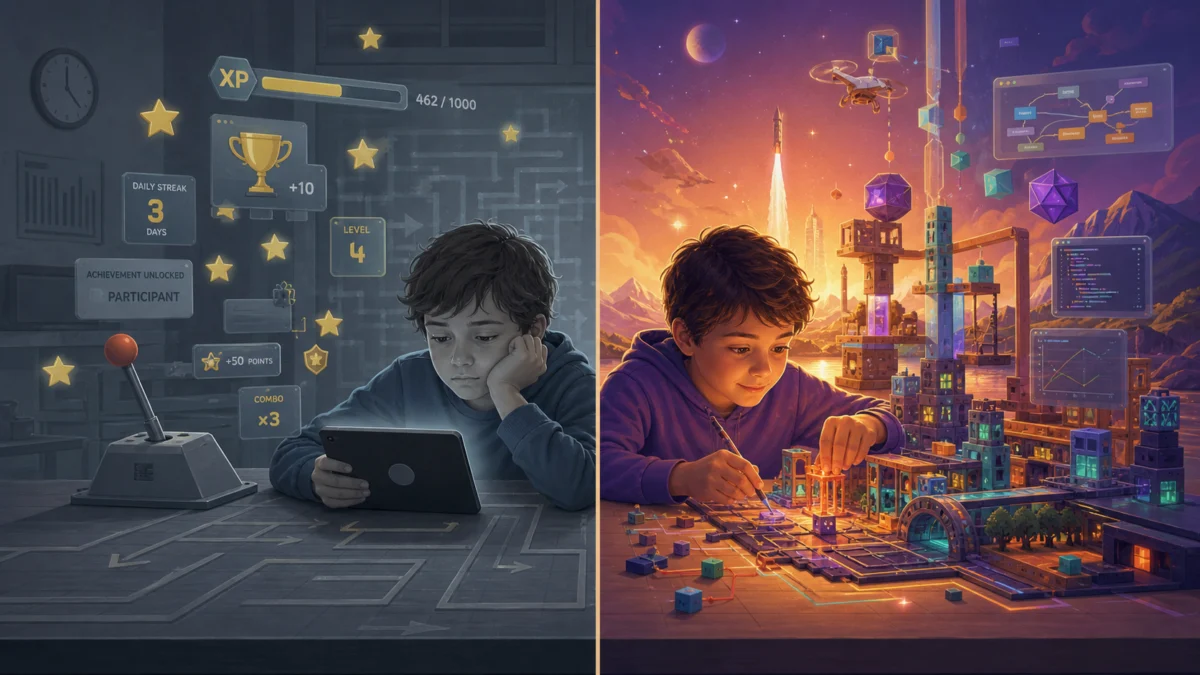
Part 4 of the "Gamification Series"
In the modern digital landscape, the intersection of education and entertainment has become a battleground. As classrooms and corporate training modules increasingly lean into "gamification"—the integration of game-like mechanics into non-game contexts—a glaring disconnect has emerged. While developers often view these additions as engagement boosters, the primary demographic—Gen Z and Gen Alpha—is increasingly signaling that these efforts are not just ineffective, but fundamentally patronizing.
The Core Problem: A Discerning Audience
The central tension lies in a generational gap. Today’s students are not merely casual observers of technology; they are "digital natives" who have spent their formative years navigating the sophisticated, player-centric ecosystems of Roblox, Minecraft, and Fortnite. These platforms offer agency, social infrastructure, and complex mechanics that reward mastery rather than rote completion.
When a twelve-year-old student, accustomed to building intricate redstone contraptions in Minecraft—a process that teaches logic, spatial reasoning, and collaborative problem-solving—is presented with a math app that simply awards a "Gold Star" for clicking the correct button, the result is predictable. They do not perceive a game; they perceive a digital worksheet disguised as a bribe.
"It’s not a game," says one middle-schooler. "It’s just homework with points." This sentiment is not an isolated complaint; it is a widespread indictment of the current EdTech paradigm.
Chronology of a Failed Trend
The history of gamification in education follows a predictable arc:
- The Early 2010s: The rise of "Badges and Leaderboards." Educators and software developers began adopting the mantra that if a task is boring, adding a point system will make it fun.
- The Mid-2010s: The proliferation of Learning Management Systems (LMS) and apps that introduced basic XP (experience point) bars to track student progress.
- The Present Day: A growing fatigue among students. The "Skinner Box" approach—where users perform a task to receive a dopamine-inducing reward—has been identified by users as manipulative. Because these apps lack meaningful progression or narrative depth, users quickly burn out, leading to high abandonment rates and, more importantly, a lack of genuine learning retention.
Supporting Data and the Psychology of Engagement
Psychologically, the failure of traditional "bad" gamification can be traced to Self-Determination Theory (SDT). According to SDT, intrinsic motivation is fueled by three factors: Autonomy, Competence, and Relatedness.
Most educational apps fail all three:
- Lack of Autonomy: The student follows a linear, pre-determined path with no room for experimentation or creative failure.
- Lack of Competence: Points and badges are often distributed regardless of actual skill mastery, making the rewards feel unearned or "cheap."
- Lack of Relatedness: These systems often function in isolation, or worse, use leaderboards to create toxic competition rather than collaborative social connection.
Data from the mobile gaming industry corroborates this. Games that succeed in the long term, like Minecraft Education Edition, allow for open-ended play. In contrast, "gamified" tools that treat students like subjects in a behaviorist experiment see a sharp drop-off in user retention after the initial novelty wears off. The metrics that developers track—such as "daily logins" or "number of badges earned"—are often vanity metrics that do not correlate with actual educational outcomes.
Official Responses and Industry Shifts
Designers and industry leaders are now beginning to acknowledge the "Gamification Wall." In professional circles, there is an ongoing debate regarding the difference between Game-Based Learning and Gamification.
- Game-Based Learning (GBL): This approach integrates the actual core loops and mechanics of gaming into the subject matter. It views the subject as a puzzle or a system to be mastered.
- Surface-Level Gamification: This is the application of "points, badges, and leaderboards" (PBL) to existing, rigid content.
Leading voices in UX design now argue that the latter is a dying model. The consensus is that if an educational tool is boring at its core, adding a layer of cosmetic gamification is akin to "polishing a rock." It does not change the nature of the task; it only makes the artifice more apparent.
Implications for Developers
For software developers, the implications are stark. When your target audience is Gen Z or Gen Alpha, your competition is not other educational tools—it is the best games in the world.
If your app offers a user experience inferior to Roblox, users will naturally gravitate toward the platform that provides genuine agency. The "predatory" nature of mobile games has taught this generation to recognize when they are being manipulated. When they see an arbitrary progress bar, they see an attempt to trick them into performing busywork.
A New Framework for Design
To succeed, developers must shift their strategy from "How do we gamify this?" to "What genre of game does this naturally resemble?"
- Language Learning as an RPG: Instead of just points, provide a sense of progression where the learner builds "power" (vocabulary/fluency) to unlock new regions (real-world scenarios or complex dialogues).
- Math as a Strategy Game: Instead of repeating problems, provide a system where mathematical tools are used to solve complex, systemic challenges.
- Scientific Inquiry as a Sandbox: Similar to the Minecraft model, give students the tools to build and experiment, allowing them to learn through failure and iteration.
The Path Forward: Designing for Players, Not Metrics
The hard truth is that the era of "Points and Badges" is ending. The users of tomorrow are too savvy to be fooled by surface-level manipulation. If you are building a tool for education or productivity, your goal should not be to trick the user into engagement through cheap rewards. Instead, your goal should be to provide a system that is inherently satisfying to engage with.
True gamification is not about adding game elements to a chore; it is about recognizing the "game-like" potential of the content itself. Whether you are teaching history through a narrative-driven simulation or physics through a puzzle-based environment, the principles remain the same: give the user agency, provide a clear path to mastery, and respect their intelligence.
If your gamification wouldn’t satisfy a player who spends their weekends on Portal or Breath of the Wild, it is time to reconsider your design philosophy. Stop treating your users like subjects in a laboratory and start treating them like players in an experience. Anything less will inevitably fail to capture their attention—and their respect.
Up next in the "Gamification" series: "Gamification 2.0: Beyond Points and Badges: Designing for Players, Not Metrics. Chapter 5: Implementation."
 Ammar Sabilarrohman
  Sagoh
Sagoh 