
 By Nana
In the rapidly evolving landscape of digital product design, a groundbreaking study has emerged that challenges the traditional approach to user experience (UX) research. For years, designers and researchers have relied on "general population" (gen pop) testing to identify usability friction. However, new data suggests that by overlooking participants with cognitive disabilities, companies are missing nearly half of the potential improvements to their digital products.
Findings from an exploratory user research study conducted by Fable, a leading accessibility testing platform, in collaboration with the University of California, Irvine, reveal a stark efficiency gap. The study demonstrates that participants with cognitive disabilities—those affecting memory, focus, and learning—identify 1.8 times more usability issues and offer 1.8 times more suggestions for improvement than their "gen pop" counterparts.
Main Facts: The Growing Imperative for Cognitive Inclusion
Cognitive disability is an umbrella term encompassing a wide range of conditions that impact how individuals process information. This includes neurodivergence (such as ADHD, Autism, and Dyslexia) as well as conditions affecting memory and focus.
The scale of this demographic is often underestimated. According to the CDC, cognitive disability is the most prevalent disability in the United States, affecting 13.9% of the population. Furthermore, a recent Yale study indicates these numbers are increasing rapidly. As the global population ages, the prevalence of cognitive decline is set to skyrocket; the U.S. Census Bureau projects that by 2060, one in four Americans will be aged 65 or older.
The Fable/UC Irvine study set out to validate a specific hypothesis: that cognitive testers are not just a "niche" accessibility group, but are actually "power users" of usability, capable of surfacing deep-seated design flaws that remain invisible to others until they cause significant user churn.
Chronology: From Working Group to Comparative Study
The journey toward these findings began in the summer of 2024. Fable’s VP of Innovation, acting as co-chair of an expert working group, initiated a project to standardize accessibility testing for people with cognitive disabilities.
Phase 1: Methodology Development (Summer 2024)
The working group established four primary goals to understand how to effectively engage this audience. They developed a specialized screener to identify participants with challenges in memory, focus, and learning. This phase involved an exhaustive review of published literature to establish best practices for inclusive interviewing.
Phase 2: The Pilot Study
A pilot study involving 25 testers was launched to refine the approach. This resulted in the creation of a "Guide to Cognitive User Interviews" and a specialized survey designed to quantify the digital experience of neurodivergent users.
Phase 3: The Formal Comparative Study (2024-2025)
To validate the hunch that cognitive testers provide superior insights, Fable partnered with researchers at UC Irvine, including Syed Fatiul Huq, Pranav Pidathala, Ali Brown, and Michael Fagan. They designed a controlled experiment comparing 15 cognitive participants with 15 gen pop participants across three distinct website archetypes.
Supporting Data: A Tale of Three Websites
To ensure the findings were not limited to a specific design style, the research team used AI prototyping tools to generate three distinct websites, each with different goals and complexities.

1. Strong Snacks (The Simple Site)
- Design: Brutalist, bright, and image-heavy.
- Task: Browse high-protein recipes and subscribe to a newsletter.
- Findings: Even on this "simple" site, cognitive participants found 3.4 times more issues than the gen pop group. They identified that continuous animations were distracting and that the lack of clear content hierarchy made the site difficult to skim.
2. Turning Pages (The Functional Site)
- Design: Moody and classic with complex filtering.
- Task: Use a "book matching" feature and navigate the checkout process.
- Findings: This site saw the highest volume of issues. Cognitive participants found an average of 17 issues per person, compared to 11 in the gen pop. Crucially, they identified that "Add to Cart" interactions were unpredictable, which directly correlates to lost revenue in an e-commerce setting.
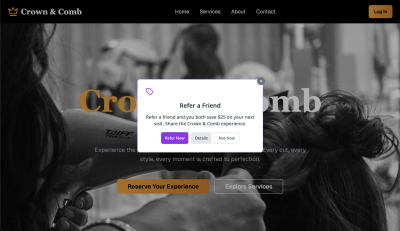
3. Crown & Comb (The Complex Site)
- Design: High-end salon site with membership tiers and booking flows.
- Task: Find a specific "bridal package" hidden within layers of navigation.
- Findings: This site was intentionally designed to be difficult. Interestingly, while cognitive participants found 7 more issues on average, they actually gave the site a higher usability score (AUS) than the gen pop. Researchers suggest this may be because cognitive participants are more accustomed to navigating "broken" digital worlds and were more forgiving of a site that was at least visually clean, whereas gen pop users were quickly frustrated by the complexity.
The Quantifiable Gap
Across all 30 sessions, the data was conclusive:
- Total Issues Identified: Cognitive (197) vs. Gen Pop (113).
- Total Suggestions Made: Cognitive (93) vs. Gen Pop (54).
- Issue Categories: Cognitive participants were significantly more likely to flag issues with content clarity, button affordances (knowing what is clickable), and distracting media.
Official Perspectives: The Psychological Impact of Poor Design
The study didn’t just count bugs; it measured the emotional and cognitive toll of navigating modern websites. The qualitative feedback highlighted a "well-being gap" between the two groups.
A gen pop participant describing a frustrating booking flow on Crown & Comb noted: "It’s really, really frustrating. This feels not particularly engaging."
In contrast, a participant with a cognitive disability described the same experience as a drain on their vital resources: "The mental energy aspect of it… ads, pop-ups, too many options… It makes me feel drained and less able to focus."
This distinction is vital for UX professionals. For a general user, a bad interface is an annoyance; for a user with cognitive accessibility needs, it is a barrier that can end their ability to use the product entirely for the day.

Implications: The "Curb-Cut Effect" for Digital Products
The implications of this research extend far beyond the 13.9% of the population with diagnosed disabilities. The study argues that designing for cognitive accessibility creates a "Curb-Cut Effect"—a phenomenon where changes made for a specific disability group end up benefiting everyone.
1. The Aging "Silver Tsunami"
As the "65 and older" demographic grows to 25% of the population, every company will essentially become a provider for users with age-related cognitive decline. Building for cognitive inclusion today is a form of future-proofing against the inevitable shift in user demographics.
2. Situational Disability
Cognitive load issues don’t just affect the neurodivergent. They affect a parent trying to buy groceries while a toddler screams, a traveler trying to navigate a booking site on four hours of sleep, or an employee under high stress. By reducing the "mental energy" required to use a site, companies improve the experience for every user in every context.
3. Efficiency in Research
The study suggests that cognitive inclusion is a massive efficiency hack for UX teams. As one UX Manager at Bell Media noted: "Two sessions with cognitive users feel like 200 because of the volume of insights we get." By recruiting from this group, researchers can find more bugs with fewer participants, speeding up the development cycle.
4. An On-Ramp to Accessibility
For many companies, full WCAG (Web Content Accessibility Guidelines) compliance feels daunting. Cognitive accessibility offers a "powerful on-ramp." By focusing on clarity, predictability, and reduced cognitive load, teams build a foundation that makes subsequent technical accessibility—such as screen reader compatibility—much easier to implement.
Conclusion: A New Standard for "General" Research
The Fable and UC Irvine study serves as a wake-up call for the tech industry. The traditional "gen pop" user is a myth that ignores the reality of human cognitive diversity.
"Cognitive inclusion in UX research is not optional, and it’s not just about accessibility," the study concludes. "It’s how UX teams can make their research more efficient, create clearer content, simpler flows, and ship better products for everyone."
As digital products become more integrated into every facet of life, the ability to navigate them should not be a test of "mental energy." By listening to those who find the most friction, designers can finally create a digital world that is smooth for all.
 Nana Wu