
 By rifanmuazin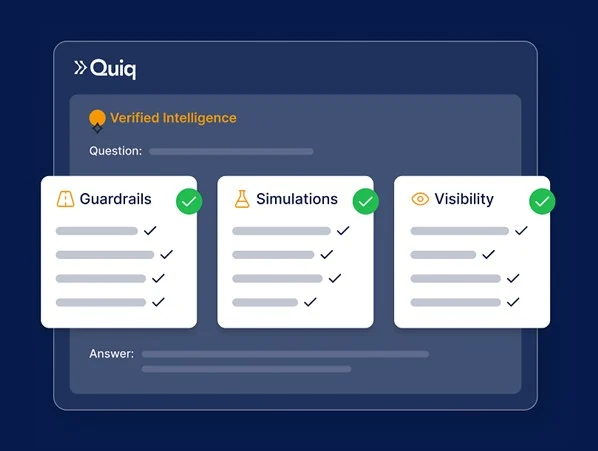
In the rapidly evolving landscape of customer experience (CX), the promise of "agentic AI"—autonomous systems capable of executing complex tasks without human hand-holding—has been tempered by a persistent, gnawing anxiety: the fear of the hallucination. As global enterprises rush to automate their customer service channels, the risk of reputational damage caused by an erratic AI has become the primary bottleneck for widespread adoption.
Today, Quiq, a leader in AI-driven enterprise CX solutions, is attempting to dismantle that bottleneck with the launch of "Verified Intelligence." This new, robust suite of capabilities is designed to bridge the gap between high-velocity automation and enterprise-grade reliability, providing a structural "control layer" that allows brands to deploy autonomous agents with absolute certainty.
The Context: The Dual Challenge of Modern CX
For years, the mandate for customer service leaders has been twofold: innovate at the speed of the market and protect the brand at all costs. Generative AI promised to revolutionize the former by offering human-like, conversational support at scale. However, the inherent unpredictability of Large Language Models (LLMs) created an immediate conflict with the latter.
When a brand’s AI agent makes an unauthorized promise, provides incorrect policy information, or deviates from brand voice, the consequences are immediate and often costly. Until now, many enterprises have been forced into a binary choice: either stick to rigid, rule-based chatbots that frustrate customers, or embrace the "black box" of LLMs and pray for accuracy.
Verified Intelligence is Quiq’s attempt to render that choice obsolete. By integrating a sophisticated framework of guardrails, simulations, and step-by-step visibility, the platform aims to prove that innovation and control are not mutually exclusive.
A Three-Pillar Framework for AI Integrity
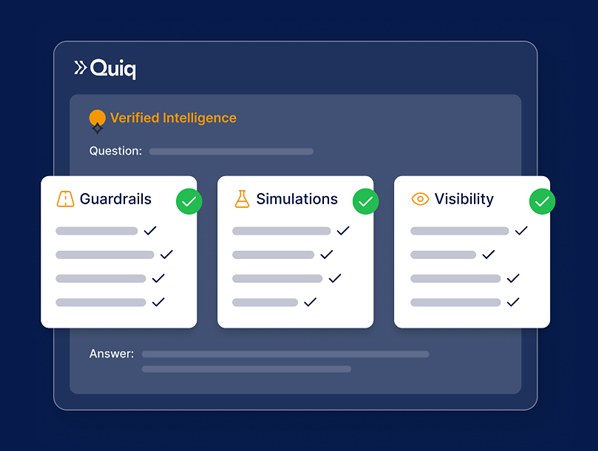
The core of Verified Intelligence rests on a three-part architecture designed to govern AI behavior from the moment of intent to the completion of a task.
1. Advanced Guardrails: Defining the "Edge" of Reason
At the first level, Verified Intelligence implements context-aware guardrails. Unlike traditional keyword-based filters, these guardrails operate on the semantic level. They are designed to monitor the AI’s output in real-time, preventing it from straying into prohibited topics, offering unauthorized discounts, or violating compliance mandates. This ensures that the agent stays within the "sandbox" of acceptable brand behavior, regardless of how complex or unpredictable the customer’s query might be.
2. Multi-Turn Simulations: Stress-Testing Before Deployment
The most innovative aspect of the release is the inclusion of rigorous simulation tools. Before a new AI workflow goes live, brands can now subject their agents to millions of simulated interactions. These simulations test the AI across a wide spectrum of edge cases, from angry customers to convoluted technical support requests. By validating the AI’s logic in a controlled, virtual environment, Quiq allows enterprises to "stress-test" their agents against real-world chaos before they ever interact with a single customer.
3. Step-by-Step Visibility: The Audit Trail
The final pillar is total transparency. In traditional black-box AI, if an agent provides a bad answer, it is often difficult to pinpoint why. Verified Intelligence introduces a "reasoning audit" feature, which tracks the AI’s decision-making process step-by-step. If an agent arrives at a conclusion, it leaves a digital paper trail showing the data it accessed and the logic it applied to reach that answer. This visibility is essential for compliance teams, quality assurance departments, and developers who need to iterate on AI performance.
The CEO’s Perspective: Balancing Action with Accountability
Mike Myer, CEO and Founder of Quiq, has been vocal about the need for this shift in the industry. For Myer, the conversation surrounding AI has been too focused on "creativity" and not enough on "reliability."
"The brands that get AI right are the ones that never had to choose between innovation and control," Myer stated during the product announcement. "Verified Intelligence is how we make sure our customers never have to make that tradeoff. You get agentic AI that acts, and a control layer that makes sure it acts correctly."
Myer’s philosophy reflects a broader realization in the C-suite: the era of "experimental AI" is coming to a close. As companies like Roku, Staples, Accor, and IHG Hotels & Resorts—all current Quiq users—continue to integrate these technologies into their core infrastructure, the demand for "auditable AI" has moved from a "nice-to-have" to a mission-critical requirement.
Chronology: From Chatbots to Agentic Orchestration
To understand the significance of this launch, one must look at the evolution of the Quiq platform over the past several years:
- 2020-2022: The focus was on omnichannel engagement, bringing messaging and SMS into a unified, agent-facing dashboard.
- 2023: The rapid emergence of Generative AI forced a pivot toward LLM-based self-service, allowing brands to deflect volume with conversational AI.
- 2024: The industry hit a "trust plateau." Brands saw the potential for AI to handle complex tasks (agentic AI) but were paralyzed by the risk of hallucinations.
- 2026 (Current): The launch of Verified Intelligence marks the transition from "conversational AI" to "governed autonomous agents."
This trajectory demonstrates that the market has matured. We are no longer impressed by an AI that can simply "chat." We are now demanding an AI that can resolve, account for its actions, and adhere to policy.
Implications for the CX Industry
The release of Verified Intelligence signals a fundamental change in the metrics by which we measure AI success. For years, the North Star metric for CX AI was "Deflection Rate." How many tickets can the bot close? How many humans can we keep off the phone?
However, with the introduction of Verified Intelligence, the industry is signaling that "Deflection" is a hollow victory if the quality of the interaction is compromised. The new metric for success will be "Verified Resolution Rate"—the number of complex, autonomous tasks completed successfully without the need for human intervention or post-interaction correction.
The Competitive Landscape
This shift places Quiq in a strong position against both legacy enterprise software providers and nimble, AI-native startups. Legacy providers often lack the agility to update their AI models to keep pace with rapid LLM advancements, while many startups lack the deep "control layer" features required by massive global enterprises. By focusing on governance, Quiq is effectively moving the goalposts for the entire industry.
Supporting Data and Enterprise Readiness
Verified Intelligence is not merely a theoretical framework; it is an active deployment capability. By supporting brands with massive, high-volume operations—such as the hospitality giant IHG and the retail powerhouse Staples—Quiq has built its architecture to handle high-stakes environments.
In these environments, a 99% accuracy rate is often insufficient. If an AI agent handles 10,000 interactions a day, a 1% error rate means 100 failed interactions, potentially leading to customer churn, legal risk, or brand damage. Verified Intelligence is designed to close that 1% gap, using the three-pillar system to catch potential errors before they reach the consumer.
The Future: Visibility as a Core Requirement
As AI becomes more deeply embedded in the enterprise, "visibility" will likely become the most requested feature from CIOs and CX directors. We are approaching a future where autonomous agents will manage not just customer service, but also logistics, personalized marketing, and real-time financial services.
In this future, "Verified Intelligence" is not just a product name; it is the prerequisite for existence. Without the ability to simulate outcomes and audit decisions, AI will remain a toy for experimentation rather than a workhorse for business.
For Quiq, the path forward is clear: continue to push the boundaries of what AI can do, but ensure that the "leash" of governance is always securely held by the brand. By providing this balance, the company is not just selling a software feature; it is selling the one thing that every enterprise executive is currently chasing: the confidence to let the machine do the work.
Verified Intelligence is available immediately to all Quiq users, marking a significant milestone in the maturation of enterprise AI. As brands begin to layer these tools over their existing deployments, the industry will be watching to see if this "control-first" approach becomes the new standard for the autonomous enterprise.
 Iffa Jayyana
  Raul Delapena Setiawan
  Laily UPN