
 By Dwi Wanna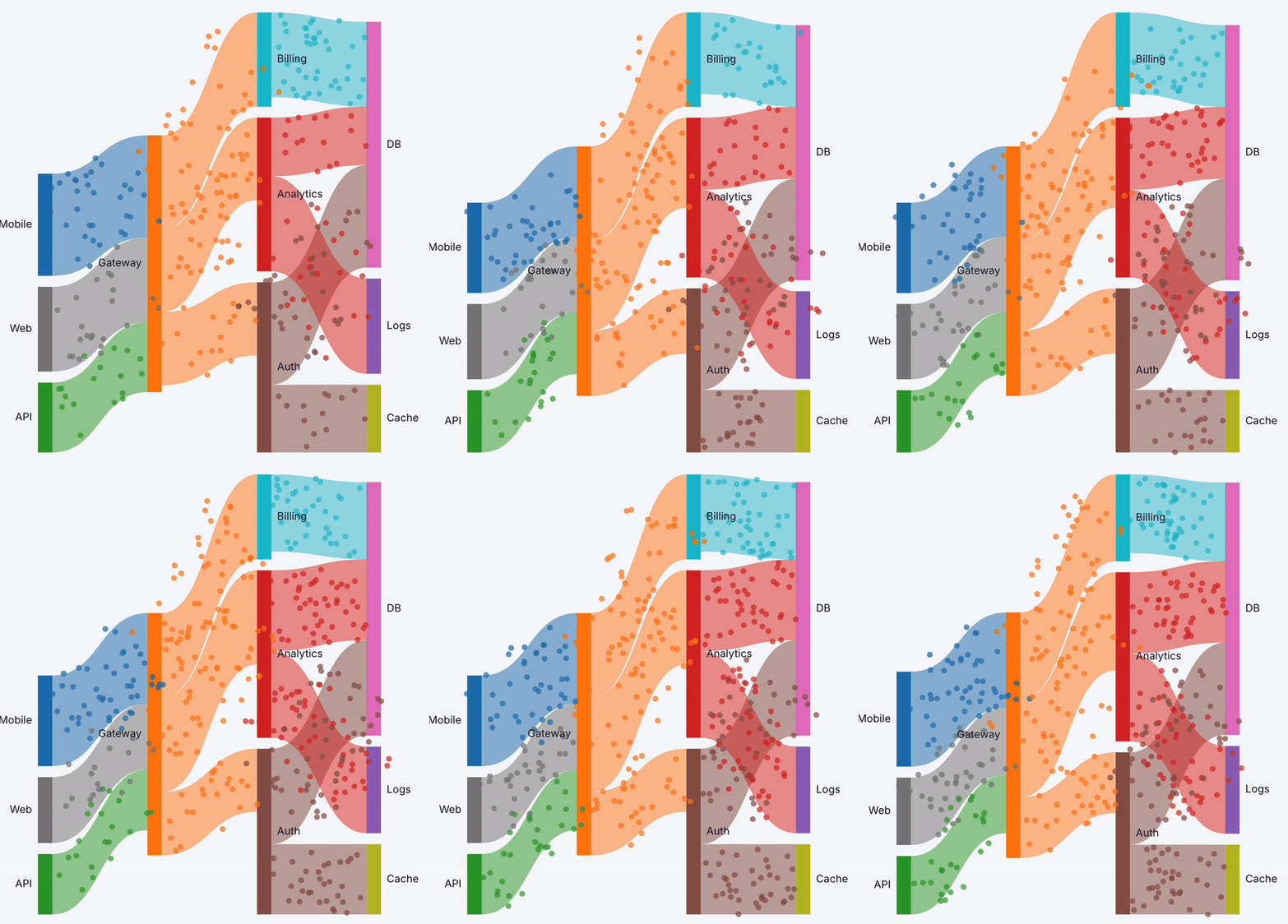
In the rapidly evolving landscape of data visualization, the lifecycle of an open-source project is often brutal. Libraries are born from passion, fueled by contributors, and frequently relegated to the "legacy" pile when their creators move on to new professional challenges. However, Elijah Meeks, a veteran of data visualization and a former Netflix and Apple engineer, is bucking this trend. With the release of Semiotic 3, Meeks has not only resurrected his signature data visualization framework but has fundamentally altered the development methodology behind it, leveraging Artificial Intelligence to overcome the historical bottlenecks of solo-maintainer projects.
The Evolution of Semiotic: From Netflix Origins to Modern Streaming
The journey of Semiotic began as the "Abacus Viz Framework" within Netflix, a internal tool designed to streamline reporting and A/B testing. At the time, it was a collaborative endeavor, drawing on the expertise of engineers like James Womack and designers like Susie Lu. Despite its conceptual success—garnering over 2,000 stars on GitHub—the library struggled to gain widespread adoption.
Meeks reflects candidly on the library’s history, noting that it often felt like a "tech demo" rather than a robust, production-ready ecosystem. Early versions were characterized by a high degree of complexity and an "escape hatch" philosophy that, while empowering for experts, created a steep learning curve for the average developer. Performance issues and a bloated library size further hindered its growth. For years, Semiotic served as a specialized tool for Meeks himself, a personal instrument he favored over the alternatives, yet he knew it required a level of engineering rigor that a single person could rarely sustain.
The "Goldilocks Zone" of AI-Assisted Development
The most significant departure in Semiotic 3 is not just the feature set, but the development process. Meeks admits that he was never a "top-tier" programmer in the traditional sense, often relying on the brilliance of others—such as Mike Bostock, creator of D3.js—to solve complex architectural puzzles.
"AI didn’t replace the best programmers I’ve worked with," Meeks writes. "It replaced the best programmers I couldn’t recruit."
This distinction is critical. In the current discourse surrounding AI in software engineering, the common critique is that AI fails when asked to invent high-level architecture or when it lacks domain context. Meeks successfully avoided this trap by acting as the "architectural lead" while using AI as the "executor." By providing precise, domain-specific instructions—such as demanding a specific diffing algorithm for streaming data—Meeks was able to bypass the trial-and-error cycle that typically plagues AI-assisted coding. He calls this the "Goldilocks Zone": the AI understands the how, provided the creator has a granular, expert-level understanding of the what and the why.
Chronology of Development: From Stagnation to Real-Time
The development of Semiotic 3 can be mapped across three distinct phases:
- The Era of Complexity (2017–2020): During his tenure at Netflix and Noteable, Meeks focused on building a "middle layer" abstraction. The library featured advanced but niche capabilities, such as radial violin plots and force-directed word clouds. While innovative, these features contributed to a lack of focus that made the library difficult to maintain.
- The Latency Period (2021–2023): As Meeks transitioned to his role as a Principal Engineer at Confluent, the library settled into a state of maintenance. He identified clear paths for improvement—specifically regarding real-time data streaming—but lacked the engineering hours to execute on these complex requirements.
- The AI-Powered Renaissance (2024–2025): With the maturation of LLMs (Large Language Models), Meeks identified an opportunity to bridge the gap between his vision and the technical reality. He applied the concept he learned from working with Flink—that streaming data is merely a superset of batch data—and utilized AI to refactor the library into a "realtime-first" entity.
Technical Implications: Why Semiotic 3 Matters
The technical upgrades in Semiotic 3 are extensive. By utilizing AI to optimize data pipelines and craft higher-order components, the library has achieved a level of performance that was previously unattainable for a solo project.
Key Technical Improvements:
- Real-Time Streaming Support: Almost every chart type within the library now supports streaming modes, allowing developers to visualize live data with low latency.
- Server-Side Rendering (SSR): A critical requirement for modern web applications, SSR support ensures that Semiotic 3 can be integrated into high-performance, SEO-friendly environments.
- Test Coverage: Through AI-assisted generation, the library is now thoroughly tested, a significant upgrade from the earlier versions that struggled with maintainability.
- Accessibility for "Vibe Coders": Meeks explicitly designed the new library to be accessible to AI-assisted developers and "vibe coders"—those who use natural language to describe features—positioning Semiotic 3 as a forward-thinking tool in an AI-driven development world.
Implications for the Open-Source Ecosystem
The success of Semiotic 3 serves as a compelling case study for the future of open-source maintenance. Historically, libraries died when the original author experienced burnout or moved on to new projects. By utilizing AI, Meeks has effectively "hired" an army of automated assistants to handle the grunt work of refactoring, testing, and performance optimization.
A New Model for Solo Maintainers
This model suggests that the next generation of open-source projects may be characterized by "Super-Soloists." These are individuals who possess the deep domain knowledge and architectural vision of a senior engineer, but who leverage AI to handle the labor-intensive implementation details. If this model proves sustainable, it could lead to a renaissance of niche, highly specialized libraries that were previously too difficult to maintain without a full team.

Bridging the Gap Between Experts and Users
Meeks’s focus on higher-order components also addresses a long-standing friction point in the data visualization community. By abstracting away the complex D3-based internals and providing more intuitive, modern React-friendly components, he is opening the door for developers who need powerful visualizations but do not wish to spend weeks learning the intricacies of SVG manipulation.
Looking Ahead: The Future of Data Visualization
The release of Semiotic 3 is not just about a library update; it is about a change in philosophy. By embracing real-time streaming and prioritizing the role of AI in the development lifecycle, Meeks is aligning his project with the current trajectory of the data industry. As businesses move toward "streaming-first" data architectures—where data is consumed as it is produced—the tools to visualize that data must evolve accordingly.
Furthermore, the introduction of features like "particle sankeys"—a long-standing passion project of Meeks—demonstrates that while the development process has become more automated, the creative, human-centric soul of the project remains intact.
In conclusion, Semiotic 3 stands as a testament to the fact that when the right human vision is paired with the efficiency of modern AI, the constraints that once limited solo open-source projects can be dismantled. As Meeks continues to drive innovation at Confluent, his work with Semiotic will undoubtedly serve as a blueprint for how developers can navigate the intersection of human creativity and artificial intelligence. Whether one is a seasoned D3 expert or a developer looking for a simpler way to render complex streaming data, Semiotic 3 offers a compelling glimpse into the future of data visualization.
 Lina Irawan
  Nana
Nana  Nila Kartika Wati