
 By Asep Darmawan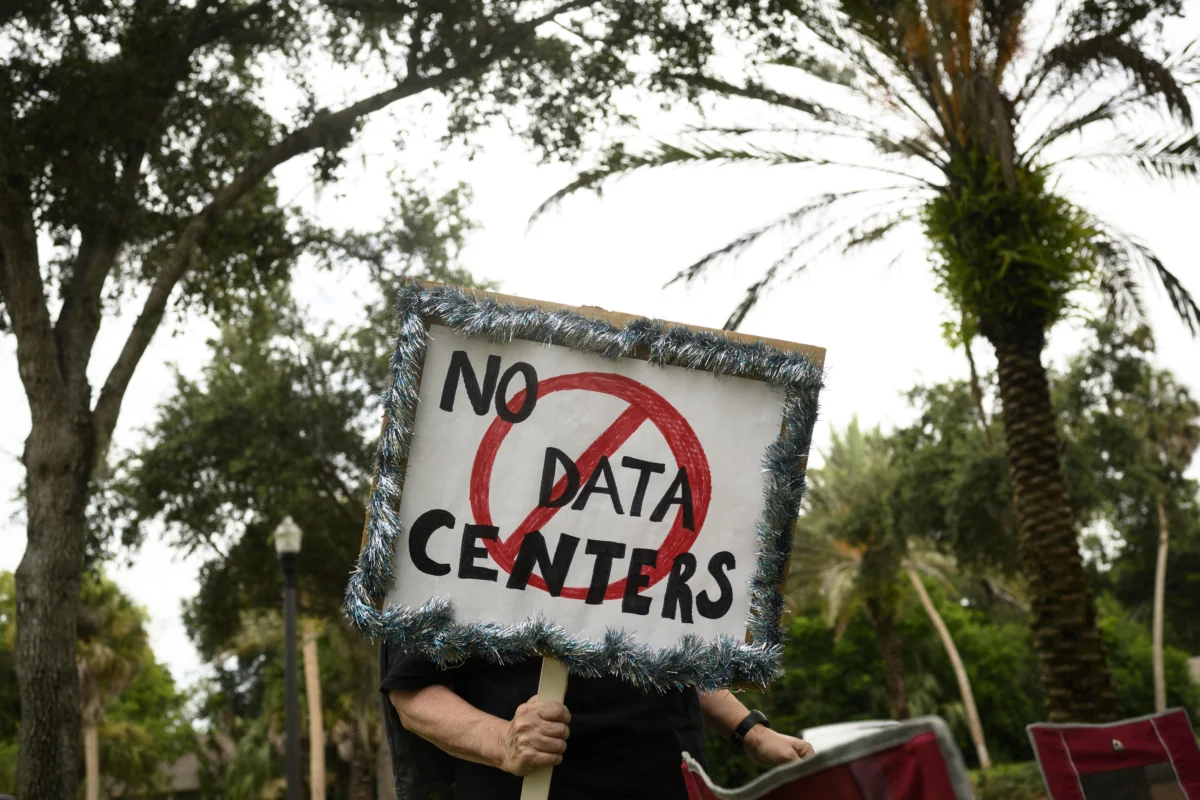
On a sweltering, gray Saturday morning in Hernando County, Florida, a small but determined group of citizens gathered outside the Spring Hill Branch Library. They were not there to protest a library closure or a zoning dispute over a strip mall; they were there to stand against the invisible, humming backbone of the modern digital age: the hyperscale data center.
While the Hernando County commission had already enacted a one-year moratorium on such developments in June, the activists—organized under the banner of "No Data Centers Hernando County"—were far from satisfied. For them, a temporary pause is merely a stay of execution for their community’s landscape. They are demanding an outright ban, a stance that has propelled this quiet Tampa exurb into the center of a rapidly escalating national debate over artificial intelligence, environmental preservation, and corporate overreach.
The Human Face of the Anti-AI Movement
The protest was anchored by volunteers like Carol, a 71-year-old retired country music radio host whose appearance defies the stereotypical image of a political insurgent. Dressed in a T-shirt featuring an American flag composed of sea turtles and a rhinestone-studded visor, Carol embodies the conservative, grassroots frustration simmering across the Sunshine State.
"How would you like to have one by you?" Carol asks, gesturing toward the horizon. "If you live within 15 minutes of a data center, night and day you’re going to hear: EEEEENNNNNNHHHHHHHHHHHH."
For Carol and her peers, the grievances go well beyond noise pollution. They speak of a laundry list of anxieties, ranging from the scientifically debated—such as the impact of electromagnetic frequencies on local honeybee populations—to the visceral and existential. Some residents express deep-seated fears regarding the societal impact of AI adoption, sharing anecdotes of friends who have become socially isolated after relying on AI chatbots for daily decision-making, from wake-up calls to social vetting.
Chronology of a Growing Grassroots Uprising
The Hernando County rally is far from an isolated incident. It is one of nearly 150 protests currently affiliated with "Humans First," a conservative-led movement dedicated to ensuring the future of AI development remains under human control rather than at the whim of Silicon Valley giants.
The movement’s trajectory has been rapid:
- Early 2026: Initial public concern grows as "hyperscale" facilities—defined as occupying at least 10,000 square feet with a minimum energy draw of 100 megawatts—begin appearing in development plans across the U.S.
- June 2026: The Hernando County commission bows to local pressure, enacting a one-year moratorium on data center construction.
- Late June 2026: The trend goes statewide. Over 20 counties and municipalities in Florida begin debating similar freezes. In Citrus County, developers officially withdraw an 800-acre project proposal following intense community outcry.
- July 2026: The political fallout hits the gubernatorial primary. Front-runner Representative Byron Donalds finds himself on the defensive as his pro-development stance alienates his core base.
Supporting Data: A Nation Divided
The resistance to data centers is not merely a local quirk; it is a statistically significant phenomenon. A recent Gallup poll reveals that seven in 10 Americans now oppose the construction of large-scale data centers in their immediate vicinity. Perhaps most striking is the breakdown of this opposition: nearly two-thirds of Republicans and 75 percent of Democrats report objecting to such projects.
This "Silicon Resistance" is creating an unlikely bipartisan alignment. While environmentalists and liberals cite the massive water and electricity consumption of these facilities as a climate catastrophe, conservatives are finding their own reasons to object. These include national security concerns regarding the sourcing of hardware from adversaries like China, and a populist suspicion of "big tech" that transcends traditional party lines.
The Paradox of Political Alliances
The "Humans First" organization, which has provided a structural framework for these protests, is helmed by Amy Kremer. A veteran conservative organizer and co-founder of Women for America First, Kremer’s involvement signals the deepening of a populist turn within the Republican Party.
Despite the high-level political branding, the local reality on the ground in Hernando County remains decidedly practical. At the Saturday rally, a local firefighter running for agricultural commissioner mingled with concerned residents, while a land-use expert provided a tutorial on how to rewrite zoning codes to explicitly exclude hyperscale facilities.
The movement has also seen a fascinating cross-pollination of information. Members of the conservative group were seen referencing investigative reports from More Perfect Union, a progressive media outlet, acknowledging that the research provided was "very informative." It is a rare moment of ideological permeability in an otherwise hyper-polarized American landscape.
Official Responses and the Gubernatorial Tussle
Florida Governor Ron DeSantis has found himself in a precarious position. While he has signed legislation requiring data centers to cover their own utility costs and allowing local governments to regulate water usage, his administration has simultaneously provided millions in tax breaks to data center developers.
This dual approach has backfired with his own constituents. Patti Zirhut, a lead organizer for the Hernando County group, expressed deep betrayal. "He’s been nothing but pro-development, just inviting everybody here, tearing up our state," she says.
The controversy has arguably turned into the defining issue of the gubernatorial race. Representative Byron Donalds, the Republican front-runner, has been a vocal supporter of making Florida the "financial capital of the world," a vision that relies heavily on AI infrastructure. However, his receipt of over $5 million in support from a pro-AI super PAC—funded by figures like Andreessen Horowitz and Joe Lonsdale—has become a potent weapon for his opponents.
Under immense pressure, Donalds recently announced new legislation aimed at preventing data centers from driving up utility costs for residents, a transparent attempt to mitigate the damage. Yet, for voters like Zirhut, it may be too little, too late. "If Byron Donalds wins the primary, I’m voting Democrat," she stated bluntly. "I will not vote for him."
Implications: A New Era of Localism?
The implications of this backlash are profound. The Data Center Coalition, an industry lobbying group, warns that these moratoriums signal that a region is "closed for business." Executive vice president Dan Diorio argues that such policies will stifle economic development and innovation.
However, the protesters are not necessarily "anti-growth." They are "pro-local." They argue that the current model of development relies on state handouts to multinational corporations that have no long-term stake in the community. Their concerns extend to the potential for AI-fueled mass surveillance, citing the installation of automated license plate readers by the Hernando County Sheriff’s Office as a preview of a dystopian future.
Ultimately, the fight over data centers in Florida represents a broader shift in American politics. Voters are increasingly prioritizing their immediate quality of life, environmental integrity, and personal privacy over the abstract promises of "technological progress" or the traditional economic policies of their party leaders.
As these communities continue to organize, they are proving that when the hum of the machine becomes too loud, the voice of the electorate can become deafening. Whether these disparate groups—from Trump-supporting retirees to progressive environmentalists—can sustain this coalition remains to be seen. But for now, the message from the residents of Hernando County is clear: they are not just fighting a building; they are fighting for the right to define the future of their own neighborhoods.
 Raul Delapena Setiawan
  Siti Muinah
  Asro
Asro 