
 By Reynand Wu
By Daniel Oropeza | Updated October 21, 2026
For competitive gamers, simulation enthusiasts, and digital power-users, the holy grail of desktop setups has long been the ultra-wide curved monitor. Offering peripheral-filling immersion that standard multi-monitor configurations simply cannot match, these giant displays are the ultimate statement pieces for high-end battle stations. However, their elite status has always been guarded by a steep barrier to entry: exorbitant pricing.
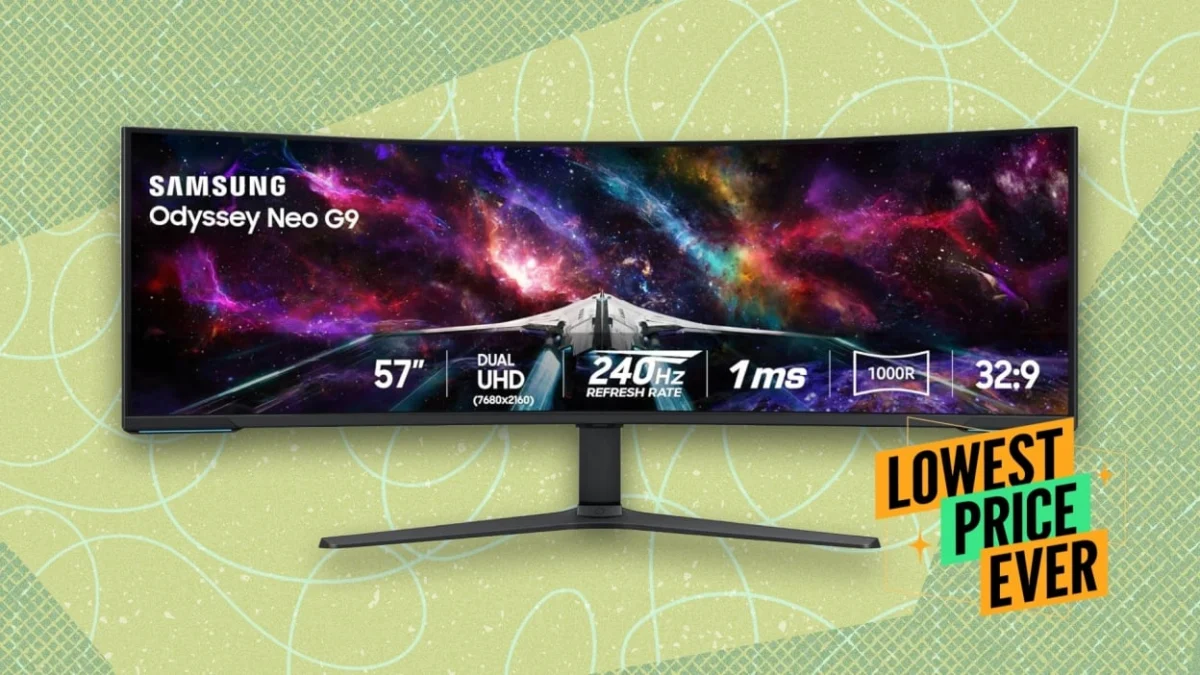
That narrative is shifting once again. The 57-inch Samsung Odyssey Neo G9—widely regarded as one of the most ambitious, feature-packed, and visually arresting ultra-wide monitors ever manufactured—has received a massive price cut. Currently sliding down to $1,499.99, the massive screen is enjoying a dramatic $1,000 discount from its original $2,499.99 launch price. According to retail price-tracking metrics, this represents the second-best discount the monitor has ever seen, making it a compelling, albeit still expensive, prospect for enthusiasts ready to take the plunge into next-generation visual fidelity.
Main Facts: What Makes the Samsung Odyssey Neo G9 a Beast?
Released to critical acclaim in 2023, the Samsung Odyssey Neo G9 is far from your average consumer display. It bridges the gap between massive desktop real estate and high-performance gaming metrics, boasting specifications that easily dwarf standard office or casual gaming monitors.
- Massive Screen Real Estate: Spanning an incredible 57 inches diagonally, the monitor utilizes a dramatic 32:9 aspect ratio, effectively replacing a dual-monitor setup without the annoying bezels cutting down the center of your field of view.
- Dual 4K Resolution: The monitor features a native resolution of 7,680 by 2,160 pixels. This is equivalent to two dual-UHD displays stitched seamlessly together, offering razor-sharp text and breathtakingly crisp asset rendering in supported games and productivity apps.
- High Refresh Rate & Panel Tech: Equipped with a rapid 240Hz refresh rate, the VA panel delivers deep blacks alongside a searing 1,000-nit peak brightness, heavily augmented by Quantum Mini-LED technology for superior local dimming and contrast control.
- Hardware Demands: To push 240Hz at its native 7680×2160 resolution, users must utilize a DisplayPort 2.1 connection paired with a top-tier, modern graphics card. Without DisplayPort 2.1, the refresh rate is typically throttled to 120Hz.
Despite its stellar specs, experts warn that this monitor is not a plug-and-play solution for everyone. Its sheer footprint demands ample desk space, while its hardware requirements mean your PC needs serious horsepower to back it up. For casual gamers or standard productivity users, investing in a smaller, more affordable alternative—such as an Asus gaming monitor currently discounted to $329.99—might make far more financial and practical sense.
Chronology: The Evolution of Ultra-Wide Dominance
To understand the significance of the Odyssey Neo G9’s current discount, it is essential to look back at the trajectory of ultra-wide display technology over the last several years.
The Foundation (Pre-2023)
For years, ultra-wide monitors hovered around the 34-inch to 49-inch sweet spots with resolutions maxing out at standard UWQHD (3,440 x 1,440) or slightly higher. While brands like Samsung, Dell, and LG experimented with curves and higher refresh rates, pixel density at ultra-wide proportions often left text looking slightly stretched or pixelated compared to dedicated 4K displays.
The Titan Arrives (Late 2023)
Samsung shattered industry expectations with the official launch of the 57-inch Odyssey Neo G9 (Model G95NC). Priced aggressively out of the gate at $2,499.99, it was marketed as the world’s first dual-UHD gaming monitor. Early reviews, including a glowing evaluation from PCMag, praised its revolutionary resolution, vibrant color accuracy, and immersive curved architecture, though reviewers universally noted that finding hardware capable of driving the display at maximum settings was a monumental challenge.
Market Maturation and Price Adjustments (2024–2026)
As component manufacturing matured and next-generation GPUs with DisplayPort 2.1 support became more widespread, ultra-high-resolution monitors slowly began to enter promotional cycles. Throughout late 2024 and 2025, minor sales cropped up around major shopping holidays. Now, in October 2026, the current markdown to $1,499.99 marks a historic low tier for the display, bringing it within closer reach of elite enthusiasts who balked at the initial launch MSRP.

Supporting Data & Technical Specifications Breakdown
When evaluating a monitor that costs as much as a high-end used car, looking closely at the technical data sheet is vital. Below is a comprehensive breakdown of what the Samsung Odyssey Neo G9 brings to the table compared to standard high-end alternatives:
| Feature / Specification | Samsung Odyssey Neo G9 (57-inch) | Standard High-End Gaming Monitor (e.g., Asus Alternative) |
|---|---|---|
| Screen Size | 57 inches (Ultra-Wide 32:9) | 27 to 32 inches (Standard 16:9) |
| Native Resolution | 7,680 x 2,160 (Dual UHD) | 2,560 x 1,440 or 3,840 x 2,160 (4K) |
| Refresh Rate | 240Hz | 144Hz – 240Hz+ |
| Panel Type | VA with Quantum Mini-LED | IPS / OLED / VA |
| Peak Brightness | 1,000+ Nits | Varies (often 400–600 Nits) |
| Connectivity | DisplayPort 2.1, HDMI 2.1, USB Hub | DisplayPort 1.4 / HDMI 2.1 |
| Current Sale Price | $1,499.99 (Orig. $2,499.99) | $329.99 (Orig. $499.00) |
The DisplayPort 2.1 Bottleneck
One of the most critical technical nuances highlighted by hardware reviewers is the connection standard. DisplayPort 2.1 is mandatory if a user wants to experience the full 240Hz refresh rate at the monitor’s native Dual-UHD resolution without compression artifacts or chroma subsampling. Older graphics cards equipped strictly with DisplayPort 1.4 will find their output restricted to a 120Hz cap, dampening the competitive edge of the hardware. Consequently, buyers must factor in the cost of a modern GPU (such as top-tier Nvidia or AMD cards) if their current rig lacks the necessary output ports.
Official Responses and Industry Reception
Tech critics, hardware analysts, and consumer advocates have weighed in heavily on the Odyssey Neo G9 since its inception, creating a nuanced consensus regarding its place in the market.
Industry reviewers have consistently lauded Samsung for pushing engineering boundaries. In its comprehensive hardware breakdown, PCMag highlighted the monitor’s stellar color range, expansive viewing angles, and the sheer jaw-dropping effect of its 1000R curvature matching the human field of view. Reviewers noted that flight simulators, racing sims, and sprawling open-world role-playing games are utterly transformed by the sheer scale of the display.
However, consumer-focused tech publications like Lifehacker have consistently added pragmatic caveats to the conversation. Retail analysts emphasize that while a $1,000 discount sounds like an unmissable bargain, spending $1,500 on a monitor remains a luxury investment. Furthermore, community feedback across enthusiast forums (such as Reddit’s r/ultrawidemasterrace) points out practical hurdles:
- Physical Space: The monitor’s base and overall width require deep, sturdy desks and significant wall clearance.
- Heat Output: Due to its massive Mini-LED backlighting array and high brightness levels, the panel can generate noticeable ambient heat during extended gaming sessions.
- Game Support: While most modern AAA titles support ultra-wide resolutions natively, older games, competitive shooters (which sometimes lock aspect ratios to prevent unfair advantages), and cutscenes frequently display black pillar-boxes on the sides, rendering the extra screen real estate dormant.
Implications: Who Should Buy This, and Who Should Pass?
The deep discount on the Samsung Odyssey Neo G9 forces potential buyers to evaluate their specific computing habits, workflow demands, and budget thresholds.
1. The Ideal Candidate: Sim Racers, Content Creators, and Hardcore Enthusiasts
If your daily routine involves professional video editing, multi-window programming workflows, or heavy simulation gaming (such as Microsoft Flight Simulator, iRacing, or Assetto Corsa), this monitor acts as a genuine productivity and immersion multiplier. Having three or four full-sized windows open side-by-side without straining your eyes or alt-tabbing is a game-changer for digital professionals. For these users, grabbing the screen at a $1,000 discount represents exceptional long-term value.
2. The Casual Gamer: Better Off Looking Elsewhere
If you primarily play fast-paced esports titles (like Counter-Strike, Valorant, or Apex Legends), an ultra-wide 32:9 monitor is actually counterproductive. Keeping track of the entire HUD on a 57-inch curved screen requires excessive head movement, which can hurt reaction times. Furthermore, if your PC features mid-range graphics hardware, you will not be able to drive games at 7680×2160 resolution while maintaining high frame rates. For this demographic, traditional 16:9 monitors—such as the discounted Asus alternatives retailing around $329—will yield a far better gaming experience without breaking the bank.
Final Verdict
Samsung’s price adjustment on the Odyssey Neo G9 signals a maturing market for ultra-high-end desktop displays. While it remains a niche product destined primarily for enthusiasts with deep pockets and high-end rigs, the $1,000 saving makes the dream of owning the ultimate battle station display significantly more attainable. Just be sure to measure your desk—and check your graphics card ports—before clicking "Buy."
 rifanmuazin
 Nila Kartika Wati
 Nana
