
 By Ammar Sabilarrohman
SEATTLE — Twenty years ago, the enterprise technology landscape was tethered to physical server racks, cumbersome procurement cycles, and rigid data center provisioning. Companies spent weeks—sometimes months—waiting for hardware to be shipped, racked, and configured just to launch a new web application.
That paradigm changed on a single day in August 2006, when Jeff Barr penned a modest blog post introducing the Amazon Elastic Compute Cloud (EC2) Beta.
What started as a minimalist offering—resizable Linux virtual servers billed by the hour, limited to a single instance type (m1.small) within one AWS Region (US East)—has since evolved into the invisible backbone of the modern internet. Today, Amazon EC2 celebrates its 20th anniversary, standing not just as a pioneer of cloud computing, but as the foundational engine that powers modern enterprise software, hyperscale web applications, and the explosive growth of artificial intelligence.
Main Facts: The Genesis and Scale of a Cloud Titan
To understand the scale of Amazon EC2 today is to understand the transformation of global IT infrastructure. From its humble beginnings with one instance type in a single geographic zone, EC2 has matured into a sprawling, hyper-distributed computing grid.
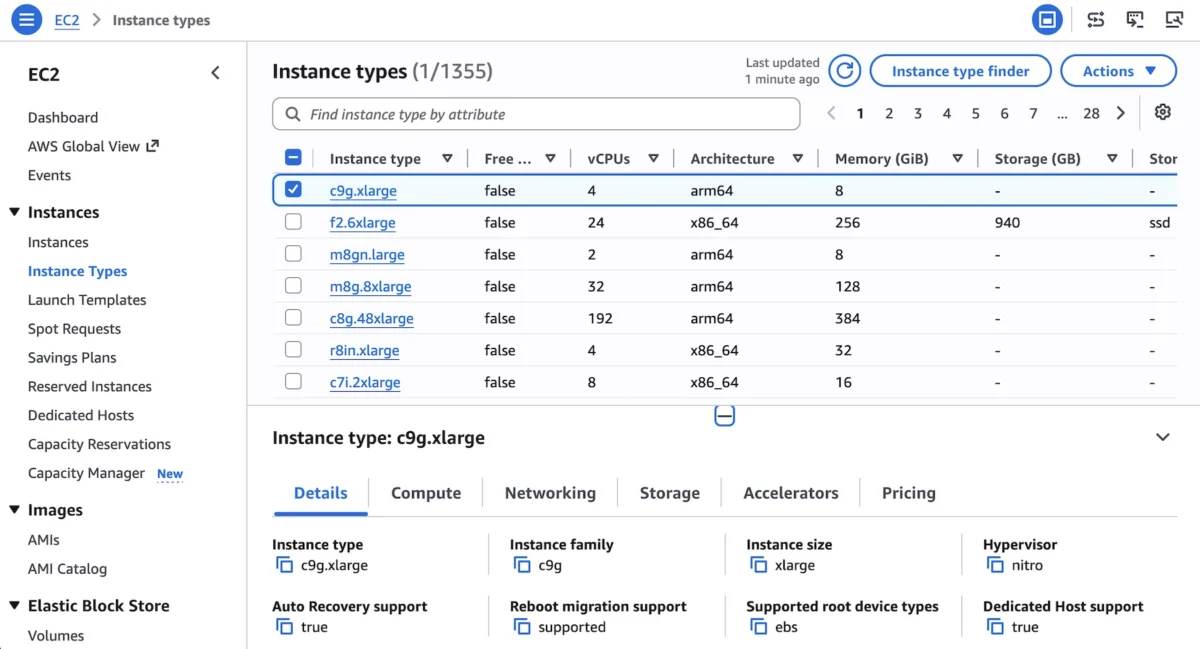
- Explosive Variety: EC2 has grown from a single virtual server configuration to over 1,200 distinct instance types. These are meticulously tailored to meet specialized workloads across general-purpose, compute-optimized, memory-optimized, storage-optimized, accelerated computing, and high-performance computing (HPC) families.
- Global Footprint: What was once confined to US East now spans 39 AWS Regions worldwide. Furthermore, AWS has pushed compute beyond traditional data center walls through hybrid and edge architectures like AWS Outposts, AWS Local Zones, and AWS Wavelength (embedded directly within 5G telecommunication networks).
- Proprietary Silicon: Breaking away from sole reliance on off-the-shelf merchant hardware, AWS has engineered its own advanced silicon families, including the AWS Nitro System (which offloads virtualization tasks for enhanced security and performance) and AWS Graviton processors (designed to deliver superior price-performance for scale-out workloads).
- The Ultimate Foundation: EC2 is not merely a standalone infrastructure service; it is the bedrock upon which nearly the entire AWS ecosystem rests. High-level services—ranging from container orchestrators like Amazon ECS and EKS to serverless platforms like AWS Lambda and Fargate, and enterprise AI frameworks like Amazon SageMaker and Amazon Bedrock—ultimately draw their raw power from underlying EC2 capacity.
Chronology: Milestones That Shaped Two Decades of Cloud
The 20-year trajectory of Amazon EC2 can be mapped through a series of architectural leaps that systematically dismantled the limitations of traditional hardware.
Phase 1: Establishing the Building Blocks (2006–2009)
- August 2006: The launch of the Amazon EC2 Beta by Jeff Barr introduces pay-as-you-go, elastic virtual compute to the world.
- 2008: The introduction of Amazon Elastic Block Store (EBS) solves the critical need for persistent, low-latency block storage attached to EC2 instances.
- 2009: AWS unleashes Elastic Load Balancing (ELB), Auto Scaling, and Amazon CloudWatch, giving developers the tools to build truly fault-tolerant, self-healing, and dynamically scalable applications.
- 2009: Amazon Virtual Private Cloud (VPC) launches, allowing enterprises to provision logically isolated, secure virtual networks within the public cloud—a massive win for corporate adoption.
Phase 2: Performance, Security, and Custom Hardware (2010–2018)
- 2017: The debut of the AWS Nitro System revolutionizes virtualization. By offloading I/O virtualization to dedicated hardware and software, Nitro delivers near-bare-metal performance, enhanced security, and rapid feature innovation.
- 2018: AWS introduces AWS Graviton, its first custom ARM-based processor designed to optimize cost and energy efficiency for scale-out workloads.
- 2018: With AWS Outposts, EC2 steps out of the cloud and into on-premises enterprise data centers, bridging the hybrid cloud divide.
Phase 3: Edge Computing and the AI Revolution (2019–Present)
- 2019: AWS expands its geographic edge via AWS Local Zones (placing compute closer to major population centers) and AWS Wavelength (bringing ultra-low latency compute inside 5G carrier networks).
- 2021–2026: As generative artificial intelligence takes center stage, EC2 adapts to support massive trillion-parameter foundation model training clusters, deploying advanced accelerators and high-throughput networking to meet the voracious demands of modern AI.
Supporting Data: The Economic and Technical Impact
The rise of EC2 did more than alter software architecture; it fundamentally shifted corporate balance sheets from Capital Expenditure (CapEx) models to Operational Expenditure (OpEx) models.
Before EC2, launching a startup required hundreds of thousands of dollars in venture capital dedicated upfront to buying physical servers, renting colocation space, and hiring engineering teams to manage hardware failures. EC2 democratized entrepreneurship. A developer in a dorm room could launch a production-grade server with a credit card in minutes, scale it seamlessly as users flooded in, and scale it back down when traffic subsided, paying strictly for the compute seconds consumed.
Furthermore, the introduction of specialized instance families has driven staggering efficiency gains:

- Graviton Processors: Customers migrating scale-out workloads to ARM-based Graviton instances regularly report up to 40% better price-performance compared to comparable x86 processors.
- Accelerated Computing: By integrating high-end GPUs and custom machine learning accelerators into the EC2 fleet, AWS has democratized access to supercomputing-class hardware, enabling researchers to train complex large language models (LLMs) without purchasing multi-million-dollar supercomputers.
Official Perspectives: Reflections from AWS Leadership
Reflecting on the 20-year milestone, AWS leadership emphasizes that the core philosophy established in 2006 remains completely unchanged.
"We made strong foundational decisions in 2006, and we left room for the service to grow," notes Channy Yun, Senior Developer Advocate at AWS. "Twenty years later, that strategy of creating services that are minimal-yet-useful, launching quickly, and iterating rapidly in response to your feedback continues to guide how we build."
AWS executives point out that while the workloads of 2006—mostly basic LAMP-stack web applications—look quaint compared to the autonomous agents and generative AI models of 2026, the fundamental value proposition has proven timeless. Customers demand secure, resizable compute capacity on demand, without long-term hardware lock-in.
"Every architectural pattern customers have built over the past twenty years, from simple web servers to trillion-parameter foundation model training clusters, starts with a decision to launch an instance," Yun adds.
Implications: The Next Twenty Years of Compute
As Amazon EC2 enters its third decade, the computing landscape faces a new frontier defined by artificial intelligence, edge autonomy, and quantum integration. Yet, the lessons learned from EC2’s 20-year evolution offer a clear roadmap for the future.
- AI as the Default Workload: Just as virtualization became the default paradigm for enterprise software in the 2010s, accelerated computing optimized for artificial intelligence is becoming the baseline requirement for modern infrastructure. EC2’s capacity to dynamically provision heterogeneous hardware (CPUs, GPUs, and custom AI chips) positions it at the center of the AI revolution.
- Ubiquitous Infrastructure: The boundaries of the "cloud" will continue to dissolve. Through Local Zones, Wavelength, and Outposts, EC2 is increasingly running wherever data is generated—whether that is a hospital room, a connected vehicle, a factory floor, or a cellular tower.
- Sustained Simplicity Amid Complexity: Beneath the hood, modern EC2 instances are marvels of hardware-software co-design, managed by sophisticated hypervisors and distributed control planes. Yet, for the end user, the core interaction remains unchanged: a simple API call to provision power.
As the industry looks ahead, one reality remains undisputed: whether powering a hyper-growth SaaS startup or training the world’s most advanced artificial intelligence systems, the modern digital economy still runs on the foundational promise made twenty years ago—the power to compute, instantly and on demand.
 Sagoh
 Siti Muinah
 Reynand Wu
