
 By Azzam Bilal Chamdy
In the evolving landscape of cloud-based accounting, the gap between Xero and FreshBooks has narrowed significantly. Once strictly defined by their core competencies—Xero as a powerhouse for small-to-medium enterprises and FreshBooks as the gold standard for service-based freelancers—these platforms now share a robust suite of overlapping features. From double-entry accounting to sophisticated automation and AI-driven insights, both tools are designed to alleviate the burden of financial management.
However, beneath these shared capabilities, their core philosophies remain distinct. Choosing the right software is no longer just about selecting a brand; it is about aligning your business model with a platform built to support your specific trajectory.
The Core Philosophy: A Tale of Two Architectures
To understand which platform fits your needs, one must look at the "ideal user" profile each company targets.
FreshBooks is fundamentally an invoicing and client-management machine. It excels in environments where the primary focus is the service-client relationship. If your daily workflow involves tracking billable hours, generating custom invoices, or managing recurring retainers, FreshBooks provides an interface that is intuitive, inviting, and remarkably low-friction.
Xero, conversely, acts as a centralized financial operating system. It is engineered for businesses that have moved beyond the "one-person show" phase. It shines in environments characterized by complex inventory management, global sales channels, and multiple currencies. While it demands a higher degree of accounting literacy, it rewards that effort with depth, scalability, and a transparent pricing structure regarding user access.
Chronology of Evolution: How We Got Here
Both platforms have traversed a decade of rapid expansion to reach their current parity.
- Early Days: FreshBooks launched in 2003 with a singular mission: to stop freelancers from using Excel to invoice. It was a disruptor in the simplicity space. Xero, emerging in 2006, took a different approach by building a cloud-native platform based on double-entry bookkeeping, aiming to bring "enterprise-grade" accounting to small businesses.
- The Middle Era: As the platforms matured, they began encroaching on each other’s territory. FreshBooks added double-entry accounting features to cater to users who needed more than just invoicing, while Xero invested heavily in its API ecosystem, allowing third-party developers to create "Best-of-Breed" stacks.
- The Modern Era (2024–2026): We are currently in the age of AI and deep automation. Xero has integrated its JAX AI assistant, which can perform predictive cash-flow modeling and document evaluation. FreshBooks has focused its latest updates on expanding the flexibility of its payment plans and strengthening its integrations with service-based CRM tools.
Supporting Data: Pricing and Total Cost of Ownership
Pricing models between the two represent a fundamental disagreement on how to charge for value.
Xero: The Feature-Based Scaler
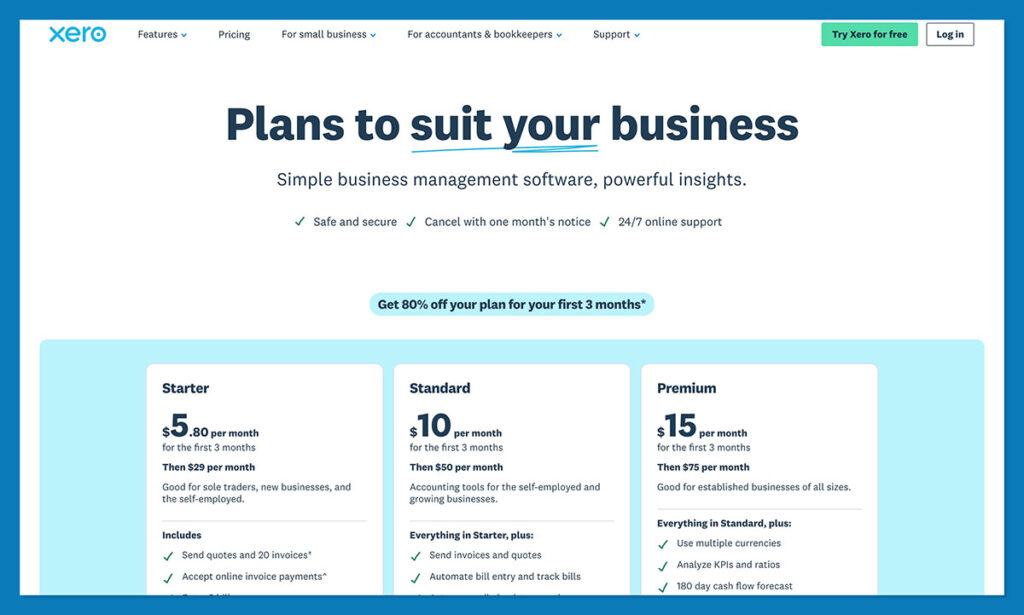
Xero charges based on the depth of features required. Its pricing (as of late 2026) is as follows:
- Early ($25/mo): Limited to 20 invoices and 5 bills. Ideal for solopreneurs.
- Growing ($59/mo): Removes the caps on invoices and bills.
- Established ($97/mo): Adds multi-currency, advanced reporting, and expense management.
The critical "hidden" advantage of Xero is that all plans include unlimited users. Whether you have one employee or twenty, the price remains consistent.
FreshBooks: The User-and-Client Based Model
FreshBooks scales based on the size of your client list:
- Lite ($23/mo): Up to 5 billable clients.
- Plus ($43/mo): Up to 50 billable clients.
- Premium ($70/mo): Unlimited clients.
While FreshBooks may appear cheaper for a single user, it charges per additional team member. For a growing agency with a team of four, FreshBooks quickly becomes the more expensive option compared to Xero’s unlimited-user model.
Feature Comparison: The Technical Divide
Invoicing and Service Billing
FreshBooks remains the undisputed champion for service providers. Its ability to create custom payment plans—allowing clients to pay in up to 12 installments—is a massive advantage for consultants working on high-ticket projects. Its retainer management system is similarly elegant, automatically deducting hours and alerting the user when a retainer is running low.
Xero is highly competent here, allowing for automated reminders and scheduled invoices. Its JAX AI can even assist in drafting professional invoice templates. However, it lacks the specialized "client-facing portal" experience that makes FreshBooks so intuitive for your customers to use.
Inventory and Ecommerce
If you are running an online store, Xero is the superior choice. Its native integration with Shopify is comprehensive, pulling in not just sales, but also fees, taxes, and refunds. Xero’s "Inventory Plus" add-on offers robust tracking of Cost of Goods Sold (COGS), gross profit monitoring, and backorder management.
FreshBooks allows for basic inventory tracking—creating products and assigning income accounts—but it is not built for high-volume retail. If your business involves complex supply chains, Xero is the only viable option of the two.

Multi-Currency and Compliance
For international business, the divergence is clear. Xero’s "Established" plan supports over 160 currencies and allows for foreign currency reporting. It handles tax compliance in various jurisdictions using Avalara rates, making it far more capable for businesses selling across borders.
FreshBooks permits working in multiple currencies, but it lacks the ability to report across them. If you hold foreign bank accounts or need to track currency fluctuations in your balance sheet, FreshBooks will force you to rely on external spreadsheets, whereas Xero keeps it all within the ledger.
Official Perspectives and Industry Implications
When asked about their target demographics, spokespeople from both companies emphasize the user experience (UX) over raw technical specs.
FreshBooks representatives often highlight their human-centric support, noting that the availability of phone support is a lifeline for small business owners who are not "math-inclined." The implication here is that for many, the complexity of an accounting tool is a barrier to entry, and FreshBooks is designed to remove that fear.
Xero’s leadership often points to their ecosystem. By positioning themselves as an "open platform," Xero implies that they don’t need to be the best at every single feature; they just need to be the best at connecting to the apps that are. This has significant implications for businesses planning to scale; the ability to plug in inventory, payroll, and project management tools means Xero can evolve with you, rather than forcing you to switch software as you grow.
Conclusion: Which Should You Choose?
Choose FreshBooks if:
- You are a freelancer or service agency: Your income comes from billable hours or retainers.
- You value simplicity: You want to spend less than an hour a month on bookkeeping.
- You want phone support: You prefer talking to a human when a transaction doesn’t reconcile.
- You have a small team: You don’t need a large finance department, and you want a clean, simple client portal.
Choose Xero if:
- You are a growing product business: You manage inventory, retail, or ecommerce.
- You operate internationally: You deal with multiple currencies and complex tax jurisdictions.
- You have a growing team: You need multiple people to access the books without paying extra user fees.
- You want data insights: You want AI to help you forecast cash flow and benchmark your performance against industry standards.
Ultimately, the best accounting software is the one you will actually use. If the complexity of Xero keeps you from logging in, it’s the wrong tool, regardless of its superior feature set. If the limitations of FreshBooks force you into manual workarounds once your business scales, it’s time to move on. Both platforms represent the best of current financial technology; your choice simply comes down to whether you are managing a service practice or building a scaling enterprise.
 Dwi Wanna
  Lina Irawan
  Basiran