
 By Azzam Bilal Chamdy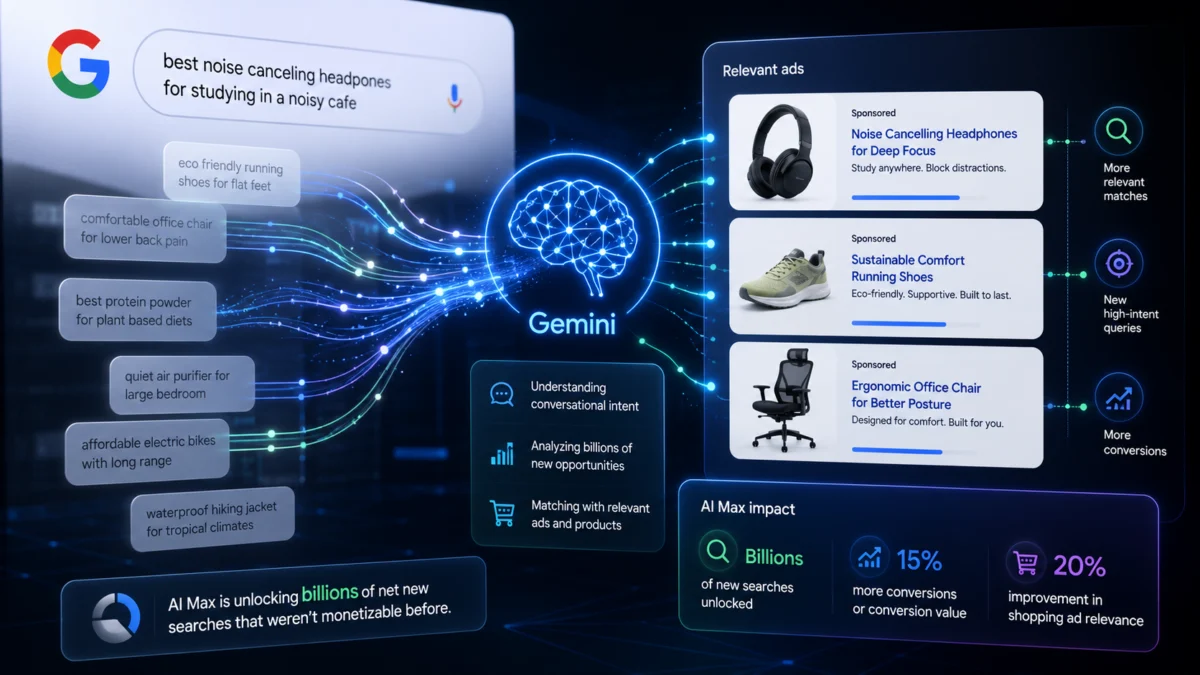
In a move that signals a profound paradigm shift in digital advertising, Google has officially graduated its advanced AI-driven ad campaign system, AI Max, out of beta. Announced during Alphabet’s Q2 2026 earnings call, the technology is designed to unlock "billions" of previously unmonetized, highly complex, and conversational search queries. By leveraging the advanced semantic understanding of Google’s Gemini models, the search giant is charting a clear path toward sustained revenue expansion, moving decisively beyond the constraints of traditional keyword-based targeting.
The announcement marks a critical milestone in Google’s long-term strategy to monetize the evolving search landscape. As search queries become increasingly conversational, natural, and lengthy—driven by the rise of voice search and generative AI search experiences—traditional keyword matching has struggled to keep pace. AI Max represents Google’s definitive answer to this challenge, transforming highly ambiguous user intents into highly relevant, monetizable ad placements.
Main Facts: The AI Max Rollout at a Glance
The transition of AI Max from a restricted beta to general availability brings several key developments to the forefront of the digital advertising industry:
- General Availability: AI Max is officially out of beta and has already been adopted by more than 500,000 advertisers globally.
- Performance Uplift: Advertisers utilizing AI Max alongside Performance Max (PMax) are experiencing an average 15% lift in conversions or conversion value at a comparable Return on Ad Spend (ROAS).
- Gemini-Powered Precision: Integration with Google’s Gemini models has improved the relevance of Shopping ads for complex, multi-layered queries by approximately 20%.
- Intent-Based Matching: The technology shifts the advertising paradigm from matching exact keywords to interpreting user intent, conversational context, and commercial viability.
- The Black Box Trade-Off: While AI Max promises to unlock entirely new streams of high-intent traffic, it offers advertisers less visibility and granular control over exact search query matching.
Chronology: The Evolution from Keywords to AI Max
To understand the significance of the AI Max launch, it is essential to trace the trajectory of Google’s advertising ecosystem over the last several years. The path to AI-driven intent matching has been a gradual process of shifting control from human operators to machine-learning algorithms.
[Early 2010s] Exact/Phrase/Broad Match Keywords
       │
[2021] Launch of Performance Max (PMax) - Channel Consolidation
       │
[2024-2025] Introduction of Gemini & Generative AI Search (SGE / AI Overviews)
       │
[Late 2025] AI Max Beta Testing with Select Advertisers
       │
[Q2 2026] AI Max General Availability & Official Launch (500k+ Advertisers)
The Keyword Era (Early 2000s – 2020)
For over two decades, Google Search Ads operated on a keyword-centric model. Advertisers bid on specific terms (e.g., "running shoes" or "best CRM software") using match types like Exact Match, Phrase Match, and Broad Match. While highly controllable, this model struggled with the "long tail" of search—the 15% of daily searches Google receives that have never been seen before. These queries were often too long, specific, or grammatically complex to match existing keyword lists effectively.
The Rise of Performance Max (2021–2024)
Recognizing the limitations of manual keyword management, Google introduced Performance Max (PMax) in 2021. PMax allowed advertisers to access Google’s entire ad inventory (Search, YouTube, Display, Discover, Gmail, and Maps) from a single campaign, relying heavily on machine learning to optimize bids and placements based on conversion goals. However, PMax still relied on traditional keyword inputs and search themes to guide its targeting.
The Gemini Integration and AI Max Beta (2024–2025)
With the launch of Gemini, Google’s multimodal large language model, the search engine gained a vastly improved capability to comprehend natural language, context, and nuance. In late 2025, Google quietly entered AI Max into beta testing with a select group of enterprise advertisers. This new campaign type was built from the ground up to utilize Gemini’s semantic understanding, specifically targeting long-tail, conversational queries that traditional keyword campaigns could not reach.
Q2 2026: General Availability and Scaling
During the Q2 2026 earnings call, Google executives confirmed that AI Max had officially graduated from beta. With over half a million advertisers already onboarded, the system is now actively processing billions of previously unmonetized queries, establishing itself as the core engine of Google’s next-generation search monetization strategy.
Supporting Data: Quantifying the Impact of AI Max
The financial and operational metrics shared during Alphabet’s Q2 2026 earnings call highlight the rapid adoption and tangible business impact of AI Max.
Advertiser Adoption and Conversion Performance
Google’s data indicates that the transition to AI-first campaigns is delivering immediate performance benefits for early adopters.
| Metric | Performance Impact |
|---|---|
| Total Active Advertisers | 500,000+ |
| Average Conversion/Value Lift | 15% (at comparable ROAS) |
| Shopping Ad Relevance Improvement | 20% on complex queries |
| Incremental Traffic Source | Billions of previously unmonetized long-tail searches |
The 15% lift in conversions is particularly notable because it occurs at a stable Return on Ad Spend. Historically, scaling campaign reach often resulted in a dilution of conversion rates and a drop in ROAS. AI Max bypasses this limitation by finding highly specific, high-intent queries that competitors are not actively bidding on, keeping acquisition costs competitive.
Gemini’s Semantic Relevance Breakthrough
According to Google, the integration of Gemini has resolved a long-standing challenge in retail advertising: matching complex, conversational queries with specific products in a merchant feed. By improving Shopping ad relevance by 20%, Gemini can successfully parse queries such as:
"I need a durable, water-resistant backpack that fits a 16-inch laptop and has a minimalist design for business travel."
Under traditional keyword systems, this query might fail to trigger an ad, or trigger an irrelevant ad for generic backpacks. Gemini analyzes the commercial intent, extracts the specific product attributes (water-resistant, 16-inch laptop compartment, minimalist style, business travel), and matches them against product feed specifications to display the perfect product ad.
Official Responses: Insights from Alphabet Leadership
During the Q2 2026 earnings call, Alphabet’s executive leadership emphasized that AI Max is not merely an incremental campaign feature, but a structural redesign of how search inventory is created and monetized.

Philipp Schindler, Google SVP and Chief Business Officer
Addressing shareholders and analysts, Philipp Schindler explained the strategic necessity of AI Max in an era dominated by conversational AI:
"AI Max is helping us match ads to searches that were historically too complex or ambiguous for traditional keyword targeting. As user behavior shifts toward longer, more conversational queries, we are no longer constrained by exact keyword matching. We are now able to interpret the true commercial intent behind a user’s natural language, opening up billions of previously unmonetized searches to our advertising partners. This is fundamentally expanding our search inventory without compromising the user experience."
Schindler also emphasized that the transition to AI Max is a win-win for both advertisers and consumers:
"For advertisers, this means finding new pockets of high-value demand that were previously invisible. For users, it means seeing highly relevant, helpful ads that directly address their complex, real-world questions."
Implications: What AI Max Means for the Future of Digital Marketing
The broad rollout of AI Max has profound implications for advertisers, search engine optimization (SEO) professionals, and the broader digital marketing landscape. By decoupling search advertising from the keyword, Google is forcing a fundamental rewrite of industry best practices.
1. The Decline of Keyword Control and the Rise of the "Black Box"
For decades, search engine marketing (SEM) was defined by granular keyword control. Marketers spent hours refining negative keyword lists, adjusting match types, and structuring campaigns into tight ad groups.
AI Max accelerates the shift toward automated targeting. Because Google’s AI matches ads based on intent rather than explicit keywords, advertisers have significantly less visibility into the exact search queries driving their traffic.
- The Benefit: Drastically reduced campaign management overhead and access to untapped, low-competition search volume.
- The Risk: A loss of transparency. Advertisers must trust Google’s algorithms to spend their budgets wisely, raising concerns about brand safety and budget waste on tangential queries.
2. The Critical Importance of High-Quality Creative Assets and Product Feeds
In an AI-driven search ecosystem, the primary levers of control for advertisers shift from bidding and keywords to assets and data inputs. To successfully guide AI Max, advertisers must provide the algorithm with rich, high-quality signals:
- Optimized Product Feeds: Merchant Center feeds must be meticulously detailed, containing robust product descriptions, accurate attributes (materials, dimensions, use cases), and high-quality imagery.
- Diverse Creative Assets: Advertisers must supply a wide array of headlines, descriptions, images, and videos. AI Max will dynamically assemble these assets to match the unique context of the user’s conversational search.
- High-Intent Landing Pages: Landing pages must be structurally and textually optimized so Google’s crawlers can easily match the landing page content with the complex queries parsed by Gemini.
[Advertiser Inputs]
  ├── Rich Product Feeds (Attributes, Specs)
  ├── Diverse Creative Assets (Images, Videos, Copy)
  └── High-Intent Landing Pages
            │
            ▼
[AI Max Engine (Gemini)] ──► Interprets Conversational Query ──► Dynamically Assembles & Delivers Highly Relevant Ad
3. Monetization of the AI-First Search Experience
The deployment of AI Max is closely tied to how Google plans to monetize its conversational search interfaces, such as AI Overviews (formerly SGE) and Gemini-powered search modes.
Traditional text ads are poorly suited for conversational search results pages. AI Max provides the technical framework to dynamically inject highly context-aware shopping and text ads directly into AI-generated answers. This ensures that as users migrate from classic blue-link search results to conversational AI interactions, Google’s ad revenue stream remains uninterrupted.
4. A New Era for SEO and Organic Search
The implications of AI Max extend beyond paid search. As Google monetizes "billions" of previously unmonetized long-tail queries, the real estate on the Search Engine Results Page (SERP) for organic listings will likely shrink further.
Queries that once yielded purely organic, informational results will now feature AI Max-powered ads. SEO professionals must adapt by targeting even deeper informational intent, optimizing for conversational voice search, and ensuring their brand’s digital footprint is strong enough to be cited by Gemini within AI-generated search summaries.
Conclusion: The New Frontier of Intent-Based Commerce
The graduation of AI Max from beta represents a defining moment in the history of search advertising. By successfully leveraging Gemini to understand, interpret, and monetize the complex, conversational long-tail of search, Google is proving that its ad business can thrive in the age of artificial intelligence.
For advertisers, the message from Alphabet’s Q2 2026 earnings call is clear: the future of search marketing belongs to those who embrace automation, prioritize high-quality data feeds, and trust AI to bridge the gap between human curiosity and commercial intent. While the loss of keyword-level control will undoubtedly cause friction, the promise of a 15% lift in conversions and access to billions of untapped customers makes the transition to AI Max an inevitability for brands looking to compete in the modern digital economy.
 Jia Lissa
  Nana Muazin
  Layla Zulfa