
 By Basiran
As the global social media management software market surges past a staggering $33.46 billion, digital marketing leaders find themselves under intense pressure to optimize their operations. Compounding this challenge, worldwide social media advertising budgets are projected to skyrocket to $338.75 billion in 2026.

Yet, as enterprise organizations scale their digital footprints, frustration with legacy software pricing and packaging is reaching a boiling point. Chief among these friction points are the structures employed by industry stalwarts like Sprout Social, where per-seat pricing models—starting at $199 per seat per month (billed annually) for Standard and escalating to $299 for Professional—cause operating costs to spiral out of control. Furthermore, critical capabilities like advanced social intelligence are routinely locked behind expensive premium add-ons, leaving expanding teams with noticeable gaps in governance and enterprise oversight.

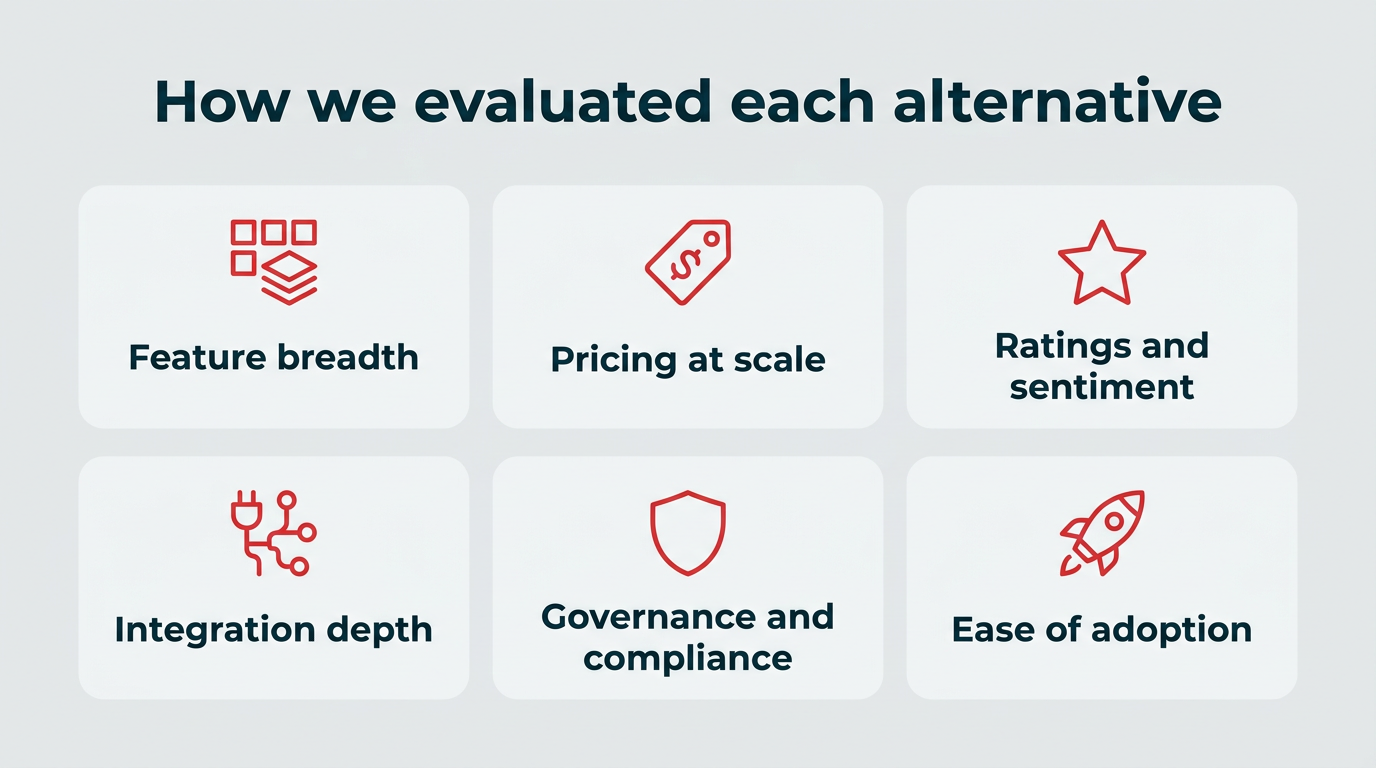
To help marketing executives, agency directors, and solo creators navigate these shifting market dynamics, this comprehensive guide evaluates 12 of the top Sprout Social alternatives for 2026, breaking down pricing, listening depth, governance features, pros, cons, and best-fit use cases.
Main Facts: Why Marketers Are Re-Evaluating Sprout Social
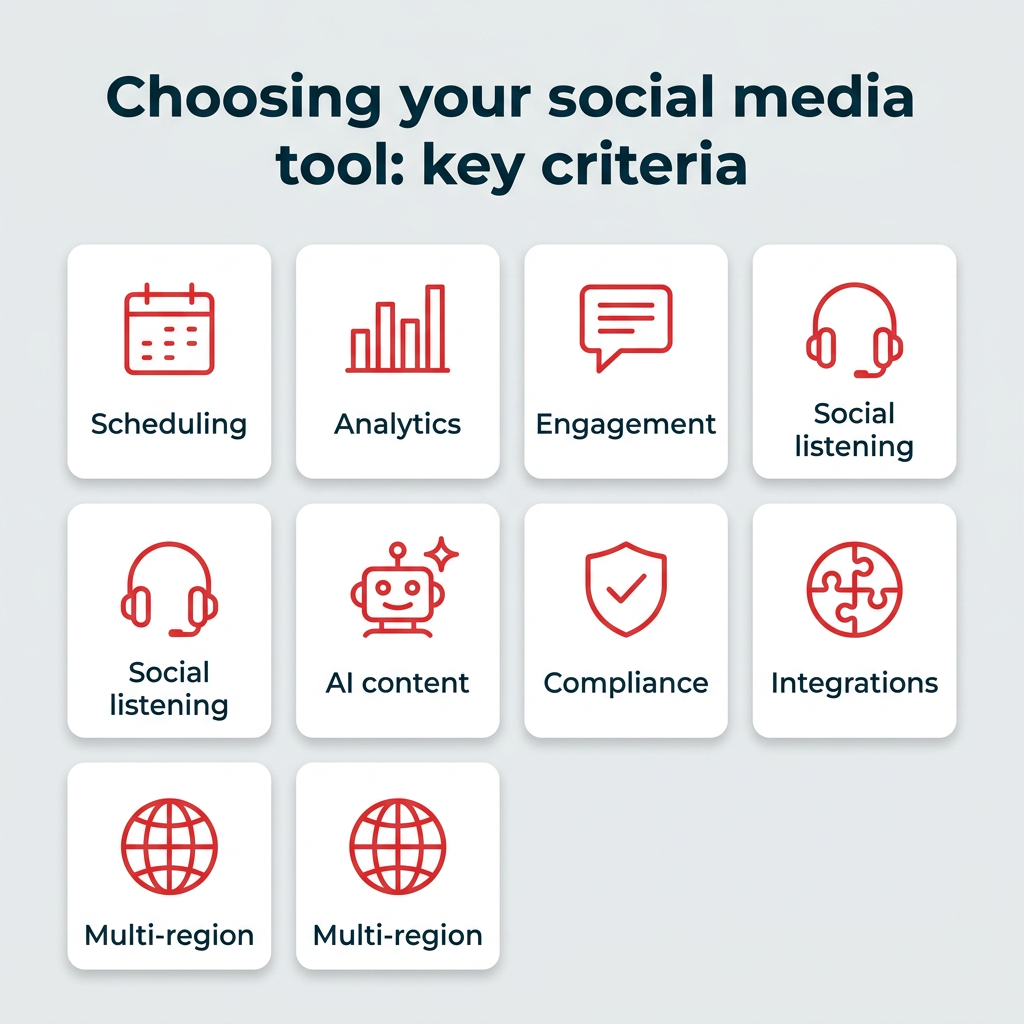
The modern social media ecosystem demands agility, deep analytics, and cross-functional collaboration. However, organizations utilizing Sprout Social frequently cite three core limitations that trigger a market scan for alternatives:
- Escalating Per-Seat Costs: Because pricing is tied strictly to user licenses, adding team members, regional managers, or client stakeholders dramatically inflates monthly software expenditures.
- Gated Social Listening: Organizations often find that comprehensive social listening and consumer insights require purchasing costly platform add-ons rather than being integrated natively into foundational tiers.
- Enterprise Governance Gaps: For heavily regulated industries—such as financial services, healthcare, and multinational retail—robust compliance controls, audit trails, and multi-level approval workflows are non-negotiable. Gaps in these areas often force enterprises to look elsewhere.
Recognizing these pain points, the software market has evolved rapidly. Today’s alternatives range from all-encompassing enterprise operating systems to nimble, budget-friendly tools tailored for creators and small agencies.
Chronology and Evolution of the Social Media Management Market
To understand where the software market stands in 2026, it is helpful to trace its trajectory over the past decade:

- The Scheduling Era (Early 2010s): Tools emerged primarily as basic calendars designed to queue posts across Facebook and Twitter, saving manual labor for social media managers.
- The Unified Inbox Revolution (Mid-to-Late 2010s): As social platforms transformed into primary customer service channels, vendors introduced unified social inboxes, allowing brands to manage customer care and comments alongside publishing workflows.
- The AI and Intelligence Integration (2020–2024): Artificial intelligence shifted from a novelty to a core infrastructure component. Predictive analytics, automated sentiment analysis, and generative content assistants became standard expectations.
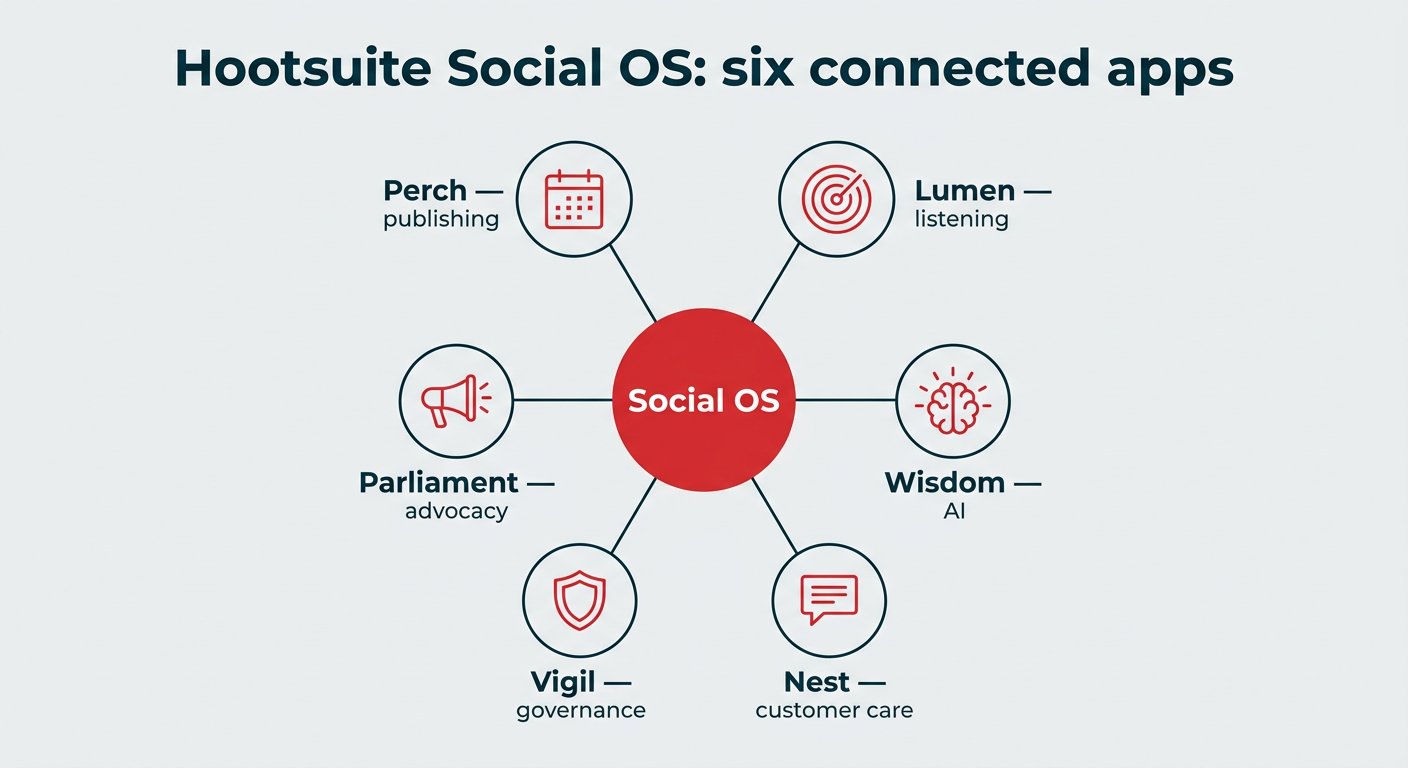
- The Connected Operating System Era (2025–2026): Today, isolated point solutions are being phased out in favor of interconnected suites. Modern platforms—exemplified by Hootsuite’s Social OS—unify listening, publishing, care, AI orchestration, and compliance into a single data-sharing ecosystem.
Supporting Data: Comparative Breakdown of Top 2026 Alternatives
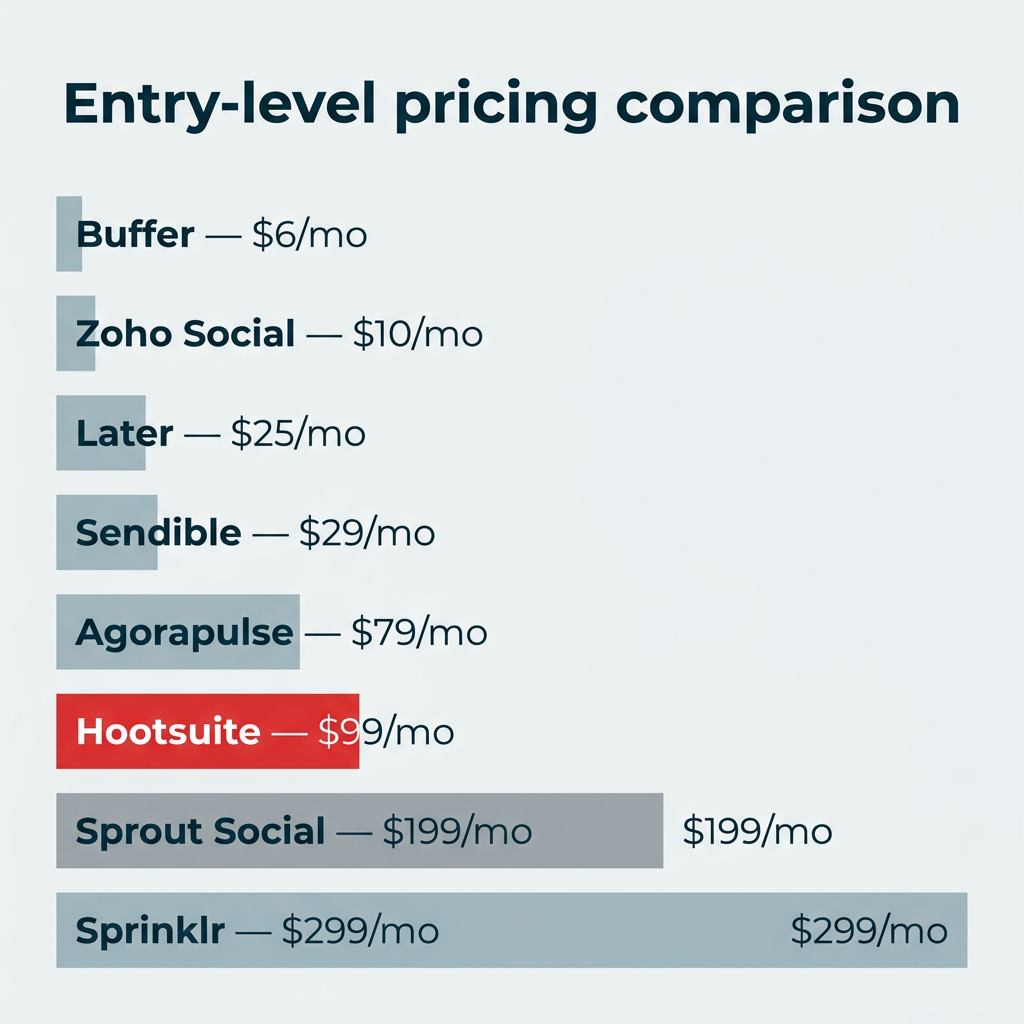
When evaluating alternatives, marketing leaders must balance upfront costs against total feature depth. Below is an updated comparative overview of the leading tools on the market:

| Tool | Best For | Starting Price (2026) | G2 Rating | Key Differentiator |
|---|---|---|---|---|
| Hootsuite | Enterprise teams & regulated industries | $99/user/month | 4.3/5 | AI-first social operating system (Lumen, Wisdom, Vigil) |
| Sprinklr | Large enterprises | $299/month | 4.1/5 | Unified CXM platform across 30+ channels |
| Brandwatch | Enterprise research & insights teams | Custom pricing | 4.4/5 | Deep consumer intelligence and listening |
| Emplifi | Retail & commerce-led brands | Custom pricing | 4.3/5 | Social commerce + influencer marketing suite |
| Khoros | Multinational corporations | Custom pricing | 3.8/5 | Community management & strict compliance controls |
| Agorapulse | Mid-size marketing teams | $79/user/month | 4.5/5 | Unified social inbox with built-in ROI tracking |
| HubSpot | Teams using HubSpot CRM | $890/month (Marketing Hub) | 4.4/5 | CRM-integrated social within a full marketing suite |
| SocialBee | Small teams managing diverse categories | $29/month | 4.8/5 | Content categories and evergreen recycling |
| Sendible | Agencies | $29/month ($25 annual) | 4.5/5 | White-label reporting & multi-client management |
| Zoho Social | Teams in the Zoho ecosystem | $10/month | 4.6/5 | Deep Zoho CRM integration |
| Buffer | Small teams and creators | Free (Paid from $6/mo/channel) | 4.3/5 | Simple, affordable scheduling and analytics |
| Later | Visual content creators | $25/month | 4.5/5 | Visual content calendar & Instagram-first planning |
Deep Dive: The Top Enterprise and Mid-Market Contenders
1. Hootsuite (Best Enterprise Alternative)
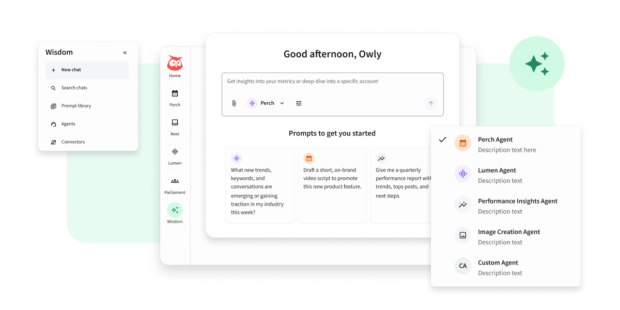
Hootsuite Social OS remains the premier alternative for organizations requiring a seamless blend of publishing, deep analytics, social listening, customer care, and strict governance. Supporting all major platforms (Facebook, Instagram, X, LinkedIn, TikTok, Pinterest, YouTube), it operates as a connected suite of apps sharing unified contextual data.

- Pros: Highly secure compliance frameworks; powerful AI orchestration (Wisdom AI); robust listening via Lumen (150M+ sources); transparent pricing starting at $99/user/month.
- Cons: Steeper learning curve due to the sheer depth of features across its expanded app ecosystem.
2. Agorapulse (Best for Mid-Sized Teams)
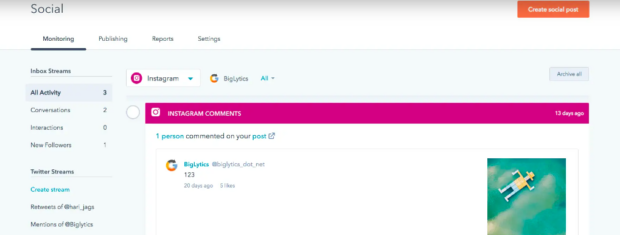
Striking a balance between capability and user-friendliness, Agorapulse offers a pristine unified social inbox and reliable ROI tracking without enterprise bloat.
- Pros: Intuitive interface; highly rated customer support; competitive starting price of $79/user/month.
- Cons: Lacks the enterprise-grade social listening depth and complex audit trails required by heavily regulated global corporations.
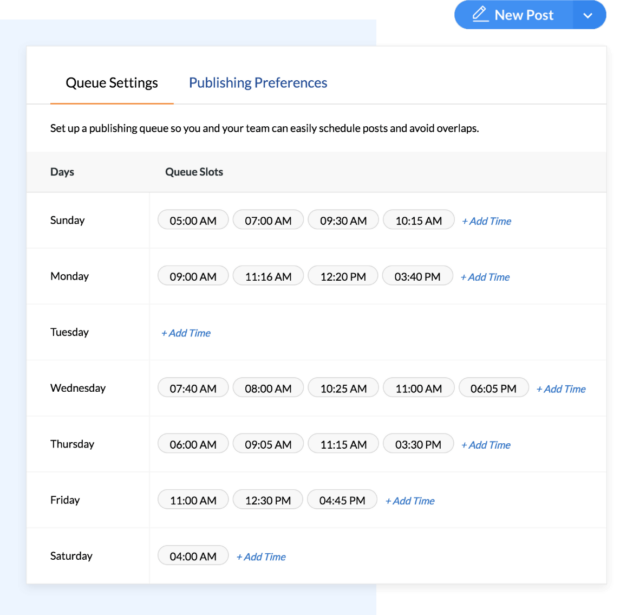
3. Sprinklr (Best for Global CXM)
Sprinklr is a massive Customer Experience Management (CXM) suite built to unify interactions across 30+ digital channels.
- Pros: Unmatched multichannel scale; advanced AI-powered automation and customer care workflows.
- Cons: High implementation overhead; steep learning curve; can feel like costly overkill for teams focused strictly on social media marketing.
Official Responses and Industry Guidance
Industry analysts and brand executives emphasize that software selection must be tied directly to strategic organizational goals rather than brand recognition alone.

According to market research from leading tech advisory firms, enterprise software buyers are increasingly demanding modular pricing structures that prevent organizations from paying for unused seats. Vendors that fail to integrate AI natively across publishing, listening, and customer care workflows are seeing diminished retention rates among mid-market and enterprise cohorts.

Furthermore, compliance officers across financial and healthcare sectors note that third-party audit readiness is now a primary qualifying metric. Software that cannot seamlessly log content changes, user approvals, and regulatory disclaimers is routinely eliminated during early-stage procurement rounds.
Implications for Digital Marketers and Future Outlook
The shift away from rigid enterprise pricing models like Sprout Social’s signals a broader maturation of the digital marketing industry. As budgets face heightened scrutiny in 2026, marketing leaders are prioritizing total cost of ownership (TCO) alongside technological capability.
- Financial Predictability: Organizations are migrating toward platforms with transparent, scalable per-user pricing models (such as Hootsuite’s $99/user/month tier) to protect operating margins as headcount expands.
- Consolidated Workflows: The era of siloed tools is ending. Teams are actively consolidating their tech stacks, opting for comprehensive platforms where insights gathered from social listening instantly inform publishing calendars and customer care responses.
- Heightened Security Standards: With digital threats and compliance mandates multiplying, governance is no longer an enterprise afterthought; it is a foundational pillar of social media operations.
Strategic Action Plan for Buyers
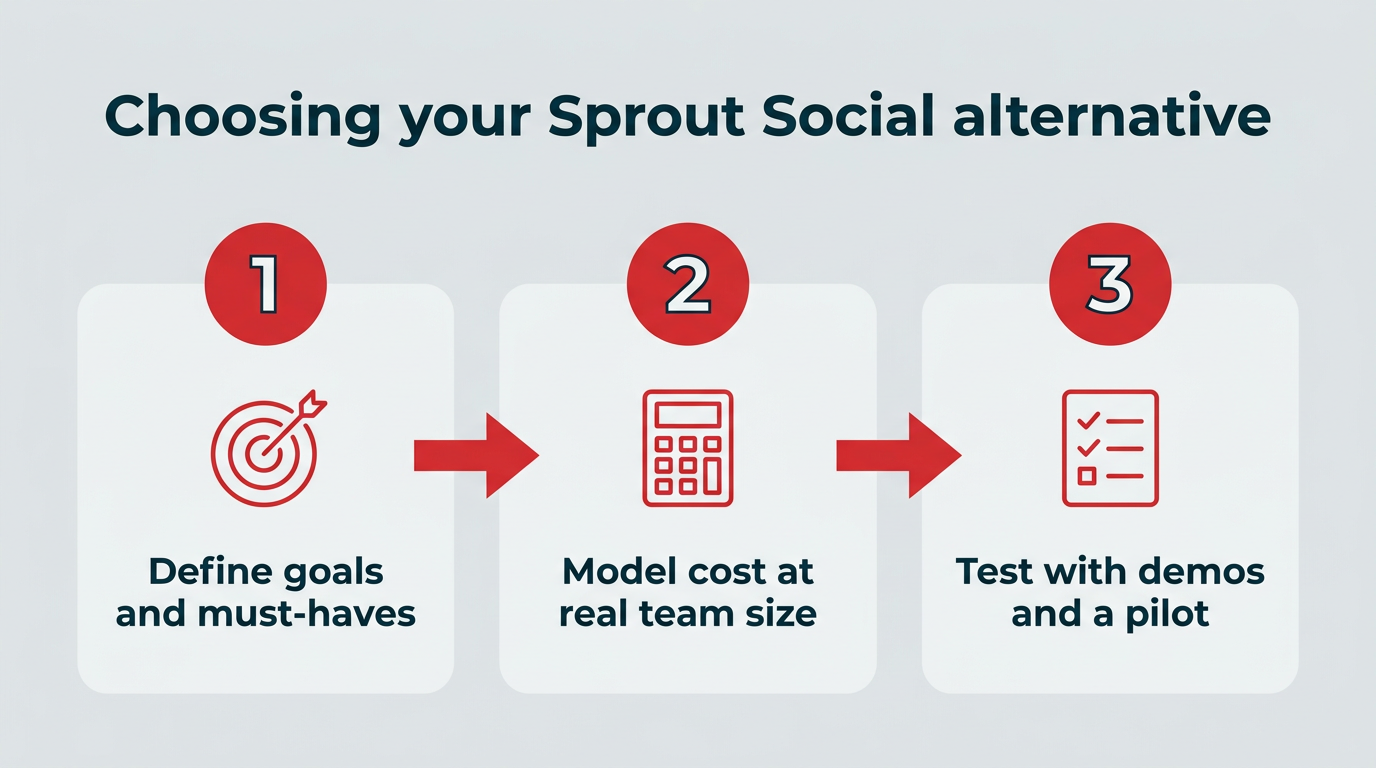
To select the ideal Sprout Social alternative for your organization, follow a disciplined three-step framework:
- Define Core Objectives: Separate absolute "must-haves" (e.g., automated approval workflows, native listening) from "nice-to-haves."
- Model Total Cost of Ownership: Calculate expenses not just for today’s team size, but project costs across a 12-to-18-month growth horizon.
- Run Hands-On Pilots: Leverage free trials and targeted product demos (such as Hootsuite’s 30-day trial) to test the software under real operational conditions before executing a full migration.
By taking a measured, data-driven approach, marketing leaders can future-proof their operations, cut unnecessary overhead, and equip their teams to win in an increasingly competitive digital arena.
 Reynand Wu
  Muslim
  Nila Kartika Wati