
 By Ali Ikhwan
Written by Alexey Pomigalov, PhD in History and Curator of the DataArt IT Museum
Published: April 2026
Drawing from the online historical initiative Retrospect by DataArt
1. Main Facts: Redefining the Origins of Data
For decades, mainstream historical narratives anchored the dawn of data processing in commerce, taxation, and warfare. We were taught that writing, arithmetic, and record-keeping emerged strictly out of an administrative necessity to track grain surpluses, tax citizens, or inventory military campaigns in ancient empires. However, a radical paradigm shift is underway across modern anthropology, bioarchaeology, and media archaeology.
New research demonstrates that human data processing did not begin with the rise of state-level commerce; it began with biology, survival, and human observation of the natural world. Long before the first city-states of Mesopotamia drafted administrative ledgers, prehistoric humans—frequently women tracking lunar cycles—were observing recurring environmental patterns, abstracting that information, and externalizing their memories onto physical media.
This foundational shift moves the starting line of human "data civilization" back tens of thousands of years. From notched baboon bones in Stone Age caves to proto-cuneiform brewery tablets, from the meticulous library indexing systems of the Hellenic world to the punch-card automation of the Industrial Revolution, data has always been humanity’s primary tool for enduring a changing environment. Today, modern relational databases and computational software are even allowing contemporary researchers to retroactively decode these ancient records, closing a loop that spans over 35,000 years of human cognition.
2. Chronology: Milestones in the Evolution of Data Processing
The trajectory of human data processing is a multi-millennia progression from biological observation to automated computation and digital abstraction.
Phase I: Biological and Natural Observation (Paleolithic Era)
- c. 35,000 – 10,000 BCE: Prehistoric humans engage in systematic observation of natural phenomena. Modern anthropological analysis reveals that women, challenging the reductive "Man the Hunter, Woman the Gatherer" paradigm, frequently spearheaded early tracking of lunar cycles and biological patterns.
- The Lebombo Bone: Discovered in the Border Cave of the Lebombo Mountains, this baboon fibula features 29 distinct notches. Long misattributed as a hunter’s tally, modern consensus identifies it as one of the world’s earliest lunar calendars—an externalized memory storage device mapping the recurring cycles of life.
Phase II: Administrative Tabulation and the Birth of Writing (Mesopotamia)
- c. 3300 – 3200 BCE: The urban revolution in Uruk (modern-day Iraq) gives rise to proto-cuneiform administrative records.
- The Uruk Brewery Tablet: Stored today in the Louvre, this small clay tablet represents the earliest known spreadsheet-like tabular representation of numerical information, organizing barley and malt deliveries for beer production into structured rows and columns.
Phase III: Information Retrieval and Physical Indexing (Hellenistic Era)
- c. 305 – 30 BCE: The Great Library of Alexandria becomes the intellectual epicenter of the Mediterranean.
- The Pinakes of Callimachus: The poet and bibliographer Callimachus of Cyrene compiles 120 bibliographic tablets (pinakes) that serve as a physical index for over half a million papyrus scrolls. This system of precise addressing and cataloging establishes the conceptual foundation for modern library science and digital storage architecture.
Phase IV: Programmable Logic and the Industrial Revolution
- 1725: French textile worker Basile Bouchon introduces perforated paper tape to control weaving patterns, adapting concepts from automated music boxes.
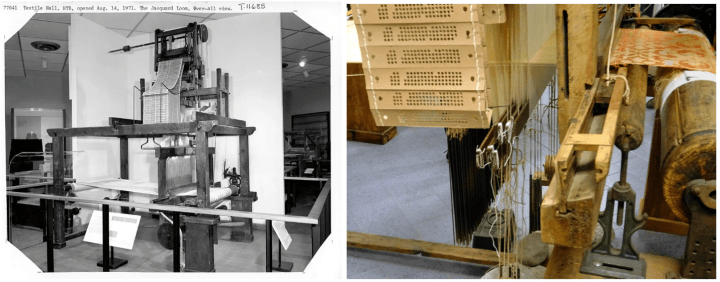
- 1804: Joseph-Marie Jacquard perfects the automated loom using chained punch cards. By encoding textile designs into binary sequences, Jacquard introduces modularity, repeatability, and the separation of logic from physical mechanics—directly inspiring Charles Babbage’s Analytical Engine.
- 1890: Herman Hollerith applies punched-card processing to the U.S. Census, reducing decades of manual tabulation to three years and launching modern automated data processing.
Phase V: Digital Retroactive Analysis (Modern Era)
- 2010 onward: Researcher Genevieve von Petzinger utilizes modern relational database software to analyze non-figurative geometric symbols across 146 Ice Age rock art sites in France, identifying 32 universal sign types and proving that art and data transmission arose simultaneously in human history.
3. Supporting Data: Artifacts That Shaped Human Memory
To understand how data processing evolved, one must examine the physical artifacts that served as humanity’s external hard drives across different epochs.
| Artifact / Innovation | Estimated Date | Geographic Origin | Primary Function / Purpose | Modern Significance |
|---|---|---|---|---|
| The Lebombo Bone | Upper Paleolithic | Southern Africa | Tracking lunar cycles and biological timing via carved notches. | Challenges commercial-origin theories of data; proves early abstraction of natural cycles. |
| Uruk Clay Tablet | c. 3300–3200 BCE | Sumer (Modern Iraq) | Recording barley and malt deliveries for brewing logistics. | The earliest known tabular layout (spreadsheet) demonstrating structural data correlation. |
| Callimachus’s Pinakes | c. 3rd Century BCE | Alexandria, Egypt | Cataloging over 500,000 papyri by author, title, and biography. | Pioneered physical indexing, addressing, and metadata standards. |
| Jacquard Punch Cards | 1804 CE | Lyon, France | Controlling warp threads in automated textile looms. | First practical implementation of programmable logic and machine-readable code. |
| Upper Paleolithic Cave Signs | c. 35,000–10,000 BCE | Europe (primarily France/Spain) | Non-figurative geometric signs accompanying animal art. | Decoded via modern relational databases to reveal early symbolic communication. |
4. Official Perspectives and Scholarly Consensus
The re-evaluation of ancient data systems has prompted commentary and analysis from leading historians, curators, and researchers specializing in media archaeology and anthropology.
Challenging the Patriarchal Narrative of Early Science
For decades, historical paradigms marginalized the contributions of women in foundational sciences. However, contemporary bioarchaeology and forensic science have dismantled these narrow frameworks. As highlighted by historical studies into early tracking systems, women were the original human computers. They monitored natural rhythms, predicted physiological and environmental changes, and externalized this knowledge onto bone and stone long before formal institutions codified science.

The Inseparable Bond Between Art and Data
The work of paleoanthropologist Genevieve von Petzinger provides a striking lens through which to view prehistoric expression. For generations, art historians focused exclusively on the figurative paintings of mammoths, horses, and lions found deep within Ice Age caves. Von Petzinger’s relational database analysis of the recurring geometric signs—crosshatches, spirals, triangles, and lines—demonstrated that these symbols were not mere decoration.
"The realization that abstract mathematical models could be applied across disciplines, including the humanities, broke down the barrier between scientific research and the arts," notes Dr. Alexey Pomigalov.
These symbols represent an extraordinary, standardized system of data transmission shared across isolated human groups millennia before the invention of formal writing.
5. Implications: What Ancient Data Means for the Future
As we navigate the mid-21st century surrounded by artificial intelligence, big data analytics, and cloud storage, looking backward through media archaeology offers profound philosophical and practical insights.

1. Data as an Inherent Survival Mechanism
From the Stone Age woman marking the lunar phases on a baboon fibula to the Sumerian clerk organizing grain supplies into rows and columns, data has always been humanity’s ultimate survival tool. It is an evolutionary adaptation designed to manage complexity, mitigate environmental uncertainty, and preserve cooperative knowledge across generations.
2. The Persistence of Structural Formats
The tabular layout conceived by Sumerian accountants over 5,000 years ago remains virtually identical in principle to the software spreadsheets utilized by billions of workers today. Similarly, the physical indexing principles developed by Callimachus in the Library of Alexandria directly inform the architecture of modern relational databases and digital file structures. Formats change, but the underlying logic of organization endures.
3. Bridging the Humanities and Data Science
The integration of relational database management systems into anthropological research—as seen in the decoding of Paleolithic cave symbols—illustrates that data science is not merely a technical discipline restricted to STEM fields. It is a universal key capable of unlocking deep historical mysteries in the humanities.
Ultimately, as Dr. Alexey Pomigalov reflects in his curatorial work for the DataArt IT Museum, data is our species’ ultimate legacy. It is a bridge built by our ancestors, encoded to transmit across millennia to recipients they could never imagine, carrying a timeless instruction across the ages: Recount, Sort, and Figure Out.
 Jia Lissa
  Neng Nana
  Iffa Jayyana