
 By Ali Ikhwan
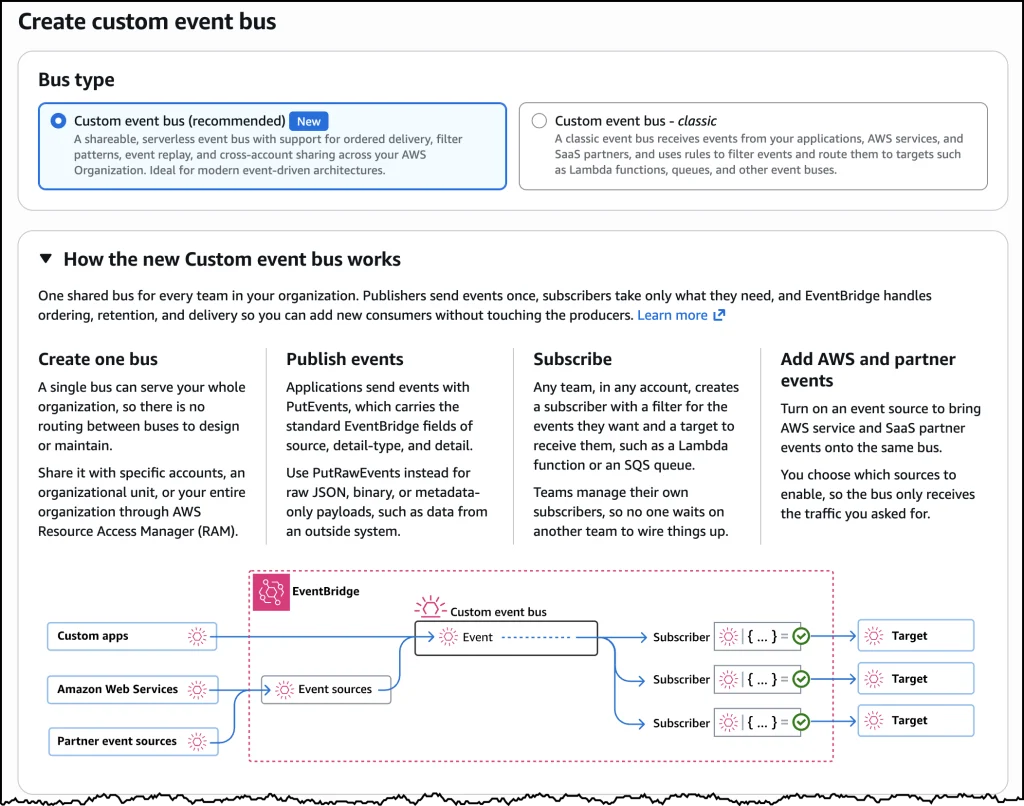
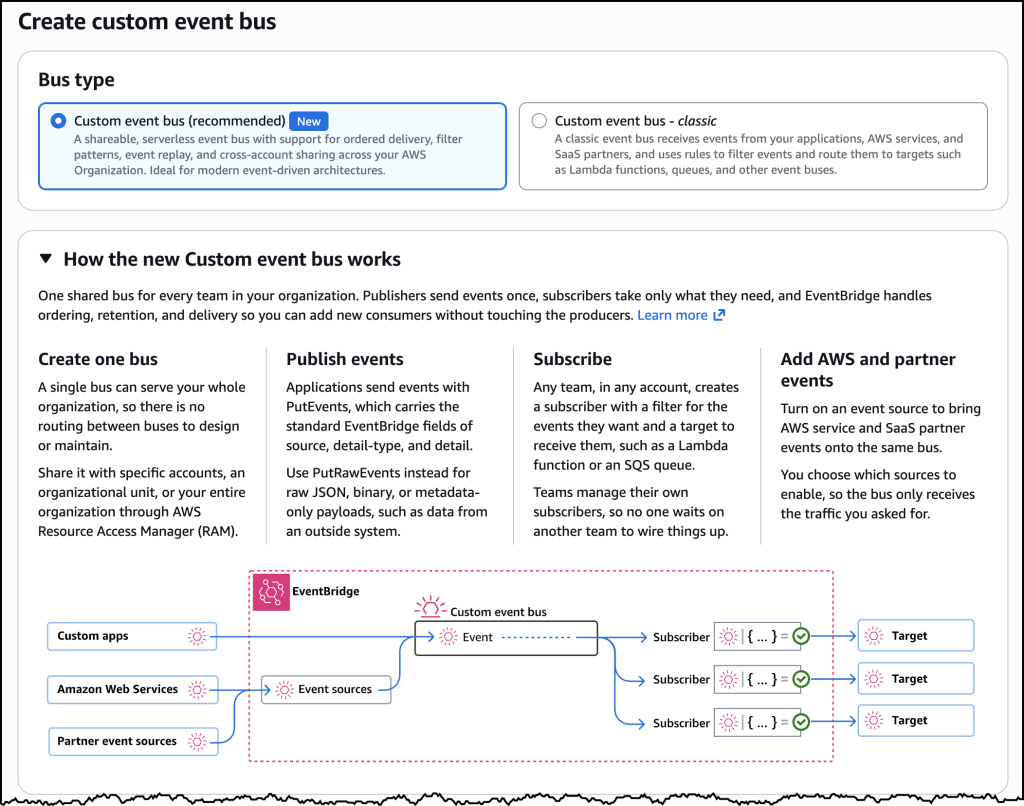
SEATTLE — In a move set to reshape how enterprises design and scale serverless environments, Amazon Web Services (AWS) has announced a powerful evolution of its flagship serverless event router. The newly introduced enhanced custom event bus for Amazon EventBridge introduces organization-wide sharing, native event ordering, simplified subscriber management, and an innovative pricing structure designed to eliminate the compounding friction of multi-account architectures.
For years, organizations building event-driven applications on Amazon EventBridge have followed a predictable trajectory. Developers typically begin with a single custom event bus housed inside a single AWS account, a setup that works remarkably well for isolated teams and straightforward workflows. However, as serverless adoption accelerates across an enterprise, organizations naturally transition to multi-account structures in alignment with AWS best practices.
Historically, bridging these boundaries required complex workarounds: teams had to set up multiple event buses connected via intricate cross-account rules or fragile bus-to-bus configurations. Rather than simplifying operations, this patchwork approach often reintroduced the very operational overhead serverless architectures are meant to eradicate. Platform teams found themselves losing critical visibility into event subscriptions, watching cross-account routing costs compound rapidly, and struggling to enforce strict event ordering without adopting entirely separate messaging technologies.
The launch of the enhanced custom event bus directly addresses these pain points. By replacing fragmented multi-bus topologies with a single, centralized event backbone shared securely across an entire AWS organization, AWS is promising to restore simplicity, enhance governance, and dramatically improve cost-efficiency at scale.
Main Facts: What is the Enhanced Custom Event Bus?
The newly minted enhanced custom event bus is a purpose-built architectural primitive designed specifically for large-scale, multi-team enterprise environments. Unlike its predecessor—which remains fully supported under the designation "Custom event bus — classic"—the new enhanced bus serves as a unified, organizational-wide ingestion and distribution hub.
Key capabilities of the new architecture include:
- Organization-Wide Resource Sharing: Leveraging AWS Resource Access Manager (AWS RAM), platform teams can provision a single event bus and share it across multiple accounts, organizational units, or specific IAM roles within an enterprise without manually configuring cross-account permissions.
- Native Event Ordering: Publishers can attach an
EventGroupIdto payloads, enabling EventBridge to route sequentially dependent messages in strict order to designated subscribers while keeping other workloads fully asynchronous. - Unified Subscriber Resources: A new Subscriber resource consolidates event filtering, target configuration, retry policies, and dead-letter queues into a single manageable unit, replacing the legacy method of managing disparate rules and targets.
- Content-Based Deduplication and Deserialization: EventBridge can now automatically hash payloads to drop duplicate retries within a five-minute window, and deserialize Apache Avro or Protocol Buffers formats directly into JSON.
- Ingress-Egress Pricing Model: A restructured pricing mechanism decouples costs, charging publishers for data ingestion and subscribers for data delivery, eliminating compounding cross-account routing charges.
Chronology: The Evolution of EventBridge Routing
To fully understand the significance of this release, it is helpful to trace the chronological evolution of event-driven architectures on AWS and the architectural debt that accumulated over time.

Phase 1: The Single-Account Paradigm
In the early days of serverless adoption, Amazon EventBridge gained massive popularity due to its simplicity. A single team could instantiate a custom event bus, configure rules, and connect serverless targets like AWS Lambda functions or Amazon SQS queues with minimal friction. Events flowed cleanly, and observability was straightforward.
Phase 2: The Multi-Account Proliferation
As enterprises scaled their cloud footprints, security and governance mandates pushed organizations toward multi-account strategies—often managed via AWS Organizations. While this successfully isolated environments (such as separating staging from production or segregating business units), it severely complicated event routing. To pass an event from Account A to Account B, teams had to configure cross-account resource policies on target buses, create specific rules, and manage complex IAM trust relationships. As dozens of teams onboarded, the number of buses and cross-account links exploded, resulting in a fragmented web of event traffic that was difficult to monitor and expensive to maintain.
Phase 3: The Search for Workarounds
Faced with these architectural limitations, platform engineers were frequently forced to compromise. When applications required strict event sequencing—such as tracking fleet logistics or financial transactions—EventBridge’s default asynchronous, out-of-order delivery model fell short. Teams had to introduce Amazon SQS FIFO queues between the event bus and their compute layers, adding unnecessary infrastructure overhead, latency, and cost.
Phase 4: The Unified Architecture Era Today
With today’s announcement, AWS is turning the page on this era of workarounds. The enhanced custom event bus consolidates the lessons learned from enterprise migrations, providing native solutions for sharing, ordering, and cost allocation directly within the managed service. Existing workloads remain completely unaffected, running seamlessly on the classic bus model, while new or migrating workloads can adopt the enhanced bus at their own pace.
Supporting Data: Architectural Depth and Technical Mechanics
A deep dive into the technical specifications reveals how AWS engineered the enhanced custom event bus to handle enterprise-grade throughput and complex routing logic.
Streamlined Sharing via AWS RAM
Setting up the new bus requires navigating to the EventBridge console and selecting the recommended "Custom event bus" option. During configuration, administrators enable event bus sharing and specify sharing boundaries—restricting access to specific AWS accounts, organizational units, or entire AWS organizations.
Under the hood, this integration with AWS Resource Access Manager (AWS RAM) means that permission management is handled natively. Application teams across different accounts can immediately publish events to or create subscriptions on the shared bus without needing custom resource policies written for every single handshake. Furthermore, the enhanced bus scales to support a default quota of 10,000 Subscribers per bus—a massive increase that prevents the artificial fragmentation previously forced by lower limits.

Balancing Asynchronicity and Event Ordering
Event-driven design principles champion asynchronous, decoupled communication where message ordering is irrelevant. However, real-world enterprise requirements often defy purity. In logistics and supply chain applications, for example, continuous location updates from a delivery vehicle must be processed in the exact sequence they occur; otherwise, routing engines risk making decisions based on stale geospatial coordinates.
The enhanced custom event bus solves this dichotomy by supporting mixed execution patterns on the same infrastructure:
- Unordered Consumers: Standard subscribers continue to process events concurrently and asynchronously, maximizing throughput and fault tolerance.
- Ordered Consumers: Publishers attach an
EventGroupIdmetadata tag to related payloads. EventBridge ensures that messages sharing the sameEventGroupIdare delivered sequentially to subscribers opted into ordered delivery.
To make ordered processing reliable, AWS introduced synchronous invocation for targets like AWS Lambda. Unlike asynchronous invocation, synchronous mode confirms that a target has successfully processed an event before acknowledging receipt, effectively removing the historical necessity of placing an Amazon SQS FIFO queue between the event bus and the compute layer.
Advanced Payload Evaluation and Transformation
Data cleanliness and schema compatibility have long been hurdles in large event meshes. The enhanced custom event bus introduces powerful preprocessing features to mitigate these challenges:
- Content-Based Deduplication: Network timeouts and transient failures often cause producers to retry sending the exact same event. Rather than forcing producers to generate and track complex idempotency tokens, EventBridge can now analyze and hash the meaningful components of a payload. If identical events arrive within a five-minute window, the service automatically drops the duplicate, granting applications "exactly-once" delivery semantics on retries.
- JSONata Transformations and Schema Deserialization: Downstream consumers often expect specific data shapes that differ from the publisher’s payload. Using JSONata expressions, subscribers can reshape, filter, and extract fields on the fly before the event hits the target. Additionally, for organizations utilizing binary serialization formats like Apache Avro or Protocol Buffers, EventBridge can deserialize payloads natively, allowing teams to filter and route based on rich event attributes without writing custom parsing boilerplate.
Official Responses and Strategic Vision
While AWS has not yet published direct executive quotes regarding the release, documentation and technical blog briefings from the AWS EventBridge engineering team underscore a clear strategic intent: removing operational friction to make event-driven architecture universally viable for complex enterprises.
"As adoption grows across an organization, things get complicated," AWS engineering leads noted in the official rollout documentation. "Our goal with the enhanced custom event bus was to eliminate the operational complexity that serverless architectures are meant to eradicate, giving platform teams absolute visibility while granting application teams the agility to build without waiting on infrastructure provisioning."
Industry analysts have broadly welcomed the announcement, noting that it directly targets the "tax" enterprises often pay when scaling serverless systems across organizational boundaries. By unifying publisher and subscriber controls under a single managed resource, AWS is signaling its commitment to enterprise governance without sacrificing developer velocity.
Implications for Developers, Platform Teams, and Cloud Economics
The introduction of the enhanced custom event bus carries profound implications across multiple dimensions of cloud engineering, financial management, and organizational workflows.
1. Empowerment for Platform Teams
For centralized cloud and platform engineering teams, the new architecture represents a major win for governance and observability. Instead of managing a sprawling constellation of cross-account routing rules and disparate event buses, platform administrators can deploy a single, centralized event backbone. They retain granular control over who can publish and subscribe, gaining unprecedented visibility into enterprise-wide event flows while delegating day-to-day subscription management to individual application squads.
2. Agility for Application Developers
Application teams are frequently bottlenecked by the need to request infrastructure changes or coordinate cross-account permissions with central IT. With organization-wide sharing enabled via AWS RAM, developers can independently subscribe to organizational events, filter payloads using advanced JSONata expressions, and configure retry or dead-letter behaviors within a single Subscriber resource. This self-service model drastically accelerates feature delivery and microservices integration.
3. A Transformed Pricing Model
Perhaps one of the most impactful changes is economic. Under legacy multi-bus architectures, cross-account routing charges compounded rapidly, creating a financial disincentive for distributed event-driven design. The new ingress and egress throughput pricing model—where publishers pay strictly for events ingested and subscribers pay for events delivered—aligns costs directly with actual consumption. This predictable, scaled pricing model removes financial barriers, making large-scale event meshes economically viable for growing startups and Fortune 500 enterprises alike.
Availability and Getting Started
The enhanced custom event bus is available immediately across a broad footprint of global AWS Regions, including:
- Americas: US East (N. Virginia, Ohio), US West (Oregon)
- Europe: Europe (Ireland, Frankfurt, Stockholm, Spain)
- Asia Pacific: Asia Pacific (Hong Kong, Malaysia, Mumbai, Singapore, Sydney, Thailand, Tokyo)
Organizations can begin provisioning enhanced custom event buses today using the AWS Management Console, the AWS Command Line Interface (AWS CLI), or via programmatic AWS APIs. Existing classic event buses will continue to operate indefinitely without disruption, allowing engineering organizations to migrate workloads to the enhanced architecture at a measured, risk-managed pace.
For comprehensive deployment guides, pricing calculators, and deep-dive technical tutorials, engineering teams are encouraged to consult the official Amazon EventBridge documentation portal.
 Reynand Wu
 Jia Lissa
 Nana Wu
