
 By Lina Irawan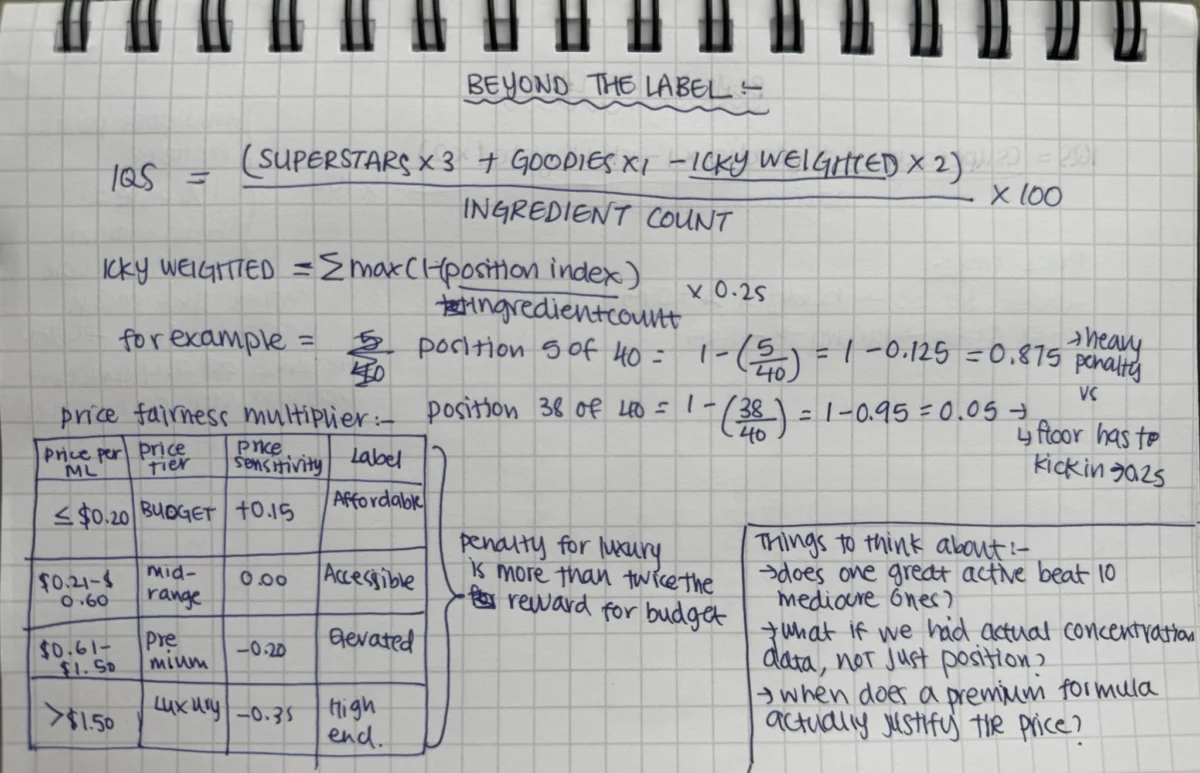
By Global Investigative Desk
Published in partnership with Data & Design Review
Introduction: The Illusion in the Sephora Aisle
Step into any high-end beauty retailer, and you will find a masterclass in psychological merchandising. On the illuminated shelves of Sephora, a $390 jar of luxury face cream sits mere inches away from a $15 drugstore alternative. To the untrained eye, the choice is obvious. The heavy glass jar, the minimalist typography, the whisper-quiet click of the lid, and the prestige of a storied brand name all whisper the same promise: You get what you pay for.
Except, according to a compelling new data-driven investigation, you almost certainly do not.
The $390 moisturiser has a better bottle. The $15 one has a better formula. That is the stark conclusion of "Beyond the Label," a groundbreaking digital project created by data visualization designer and analyst Dhruvi Mehta. By translating the legally mandated, yet largely ignored, fine print of cosmetic ingredient lists into striking three-dimensional data sculptures, Mehta’s work strips away the multi-billion-dollar marketing veneer of the beauty industry to reveal a blunt truth: at the formulation level, luxury skincare is frequently an exercise in paying exorbitant prices for cheap silicones, synthetic fillers, and aggressive irritants.

Main Facts: Decoding the Cosmetic Fine Print
Every skincare product sold in the United States—and across much of the developed world—is bound by federal law to print its full ingredient list on the packaging in order of descending concentration. The ingredient present in the highest amount sits at the very top; the trace additives rest at the bottom. In theory, this represents a rare bastion of radical transparency in consumer retail. In practice, it is a dead language.
Mehta’s obsession with this data began at home, fueled by her mother’s recurring requests to purchase La Mer’s The New Moisturizing Soft Cream for $390. A closer examination of the product’s ingredient deck revealed a striking reality: the entire formulation is anchored around a single proprietary marketing hook—a fermented algae extract called "Miracle Broth"—which does indeed occupy the first position. However, positions two through six are dominated by cheap silicones and petrolatum. The high-performance peptides and hyaluronic acid that populate the brand’s marketing campaigns do not make an appearance until past position 38.
"You are paying $390 for one hero ingredient surrounded by filler," Mehta notes.
To determine whether this was an isolated anomaly or a systemic industry-wide pattern, Mehta embarked on an exhaustive comparative study, building a mathematical scoring framework from scratch to evaluate 16 products across eight head-to-head pairs of luxury versus affordable equivalents.
Chronology: From Consumer Frustration to the Creation of "Beyond the Label"
The genesis of "Beyond the Label" traces a path from personal skepticism to methodological innovation, reflecting the broader cultural shift of the "dupe culture" era.
Phase 1: The Awakening of Ingredient Literacy
For years, modern consumers have grown increasingly skeptical of legacy beauty marketing. The rise of digital communities dedicated to "dupe culture" has turned ingredient-list literacy into a mainstream pastime. Millions of shoppers regularly debate online whether a $90 serum is genuinely superior to a $12 equivalent.
However, Mehta identified a glaring gap in these online debates. While consumers are constantly bombarded with side-by-side texture comparisons and glowing influencer video reviews, they are rarely given a rigorous, objective breakdown of the underlying chemical formulas.
Phase 2: Building the Ingredient Quality Score (IQS)
To move beyond subjective reviews, Mehta built a quantitative evaluation engine leveraging data from INCIDecoder, a publicly accessible cosmetic ingredient database. She classified every ingredient into four distinct categories:
- Superstars: Rare, high-impact active ingredients.
- Goodies: Beneficial, baseline contributors to skin health.
- Icky: Harmful, questionable, or irritating compounds.
- Neutrals: Functional fillers with no meaningful biological effect on the skin.
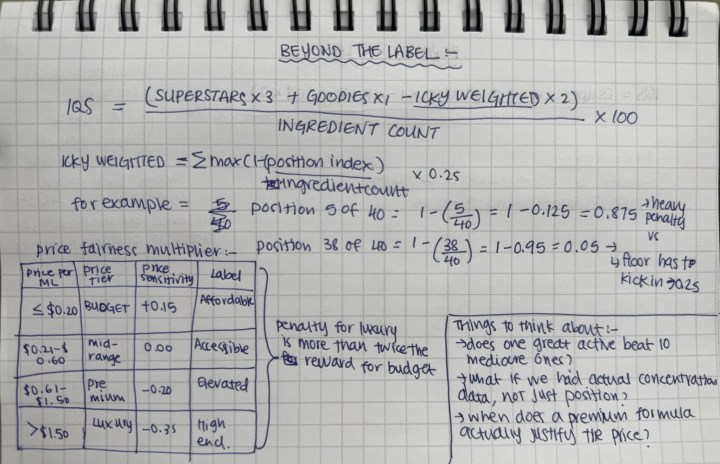
From these categories, she derived the Ingredient Quality Score (IQS). The formula heavily weights superstars (multiplying their value by three) while penalizing harmful ingredients at twice the rate that goodies are rewarded. Crucially, the system accounts for concentration: an irritant appearing at position five in a 40-ingredient list is weighted nearly 10 times more heavily than the same irritant appearing at position 38.
To account for regulatory loopholes—such as the legal "1% rule," which permits manufacturers to list ingredients present at concentrations of 1% or lower in any arbitrary order—Mehta established a strict regulatory floor, ensuring that hazardous ingredients always carry a minimum penalty regardless of where they land on the packaging.
Phase 3: The Price Fairness Multiplier and Normalization
To tie formulation quality directly to economic value, Mehta introduced a Price Fairness Multiplier. Affordable products featuring superior formulas were rewarded, while overpriced, poorly formulated luxury items were severely penalized.
The resulting raw scores were then normalized on a scale from 0 to 100. Within this closed competitive dataset, the highest-scoring product was benchmarked at 100, and the lowest plummeted to zero, providing a clear, relative yardstick for consumers.

Supporting Data: What the Scores Reveal
The results of Mehta’s comparative analysis are both damning and illuminating. When luxury brands are stripped of their marketing budgets and evaluated strictly on their molecular architecture, the data tells a stark story.
The Ultimate Benchmark: CeraVe vs. La Mer
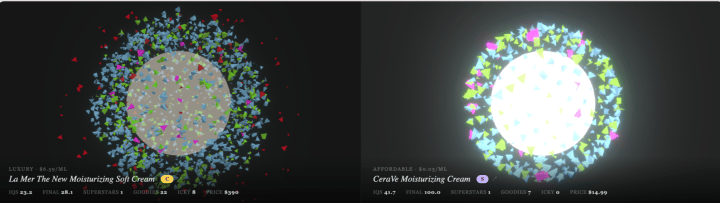
- CeraVe Moisturizing Cream ($14.99 | $0.03/mL): Achieving a final normalized score of 100, this humble drugstore staple emerged as the benchmark of the dataset. It features one superstar ingredient, seven beneficial contributors (including three essential ceramides, cholesterol, and hyaluronic acid), and zero "icky" ingredients.
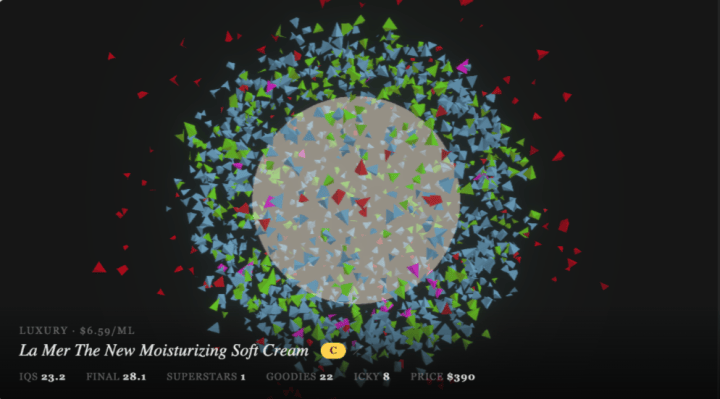
- La Mer The New Moisturizing Soft Cream ($390.00 | $6.59/mL): Scoring a dismal 28.1, the luxury icon was undone by its chemical profile. Despite its astronomical price tag—representing a roughly 220-fold markup per milliliter compared to CeraVe—the formula contains eight flagged ingredients, including eucalyptus oil, denatured alcohol, synthetic fragrance, and four recognized fragrance allergens (limonene, linalool, hydroxycitronellal, and geraniol).
The Viral Product Paradox: Sol de Janeiro vs. Trader Joe’s
- Sol de Janeiro Brazilian Bum Bum Cream ($24.00 | $0.32/mL): Despite boasting hundreds of thousands of glowing five-star reviews and dominating social media feeds as the definitive scent of summer, this viral cult-favorite hit a score of 0.0. The formula contains nine flagged "icky" ingredients—including benzyl benzoate, benzyl salicylate, citral, coumarin, eugenol, and multiple EU-regulated fragrance allergens—many of which occupy the upper half of the ingredient list.
- Trader Joe’s Brazil Nut Body Butter ($5.99 | $0.025/mL): In a direct head-to-head matchup, the grocery store alternative achieved a respectable score of 40.7, featuring seven beneficial ingredients against only a single flagged compound, all at a fraction of the cost.
Nuance in the Prestige Tier: When Luxury Delivers
Not every luxury product failed the test. The investigation acknowledged important nuances within the prestige market:
- SK-II Facial Treatment Essence scored a low 11.5, not because its core ferment filtrate (Pitera) is ineffective, but because the scoring system penalizes formulas lacking compositional breadth—highlighting a known methodological limitation when evaluating single-active essences.
- SkinCeuticals C E Ferulic ($182) scored an impressive 90.2, closely tracking alongside affordable alternatives like TruSkin’s Vitamin C Super Serum (which scored 80.6). In this rare instance, the data confirms that a high-end, heavily researched formulation genuinely delivers superior performance, justifying a portion of its premium price.
The Power of Visualization: Turning Data into Sight
One of the most innovative aspects of "Beyond the Label" is its rejection of traditional tables and flat spreadsheets in favor of interactive 3D visualizations.
Each product in the dataset is rendered as a glowing, spherical digital sculpture constructed from hundreds of individual crystal shards distributed evenly across its surface via a Fibonacci algorithm. Each shard represents a single ingredient, color-coded by category: pink for superstars, green for goodies, blue for neutrals, and red for harmful additives.
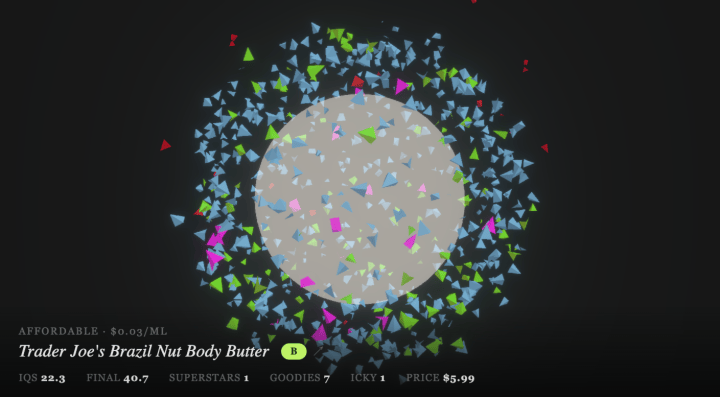
Using a visual technique borrowed from high-end cinema and video game rendering known as "bloom post-processing," beneficial ingredients are programmed to emit a soft, internal light. Conversely, harmful ingredients ("icky" shards) physically push outward from the sphere’s surface, forming jagged, aggressive spikes.
The visual contrast is instantaneous and visceral. CeraVe appears as a tightly bound, brilliantly glowing white sphere ringed in clean green and blue, completely devoid of red spikes. La Mer and Sol de Janeiro manifest as dark, unlit, highly irregular spheres choked by dense clusters of protruding red shards.
"No legend is required to understand the difference," Mehta explains. "The visual makes the argument before any number is read. That was the design goal: to make formulation quality something you can perceive, not just calculate."
Implications: What the Beauty Industry Knows That Consumers Do Not
The implications of "Beyond the Label" extend far beyond digital art and data science. They strike at the very heart of modern consumer capitalism.
The beauty industry operates on a well-funded premise: that packaging design, cinematic brand storytelling, high-profile celebrity endorsements, and prime retail positioning can substitute for chemical transparency. A $390 price tag functions as a powerful psychological heuristic, signaling luxury and efficacy to consumers who lack the scientific framework required to decode an ingredient deck.
By democratizing this data and transforming it into an intuitive, visually arresting format, projects like Mehta’s challenge the asymmetric power dynamic between cosmetics conglomerates and everyday shoppers.
The evidence has always been sitting in plain sight, legally printed on the back of every bottle, tube, and jar sold worldwide. Consumers no longer need to rely on blind faith, viral marketing, or the sleek allure of a heavy glass jar. As "Beyond the Label" forcefully demonstrates, the $390 moisturizer may have a better bottle, but the $15 alternative has a better formula—and now, everyone has the tools to see it clearly.
 Nana
Nana  Nila Kartika Wati