
 By Asro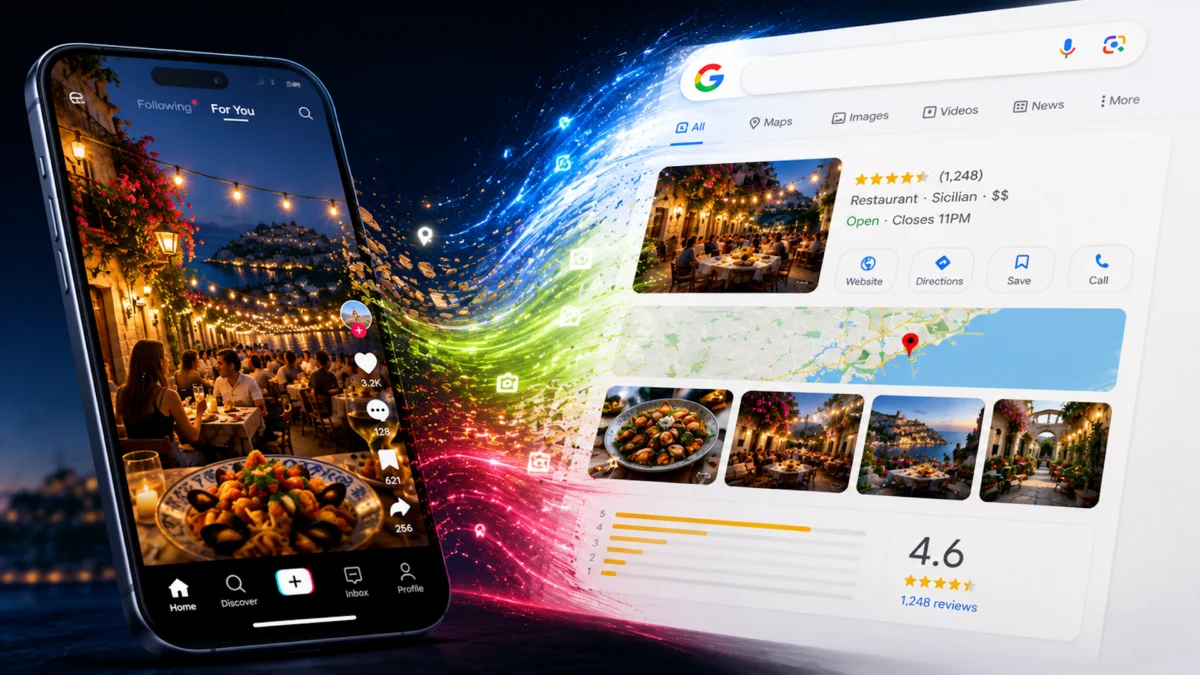
You pick up your smartphone to reply to a text message. A few taps and a casual swipe later, you find yourself watching a immersive, 15-second video of a rustic restaurant hidden in the hills of Sicily, a minimalist boutique hotel in Copenhagen, or a quirky local business just a few miles from your home.
You do not search for it immediately. You might not even think about it for days. But weeks later, when a friend mentions planning a trip or looking for a weekend spot, a memory triggers. You open a browser and type the name into Google. Just like that, passive discovery has transformed into active search.
This behavioral loop is happening far more frequently than most businesses realize. The traditional customer journey—which once began with a user typing a deliberate query into a search bar—is undergoing a profound paradigm shift. Today, consumers increasingly discover brands, destinations, and products long before they actively look for them. In this new landscape, Google is losing its status as the default starting point of the internet; instead, it is becoming a verification engine used to validate decisions that have already been made elsewhere.
For search engine optimization (SEO) professionals, local businesses, and content strategists, the implications of this shift are seismic. Winning the modern consumer requires understanding a new digital ecosystem: one where discovery happens first, and search happens second.
1. Main Facts: The Deconstruction of the Search Funnel
For over two decades, digital marketing relied on a linear funnel: a user identified a need, formulated a search query, analyzed the search engine results page (SERP), and clicked on a link. This model assumed that search was the primary driver of intent.
Today, recommendation engines have broken this funnel. Platforms like TikTok and Instagram do not wait for users to express intent. Instead, they predict curiosity.
[Traditional Funnel]
User Intent ──> Google Search ──> Discovery ──> Action

[Modern Paradigm]
Passive Discovery (TikTok/IG) ──> Curiosity ──> Google Verification ──> Action
The core mechanics of this shift rest on three foundational realities:
Discovery Precedes Intent
In the legacy search model, visibility belonged to those who optimized for high-intent keywords. In the recommendation model, visibility belongs to those who capture attention before intent is even formulated. By the time a user conducts a Google search, they are often not looking for options—they are looking for a specific brand they saw on their feed.
Google as a Verification Utility
As discovery migrates to social feeds, Google’s role is shifting. Rather than serving as a neutral directory for open-ended exploration, it is increasingly used to confirm details: checking operating hours, reading local reviews, finding directions on Maps, or making a direct transaction.
The Rise of Visual Trust
For businesses relying on experiential value—such as hospitality, travel, beauty, and dining—text-based search results and static star ratings are no longer sufficient. Modern consumers demand "visual trust." They want to experience the atmosphere, view the product in motion, and assess the authenticity of a venue through short-form video before spending their time or money.
2. Chronology: The Evolution of Digital Discovery
To understand how the internet arrived at this inflection point, it is necessary to trace the technological milestones that transformed user behavior over the last quarter-century.
1990s-2000s          2010s               2020                 2024+
┌──────────────┐     ┌──────────────┐    ┌──────────────┐     ┌──────────────┐
│  Directory   │ ──> │ Social Graph │ ──>│ Interest     │ ──> │ Integrated   │
│  Era         │     │ Era          │    │ Graph Era    │     │ Search & AI  │
└──────────────┘     └──────────────┘    └──────────────┘     └──────────────┘
The Directory Era (Late 1990s – 2010)
The early consumer web was organized like a digital library. Portals like Yahoo! and eventually search engines like Google categorized the internet based on directories and text-based indexing. User behavior was highly deliberate: if you wanted to find a local Italian restaurant, you had to actively search for "Italian restaurants near me" and browse through static, text-heavy websites.
The Social Graph Era (2010 – 2018)
With the rise of Facebook and Instagram, discovery became tied to social connections. Users discovered brands because their friends "liked" them or checked into locations. While this introduced passive discovery, the content shown to users was still largely constrained by their immediate social circles and the explicit accounts they chose to follow.
The Interest Graph Era (2018 – Present)
The launch and rapid global adoption of TikTok disrupted the social graph model. TikTok pioneered the "interest graph," driven by a hyper-sophisticated recommendation engine. Users no longer needed to follow specific accounts or have an established network to see highly relevant content. Instead, the platform analyzed passive behavioral signals to curate a continuous, hyper-personalized feed.
This model proved so effective at capturing attention that it forced legacy platforms—including Instagram (Reels), YouTube (Shorts), and even Google—to redesign their interfaces to prioritize short-form, algorithmically recommended video content.
3. Supporting Data: The Quantitative Shift in Consumer Behavior
The transition from query-based search to algorithmic discovery is supported by shifting usage patterns, particularly among younger demographics.
The 40% Pivot
During an industry conference, Google’s Senior Vice President Prabhakar Raghavan made a striking admission regarding changing search habits. He revealed that according to Google’s internal research, approximately 40% of young users (ages 18 to 24) turn to TikTok or Instagram when looking for a place to eat, rather than opening Google Search or Google Maps.

This statistic represents a massive migration of high-value, local intent queries away from traditional search infrastructure.
| Platform | Primary Search/Discovery Use Case | Key User Behavior |
|---|---|---|
| TikTok | Creative discovery, experiential search, trend-spotting | High watch-time, passive browsing, curiosity-driven |
| Aesthetic curation, local lifestyle, brand discovery | Visual validation, direct messaging, influencer trust | |
| Transactional intent, factual verification, local utility | Query formulation, review checking, direct navigation |
Algorithmic Signals: How Recommendation Engines Process Interest
Unlike Google’s search algorithm, which relies heavily on backlinks, domain authority, and structured schema markup, TikTok’s recommendation engine decodes user interest through real-time behavioral micro-signals:
- Watch Retention and Completion Rates: The algorithm tracks exactly when a user pauses scrolling, how long they stay on a video, and whether they watch it to completion.
- Looping Behaviors: Creators often craft seamless video loops where the final frames flow naturally back into the beginning. This trick triggers involuntary rewatches, sending powerful positive signals to the algorithm to distribute the content further.
- Semantic Video Analysis: Modern recommendation engines do not just read metadata. They actively transcribe spoken audio, analyze on-screen text, scan the visual background for contextual clues, and process geographic metadata to determine the video’s exact niche.
- Conversational Depth: High comment volume and deep comment-reply chains signal high engagement, prompting the algorithm to boost the video’s reach.
4. Official Responses: How Tech Giants and Marketers are Adapting
The erosion of traditional search volume has forced both search engines and social platforms to adapt their strategies, creating a highly competitive, overlapping ecosystem.
Google’s Defensive Integration
Google has not remained passive in the face of the social search threat. Over the past several years, the search giant has worked to integrate short-form video directly into its search results. Mobile SERPs now frequently feature dedicated carousels of TikTok and Instagram videos.
[Google Search Results Page]
┌────────────────────────────────────────┐
│  [Ad] Sponsored Link                   │
├────────────────────────────────────────┤
│  Organic Search Result (Website)       │
├────────────────────────────────────────┤
│  ┌──────────────────────────────────┐  │
│  │  Short Videos (TikTok/Reels)     │  │
│  │  [ Video 1 ]  [ Video 2 ]        │  │
│  └──────────────────────────────────┘  │
├────────────────────────────────────────┤
│  Google Maps Local Pack                │
└────────────────────────────────────────copy
Furthermore, Google’s development of AI Overviews (formerly the Search Generative Experience) and its "Perspectives" filter are direct attempts to capture the subjective, human-first, experiential advice that younger users seek on social media. By pulling real-world perspectives and forum discussions into search results, Google hopes to satisfy the curiosity that currently drives users to TikTok.
TikTok’s Offensive Search Features
Simultaneously, TikTok is actively positioning itself as a direct competitor to Google Search. The platform has added dedicated search bars to its interface, displays suggested search terms at the top of comment sections, and introduced search ads.
To help creators align their content with search demand, the platform launched TikTok Creator Search Insights. This tool functions similarly to Google Keyword Planner, revealing rising search terms, high-volume questions, and content gaps where users are searching for topics that lack high-quality video answers.
5. Strategic Implications: The Future of SEO and Local Visibility
As the boundaries between social media and search engines blur, businesses must fundamentally update their organic visibility playbooks. Relying solely on traditional, text-based SEO is no longer a viable strategy for long-term customer acquisition.
The Visual Trust Imperative for Local Businesses
For local businesses—particularly those in hospitality, tourism, real estate, and lifestyle retail—visual discovery is now the primary gateway to customer acquisition. Consumers want to preview their experience before they arrive.
[Experiential Visual Funnel]
Visual Trust (Short Video) ──> Emotional Connection ──> Friction Reduction (Maps/Directions) ──> Conversion
To build this trust, brands must answer key consumer questions within the first three seconds of a video:
- What does the physical space actually feel like?
- What is the signature item or standout experience?
- Is this location authentic to its online representation?
By answering these questions visually, businesses bypass the cognitive friction of traditional research, driving an emotional decision that is later verified via Google.
Optimizing Social Content for Search Algorithms
To ensure discovery-focused content is indexed by both social search engines and Google’s web crawlers, creators must apply "Social SEO" principles:
- Verbalize Keywords: Because algorithms transcribe audio in real-time, creators should clearly speak their primary keywords and locations within the first few seconds of the video.
- Leverage In-Video Text: On-screen text overlays should feature clear, descriptive terms rather than abstract or purely aesthetic phrases.
- Interactive Comment Sections: Businesses should view comment sections as semantic extensions of their content. Engaging in conversations, answering user questions, and naturally incorporating terms like "our boutique hotel in Copenhagen" or "our downtown dining menu" helps algorithms better understand the context of the page.
Leveraging Creator Search Insights for Omnichannel Strategy
The data gathered from social search behavior should not remain isolated within social media teams. Insights derived from TikTok Creator Search Insights—such as unanswered niche questions or rising lifestyle trends—should actively inform a brand’s broader digital footprint.
If users are consistently searching for a specific travel tip or product application on TikTok, that topic should be used to build detailed FAQ sections on the brand’s main website, optimize local landing pages, write long-form blog posts, and design transactional product descriptions.
Conclusion: Earning Attention Before the Search
As the search landscape shifts toward artificial intelligence and predictive algorithms, the ultimate competitive advantage belongs to brands that build strong, memorable identities before a user ever approaches a search bar.
When search engines can answer transactional queries without requiring a single click, ranking for a generic keyword is no longer a guaranteed path to conversion. Instead, businesses must focus on building pre-search equity.
The future of search engine optimization is not merely about ranking at the top of a results page when a user runs a query. It is about crafting compelling, authentic, and highly visual content that sparks curiosity, establishes trust, and ensures your brand is the one they seek out when they are finally ready to search.
 Jia Lissa
  Nana Muazin
  Layla Zulfa