
 By Nila Kartika Wati
SEATTLE — In a move set to radically simplify data architecture for enterprise applications, Amazon Web Services (AWS) has announced a powerful new capability for Amazon Aurora PostgreSQL. By natively embedding the high-performance analytical engine DuckDB directly into the database service, AWS now allows developers and data engineers to run direct, unified queries across live operational data and massive data lakes—spanning Apache Iceberg and Apache Parquet formats—using standard, familiar PostgreSQL syntax.
The innovation eliminates the longstanding engineering headache of building, maintaining, and scaling complex Extract, Transform, and Load (ETL) and reverse-ETL pipelines. Previously, combining real-time transactional data with deep historical archives meant duplicating infrastructure, driving up storage costs, and wrestling with constant data synchronization delays. Today, that friction is removed, opening new horizons for real-time analytics, comprehensive transaction enrichment, and modern generative AI architectures.
Main Facts
The newly announced capability brings deep, in-memory analytical processing capabilities straight to the heart of Amazon Aurora PostgreSQL.
- Core Technology Integration: This feature marks one of the first major fruit-bearing integrations stemming from the recent acquisition of DuckLabs—the core team behind the popular open-source analytical database engine, DuckDB—by Amazon. DuckDB is now embedded directly inside the Aurora PostgreSQL engine.
- Supported Formats & Catalogs: Developers can query Apache Parquet and Apache Iceberg tables stored in Amazon S3, S3 Tables, and external Iceberg REST Catalog (IRC)-compatible catalogs integrated through the AWS Glue Data Catalog.
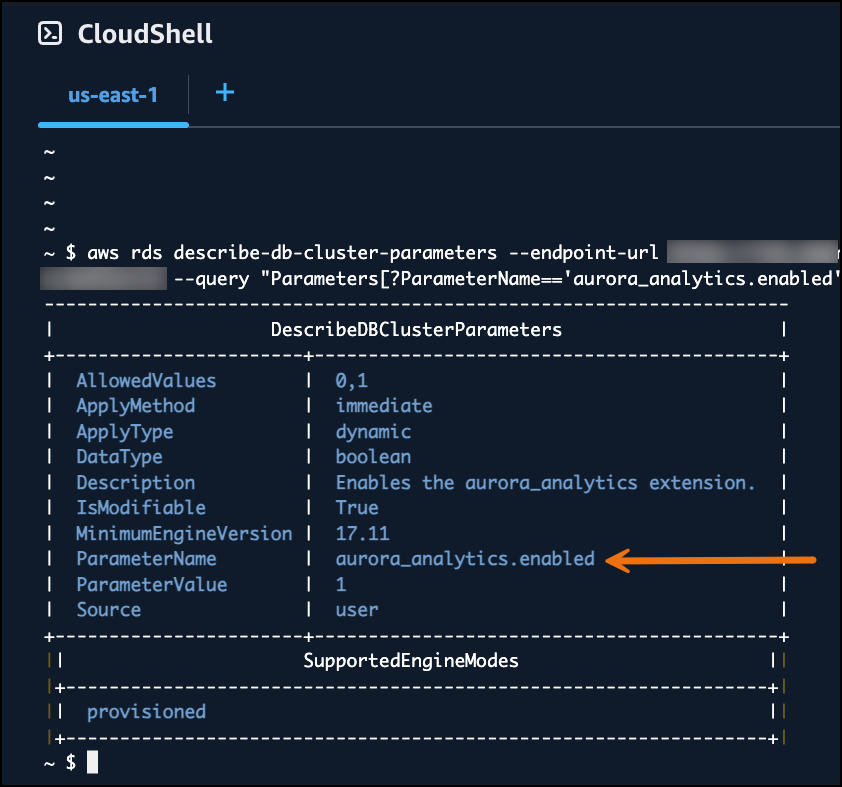
- Version Availability: The feature is supported on Aurora PostgreSQL major versions 17 (starting with version 17.11) and 18 (starting with version 18.6).
- Pricing & Region Availability: The capability is available immediately across all commercial AWS Regions and AWS GovCloud (US) Regions at no additional software charge. Customers pay only for the incremental Aurora compute resources consumed by the queries and standard Amazon S3 request costs.
- Operational Simplicity: Users activate the feature by attaching an IAM role with the
AuroraAnalyticsfeature to their cluster, enabling theaurora_analyticsextension, and defining foreign tables. Schemas are inferred automatically from file metadata, removing the need for manual column definitions.
Chronology and Evolution of the Integration
The path toward unifying transactional databases with analytical data lakes has been a multi-decade industry challenge. For years, organizations relied on a bifurcated architecture: Online Transaction Processing (OLTP) databases like PostgreSQL handled live application state, while separate Online Analytical Processing (OLAP) data warehouses and data lakes stored historical records in open formats like Parquet and Iceberg.
Bridging these two worlds typically required heavy data engineering investment. Engineers constructed complex data pipelines to push transactional updates out to data lakes, or conversely, built reverse-ETL jobs to pull historical snapshots back into operational databases so customer-facing applications could access context. These pipelines introduced latency, increased storage footprints, and proved notoriously brittle when upstream schemas evolved.
The inflection point for this latest architectural leap arrived when DuckLabs joined AWS. Recognizing the unmatched single-node analytical speed and lightweight design of DuckDB, AWS engineers began exploring ways to graft its execution engine directly into Aurora PostgreSQL. Rather than forcing data to move across network boundaries to meet compute engines, AWS brought the analytical compute engine directly to where the operational data lives—while maintaining a seamless bridge to cloud object storage.
Following rigorous internal testing and optimization phases, AWS officially rolled out the feature for Aurora PostgreSQL versions 17 and 18, enabling immediate deployment via the Amazon RDS console or standard psql clients.
Supporting Data and Technical Architecture
Under the hood, the new capability relies on sophisticated query optimization and distributed execution strategies designed to ensure high performance even as underlying datasets scale into the petabyte range.
Performance Optimizations
- Predicate Pushdown and Column Pruning: Aurora intelligently pushes filters down to the storage layer and discards irrelevant columns early in the execution plan. This guarantees that only the precise rows and columns required for a given query are read from Amazon S3.
- Intelligent Caching: Frequently accessed data lake blocks are automatically cached within the Aurora instance. Subsequent queries targeting the same historical data return significantly faster, reducing repetitive S3 read latencies.
- Granular Observability: Database administrators can audit query execution metrics using the custom
aurora_analytics_stat_statements()function, which surfaces detailed operational telemetry including rows scanned, bytes read from Amazon S3, and cache-hit ratios.
Practical Implementation Example
Setting up the feature requires minimal administrative overhead. An administrator begins by creating the extension:
CREATE EXTENSION aurora_analytics;Next, rather than manually mapping every column of a historical archive, engineers can point Aurora directly to an S3 object store housing Parquet or Iceberg files:
CREATE FOREIGN TABLE transaction_history ()
SERVER aurora_analytics_server
OPTIONS (
    location 's3://<my-bucket>/finance/transaction_history.parquet',
    format 'parquet'
);
Because Aurora automatically inspects file metadata to infer schemas, the parentheses remain empty. For large-scale data lakes comprising dozens or hundreds of tables, a single IMPORT FOREIGN SCHEMA statement can bulk-create foreign tables across an entire AWS Glue Data Catalog database instantly.
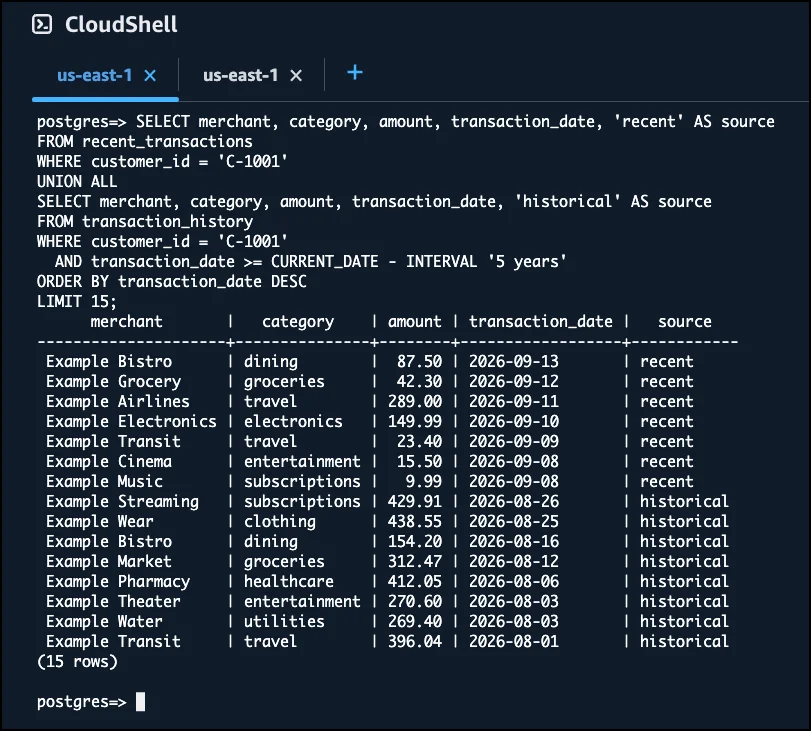
Once established, complex queries can seamlessly unify fresh, uncommitted operational writes with years of historical data in a single statement:

SELECT merchant, category, amount, transaction_date, 'recent' AS source
FROM recent_transactions
WHERE customer_id = 'C-1001'
UNION ALL
SELECT merchant, category, amount, transaction_date, 'historical' AS source
FROM transaction_history
WHERE customer_id = 'C-1001'
  AND transaction_date >= CURRENT_DATE - INTERVAL '5 years'
ORDER BY transaction_date DESC
LIMIT 15;
In this architecture, DuckDB executes the heavy lifting of scanning and analyzing the historical Parquet files in S3, while Aurora manages the live transactional records—delivering a unified result set without a single intermediate ETL pipeline. For workloads demanding single-digit-millisecond latencies, data can be permanently materialized into native Aurora tables using standard commands like CREATE TABLE AS SELECT or MERGE INTO.
Official Responses and Perspectives
While AWS has emphasized the engineering synergy between Aurora and DuckDB, the broader database and data engineering community has reacted with immense enthusiasm.
Industry analysts point out that this integration reflects a broader shift toward "composable data systems," where boundaries between operational and analytical silos continue to dissolve. By embedding DuckDB, AWS is validating the open-source analytical engine’s core philosophy: that efficient, vector-based query execution should be accessible wherever data resides, rather than locked inside monolithic, proprietary data warehouses.
"Whether you’re powering real-time dashboards, enriching transactions with historical context, or building AI agents that reason over both live and archived data, you can now do it all through a single, familiar interface," notes the official AWS engineering team behind the launch.
Furthermore, AWS leadership has highlighted that because this feature is built directly around the core open-source DuckDB engine, future performance gains and functional enhancements developed upstream within the DuckDB community will naturally flow into Amazon Aurora and potentially other AWS services down the line.
Implications for Enterprise Architecture and AI Development
The arrival of direct data lake querying inside Amazon Aurora PostgreSQL carries profound implications for software engineering teams, database administrators, and artificial intelligence developers alike.
1. Drastic Reduction in Operational Complexity
By eliminating reverse-ETL pipelines, organizations can decommission fragile cron jobs, reduce cloud storage duplication costs, and minimize the monitoring overhead associated with data synchronization failures. Engineering teams can redirect valuable cycles away from pipeline maintenance and toward core product feature development.
2. Supercharging AI Agents and LLM Workflows
As enterprises race to deploy generative AI applications and autonomous agents, a major technical bottleneck has been context fragmentation. AI agents often need access to both instantaneous state (such as a user’s current shopping cart or recent support ticket) and deep historical trends (such as five-year purchasing histories). Predicting every dataset an autonomous agent might require and pre-replicating it into a transactional database is functionally impossible.
With Aurora’s new capability, AI agents can query live operational databases and deep S3 data lakes simultaneously through a single PostgreSQL endpoint. This gives agents the comprehensive reasoning context they need on-the-fly, without requiring custom data integration layers for every new query pattern.
3. Workload Isolation and Scalability
For organizations dealing with heavy analytical scans that threaten to bog down primary operational databases, Aurora provides flexible escape hatches. Read queries against foreign tables can be offloaded to any read replica within an Aurora PostgreSQL cluster, protecting the primary writer instance from analytical resource contention. Meanwhile, hot data can be selectively materialized for ultra-low-latency access when sub-millisecond response times are mandatory.
Looking Ahead
As data volumes continue to skyrocket and expectations for real-time intelligence become standard across every digital touchpoint, architectural paradigms that isolate transactional and analytical data are increasingly showing their age. By natively fusing the transaction management of Aurora PostgreSQL with the analytical horsepower of DuckDB and the open storage standards of Apache Iceberg and Parquet, AWS has established a new benchmark for database design—delivering unprecedented power, simplicity, and cost-efficiency directly to developers.
 Sagoh
 Siti Muinah
 Reynand Wu
