
 By Nana Muazin
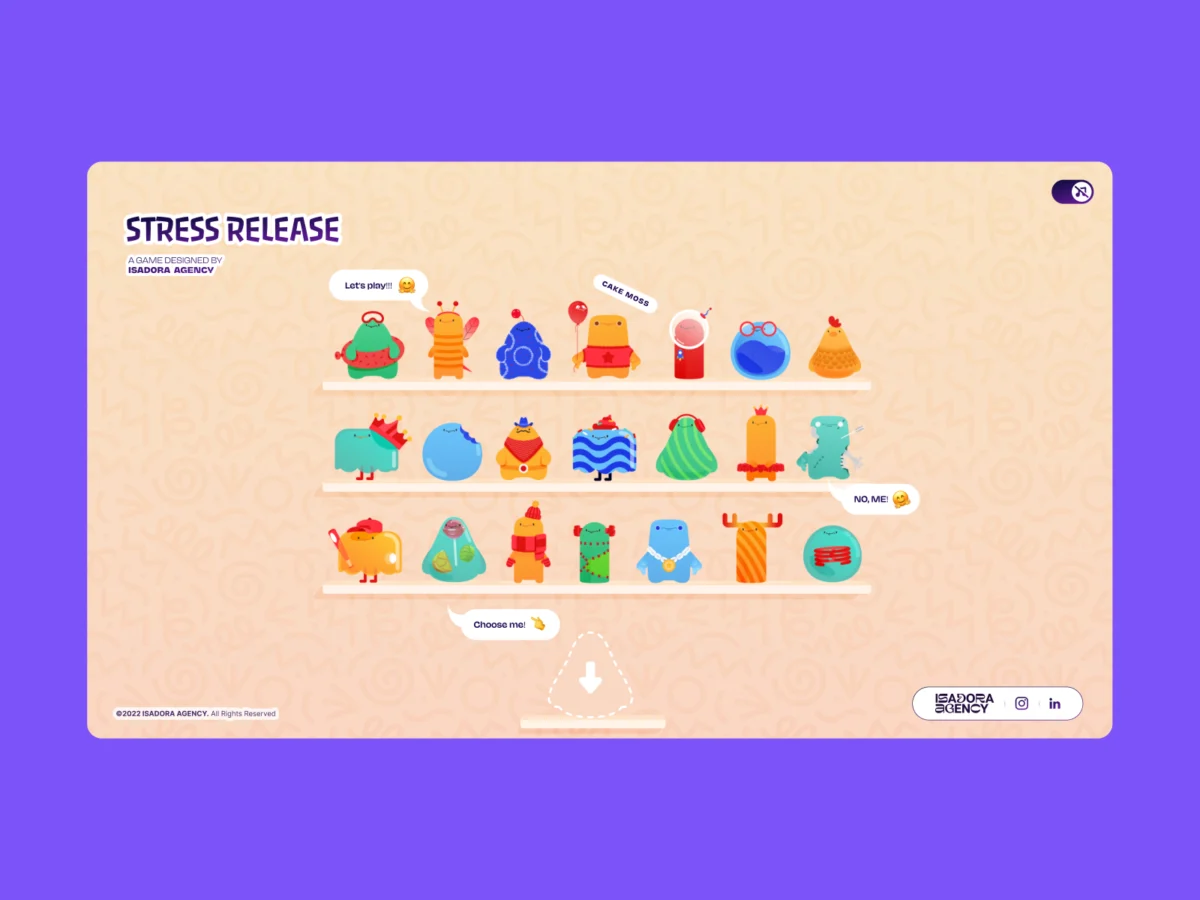
In the modern landscape of front-end web development, building interactive, bouncy, or destructive interfaces almost always triggers a collective industry reflex: reach for a physics engine. Frameworks like Matter.js, Cannon.js, or heavyweight WebGL solutions have long stood as the gold standard for creating immersive, gamified web experiences.
However, when the engineering team at Isadora Agency set out to build Stress Release—a digital stress-relief squeeze toy designed to let burnt-out creatives smash, stretch, and distort animated UI characters—they quickly realized that conventional physics libraries were the wrong tool for the job.
Instead of relying on algorithmic simulations, the team bypassed WebGL and Matter.js entirely. By combining programmatic Lottie state controls, DOM manipulation, and distance-based mathematics, they engineered an interactive web experience that honors precise artistic vision while maintaining absolute deterministic control over every frame.
Main Facts: The Architecture of Intentional Motion
When tasked with building a highly tactile web experience, architectural decisions must directly serve the art direction. For Stress Release, the core engineering challenge wasn’t about simulating realistic gravity, friction, or momentum; it was about honoring bespoke, artist-crafted keyframes.
The Problem with Physics Engines
Physics engines are exceptional at producing plausible motion. If an engineer needs a rubber ball to bounce randomly or debris to scatter realistically across a canvas, libraries like Matter.js excel.
However, Isadora Agency’s animators did not design characters to act like random bouncing balls. They produced intentional motion—complex, highly choreographed visual sequences tailored to specific user interactions. For instance, a "mega squeeze" reaction required a precise 181-frame build-up followed by a meticulously timed release sequence.
Running these assets through a physics simulator would have overridden the animators’ crafted keyframes with approximate, unpredictable algorithmic calculations. To preserve the integrity of the art direction, the team chose to scrap physics frameworks completely in favor of deterministic programmatic state control.
Core Technologies Deployed
- Lottie Animations: Serving as the visual backbone, delivering vector-based SVG animations rendered natively via JSON data.
- Standard DOM Elements: Bypassing complex canvas coordinate mapping by utilizing standard HTML elements, CSS custom properties, and native event listeners.
- Pythagorean Distance Mathematics: Using radial input mapping to translate user clicks into precise scoring zones and dynamic particle/explosion placements.
Chronology: From Concept to Optimized Execution
The development of Stress Release followed a deliberate engineering pipeline, moving from initial prototyping to performance tuning across desktop and mobile platforms.

Phase 1: Prototyping and Realizing the Limitations of Physics
During early prototyping, the Isadora Agency team experimented with traditional physics-based interactive models. They quickly discovered that random simulations conflicted directly with the tight, rewarding feedback loops required for a satisfying "squeeze toy" mechanic. If a user clicks a character, the feedback must be instantaneous, satisfying, and uniform in its narrative delivery. The team pivoted toward Lottie’s native API, mapping user actions directly to animation frame ranges.
Phase 2: Engineering Radial Input Mapping
To make clicking a character feel physically tactile, the team implemented a distance-based hit-detection system. Rather than relying on complex raycasting, they converted page coordinates into the character’s local coordinate space.
By measuring every click against the character’s center point using the Pythagorean theorem, a single distance variable was established:
// Character's center point in its own coordinate space
var x_center = parseFloat($("#playChar").width()  / 2);
var y_center = parseFloat($("#playChar").height() / 2);

// Click position relative to the character's top-left corner
var offset = $("#playChar").offset();
var X = parseFloat(e.pageX - offset.left);
var Y = parseFloat(e.pageY - offset.top);

// Vector from center to click point
var a = parseFloat(X - x_center);
var b = parseFloat(Y - y_center);

// Calculate straight-line distance
var distance = Math.hypot(a, b);
This single metric drove multiple outcomes simultaneously: reward point allocation, feedback intensity, and the exact placement of the explosion animation asset.

Phase 3: Segment-Based Animation Control
With the interaction math established, the team configured Lottie’s timeline to jump between specific frame ranges based on user actions. Each character asset was mapped with designated section arrays:
const play_segments = [
  charId: 0,
  sections:
    idle:     [0,  40],   // looping idle state
    squeeze1: [41, 80],   // light reaction
    squeeze2: [81, 120],  // medium reaction
    squeeze3: [121, 160], // heavy reaction
  ,
  playOrder: ["squeeze1", "squeeze2", "squeeze3"],
  endAnimation: [161, 200]
];
When a user interacts with the interface, the script halts the current loop, fires the next sequence in the play order, locks out overlapping clicks, and smoothly transitions back to the idle loop upon completion.
Supporting Data: Balancing Rich UX and Mobile Performance
While abandoning physics engines in favor of DOM-managed Lottie animations solved artistic control issues, it introduced a significant technical hurdle: file size and rendering performance.
Lottie JSON files can quickly become heavy, especially when dealing with dozens of unique character files and complex visual effects. To ensure the experience remained fluid across all devices—particularly resource-constrained mobile phones—Isadora Agency implemented strict optimization strategies.

Multi-Tiered Rendering Optimization
- The Character Shelf (High Density): On the main selection screen, 21 distinct character animations play simultaneously. To prevent main-thread stuttering, the team reduced rendering quality and throttled playback speeds:
shelf = lottie.loadAnimation( container: document.getElementById("charShelf" + i), renderer: "svg", loop: true, autoplay: true, path: "assets/shelf/" + shelfFolders[i] + "/" + shelfFolders[i] + ".json", ); lottie.setQuality(0.5); // 50% quality to reduce interpolation overhead shelf.setSpeed(0.6); // 60% speed to minimize frame calculations per second - The Active Play Screen (Focused Performance): When a user selects a single character to interact with, the application ramps performance back up to full fidelity:
playChar = lottie.loadAnimation(
  container: document.getElementById("playChar"),
  renderer: "svg",
  loop: true,
  autoplay: true,
  path: chosenChar.url,
);
lottie.setQuality(1); // Full quality since only one primary asset renders
Responsive Design via CSS Variables
Handling responsive layouts across diverse screen sizes is notoriously difficult when calculating bounding boxes in custom canvas environments. By building Stress Release natively in the DOM, the team bypassed these headaches entirely.
Responsive resizing was managed through dynamic CSS custom properties. By recalculating viewport dimensions on every resize event, SVGs scaled naturally inside their containers without losing active animation states:
const appHeight = () =>
  const doc = document.documentElement;
  doc.style.setProperty("--doc-height", `$window.innerHeightpx`);
  doc.style.setProperty("--doc-width", `$doc.clientWidthpx`);
;
window.addEventListener("resize", appHeight);
appHeight();
Official Perspectives: The Philosophy of Intentional Design
The architectural decisions behind Stress Release highlight a broader philosophical shift in advanced web development: technology stacks should never dictate creative output; rather, creative vision should dictate the technology stack.
Industry engineers frequently default to complex libraries simply because they are ubiquitous. However, Isadora Agency’s engineering rationale proves that simpler, deterministic tools can yield superior results when art direction requires precision.

By mapping Lottie’s native timeline capabilities directly to the DOM and managing interactions through straightforward mathematics, developers can achieve deeply engaging, tactile user experiences without bloating their applications with unnecessary physics engines or WebGL contexts.
Implications for Future Web Engineering
The success of Stress Release offers several critical takeaways for UX engineers, front-end developers, and digital agencies building highly gamified or interactive web applications:
- Deterministic Control Over Simulation: When brand identity, character personality, and micro-interactions rely heavily on bespoke timing, algorithmic physics can introduce unwanted variance. Programmatic state control guarantees that every user experiences the exact creative vision intended by the animators.
- DOM-Based Scalability: Leveraging standard DOM elements and SVGs simplifies responsive design, eliminating the complex coordinate-remapping layers often required by canvas-based WebGL implementations.
- Performance Pragmatism: Heavy animation formats like Lottie are entirely viable on mobile platforms provided developers implement smart resource throttling, such as lowering quality thresholds for background elements while preserving full fidelity for active, user-focused components.
Ultimately, the project demonstrates that crafting an unforgettable digital experience does not require the most complex technology stack on the market—it requires choosing the right technology to protect and honor creative intent.
 Nila Kartika Wati
 Evan Lee Salim
 Reynand Wu
