
 By Lina Irawan

By Alexey Pomigalov, PhD in History and Curator of the DataArt IT Museum
April 2026
Main Facts: The Deep Roots of Information Processing
Long before the advent of silicon microchips, binary code, or electronic networks, humanity was fundamentally engaged in the collection, organization, and preservation of data. History has traditionally framed the origin of data through the utilitarian lenses of commerce, taxation, and warfare. However, a profound shift in modern anthropology, bioarchaeology, and media archaeology points to an entirely different genesis: human biology, the cycles of nature, and the sheer survival of early communities.
Recent investigations into ancient artifacts and symbolic communication reveal that data processing began not with the ledger books of kings, but with observation, abstraction, and external memory. From the notched baboon fibulas of the Stone Age to the proto-cuneiform inventory tablets of ancient Sumer, the Hellenistic library catalogs of Alexandria, and the programmable punch-card systems of the Industrial Revolution, the imperative to record information has defined human civilization.
Today, this millennia-long evolution is the subject of Retrospect (accessible at https://retrospect.dataart.com), a newly published online project dedicated to charting the history of data-driven culture. Curated alongside the initiatives of the DataArt IT Museum (https://museum.dataart.com), these findings demonstrate that information architecture is as old as humanity itself.
Chronology of Data Civilization: A Historical Timeline
To understand how modern data science emerged, we must trace the timeline of externalized memory and information management across ten millennia:
- c. 35,000 BCE – Paleolithic Era: Early humans, predominantly women tracking biological cycles and environmental shifts, begin recording celestial patterns. The Lebombo Bone and similar artifacts emerge as humanity’s earliest physical "databases."
- c. 3300–3200 BCE – The Dawn of Tabulation: In the Sumerian city of Uruk, scribes press proto-cuneiform symbols into clay tablets to record barley and malt deliveries for brewing—effectively inventing the world’s first spreadsheet.
- 305–30 BCE – Hellenistic Period: Callimachus of Cyrene compiles the pinakes at the Great Library of Alexandria, establishing the foundational principles of library indexing, metadata assignment, and physical catalog architecture.
- 1725 CE – The Programmable Tapestry: Basile Bouchon introduces perforated paper tape to control textile patterns in Lyon, France, marking the birth of symbolic data storage for mechanical control.
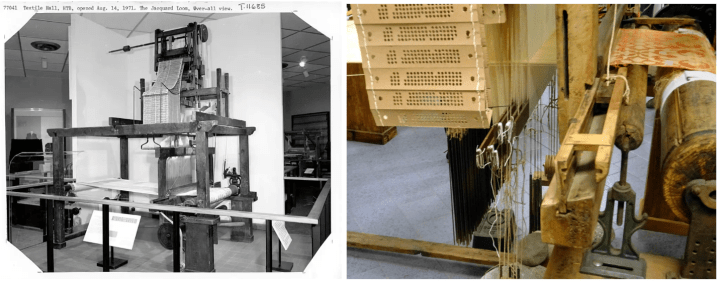
- 1804 CE – The Jacquard Loom: Joseph-Marie Jacquard perfects the punched-card system, creating a fully automated, programmable manufacturing infrastructure that directly inspires Charles Babbage’s Analytical Engine.
- 1890 CE – Automated Census Processing: Herman Hollerith applies punched-card tabulating machines to process the United States Census, reducing a decade-long manual calculation process to just three years.
- 2010 CE – Digital Humanities Breakthrough: Researcher Genevieve von Petzinger employs relational database software to cross-analyze non-figurative geometric symbols across 146 French Paleolithic cave art sites, proving that art and structured data originated in tandem.
Supporting Data & Artifact Analysis
The material evidence of data processing throughout history challenges long-held assumptions about gender roles, technological development, and the nature of early human expression.
1. The Lebombo Bone: The First Lunar Database
Discovered in the Border Cave of the Lebombo Mountains, the Lebombo Bone is a baboon fibula featuring 29 distinct notches carved along its edge. For decades, traditional archaeological frameworks assumed such artifacts were hunting tallies created by men—aligning with the outdated "Man the Hunter, Woman the Gatherer" paradigm.
However, modern bioarchaeology and anthropological revisions suggest a different origin. Given that early human tracking of lunar phases aligned intimately with biological rhythms and seasonal survival, these notches represent early lunar calendars likely maintained by women. This object reframes our understanding of data: its earliest purpose was not to quantify conquest, but to synchronize human life with natural cycles.
2. The Uruk Brewing Tablet
Unearthed among rubbish and floor fillings in the ancient Sumerian city of Uruk, a small clay tablet dating to roughly 3300–3200 BCE stands as a monumental milestone in information design. Deciphered by archaeologist Robert K. Englund, the tablet records allocations of barley groats and malt used for beer production.
What makes the artifact revolutionary is its layout. By organizing data into distinct sectors, rows, and columns, the ancient scribe created a structured grid. This tabular arrangement allowed for the rapid cross-referencing of quantities and ingredients—a conceptual leap as impactful to administrative efficiency as the invention of the wheel was to transport.

3. The Pinakes of the Library of Alexandria
As human knowledge expanded, recording data was no longer sufficient; retrieval became the primary engineering challenge. In Ptolemaic Egypt, poet and bibliographer Callimachus of Cyrene solved this by creating the pinakes—a set of 120 bibliographic tablets that served as a master index for the Great Library’s collection of over half a million papyrus scrolls.
Each entry contained the author’s name, birthplace, lineage, educational background, and a critical summary. By assigning physical addresses and standardized metadata to each scroll, Callimachus established the foundational indexing principles that govern modern libraries and digital databases to this day.
4. Paleolithic Geometric Symbols and Relational Databases
For over a century, researchers studying European cave art fixated primarily on figurative drawings of horses, mammoths, and human hunters. They frequently dismissed the surrounding non-figurative geometric signs—dots, lines, triangles, and spirals—as mere decorative doodles.
In 2010, paleoanthropologist Genevieve von Petzinger upended this consensus. Utilizing modern relational database software, she cataloged and cross-referenced geometric signs from 146 Ice Age rock art sites spanning 25,000 years. Her analysis revealed a startlingly consistent set of just 32 signs used repeatedly across vast geographical distances. Without modern computational tools, recognizing these continent-wide patterns would have been virtually impossible, illustrating how advanced data structures can unlock prehistoric mysteries.
Official Perspectives and Expert Insights
The intersection of media archaeology, historical preservation, and data science has drawn commentary from leading scholars examining how ancient information systems mirror contemporary digital networks.

"The first ‘database’ was a tool to track the most important recognizable patterns—cycles of life," explains Dr. Alexey Pomigalov, historian and curator of the DataArt IT Museum. "Life itself became the very first reason humans felt the need to record, measure, and process. These recordings began evolving as more life-related matters became countable, eventually becoming vital for life-or-death decisions."
Scholars emphasize that the erasure of women’s contributions as history’s first "human computers" has distorted the mainstream narrative of technological progress. Patriarchal historiography frequently overlooked the domestic, biological, and observational labor required to sustain early communities, attributing complex record-keeping exclusively to state administrators and merchants.
Furthermore, historians of technology emphasize the direct lineage connecting the Jacquard loom to modern computing. By separating instruction logic from physical mechanics via punched cards, industrial engineers proved that abstract ideas could be encoded, stored, and executed repeatedly.
"The importance of the Jacquard loom lies less in automated weaving than in abstraction," notes Pomigalov. "It marked the moment when patterns became code—transferable sequences that could be stored, reused, and combined. This conceptual leap… made later computational systems imaginable."
Implications: The Continuity of the Data Civilization
The realization that data processing spans tens of thousands of years carries profound implications for how we view our technological present and future.

- Bridging Humanities and Sciences: The application of computational tools—such as relational databases—to archaeological and historical research has permanently dissolved the artificial barrier between the sciences and the humanities. As demonstrated by modern data-driven archaeology, complex algorithms can decode artistic and cultural artifacts, revealing deep structural patterns hidden within human history.
- Redefining "Data": Society often equates data with digital streams, corporate metrics, and algorithmic feeds. Historical perspective reminds us that data is fundamentally an evolutionary survival mechanism. From Stone Age bone notches to cloud servers, the underlying objective remains identical: to organize reality, reduce environmental uncertainty, and transmit knowledge across generations.
- The Anonymous Architects of Civilization: Just as the ancient women tracking lunar cycles and the anonymous scribes of Uruk laid the groundwork for complex society, contemporary data workers build digital architectures whose beneficiaries they will never meet.
As explored in the Retrospect project, humanity has spent millennia refining a single, continuous enterprise: the encoding of reality into external memory storage. Whether sitting in a prehistoric cave or a modern office analyzing massive datasets, the human impulse remains unchanged. To borrow the guiding ethos of our data civilization: Recount, Sort, and Figure Out.
 Azzam Bilal Chamdy
 Asep Darmawan
 Suro Senen
