By Alexey Pomigalov, PhD in history and curator of the DataArt IT Museum Published: April 2026 Source Material: Retrospect Online Project
Main Facts
Humanity’s relationship with data did not begin in corporate boardrooms, modern silicon laboratories, or war rooms. Recent breakthroughs in bioarchaeology, bioanthropology, and media archaeology reveal a startling truth: data processing was born out of biology, survival, and the desire to track the cyclical patterns of life itself.
For decades, the dominant historical paradigm was tethered to the "Man the Hunter, Woman the Gatherer" archetype, which routinely overlooked the expansive, foundational contributions of women in early cognitive milestones. Contemporary forensic science, DNA analysis, and paleoanthropological studies have upended this traditional narrative. It was prehistoric women—stargazing, tracking biological cycles, and monitoring seasonal shifts—who first engaged in systemic observation, abstraction, and external memorization.
The historical timeline of information architecture demonstrates a continuous thread from prehistoric notched bones to relational databases. Key milestones in this evolution include:
The Lebombo Bone (c. 35,000 BCE): A baboon fibula bearing 29 distinct notches, re-evaluated by modern anthropologists not as a hunter’s tally, but as an ancient lunar calendar engineered by women.
The Uruk Administrative Tablet (c. 3300–3200 BCE): The earliest known tabular representation of numerical data, tracking barley and malt distribution for an ancient Sumerian brewery.
The Pinakes of the Library of Alexandria (c. 305–30 BCE): The creation of physical indexing, addressing, and library cataloging systems by Callimachus of Cyrene, setting the blueprint for information retrieval.
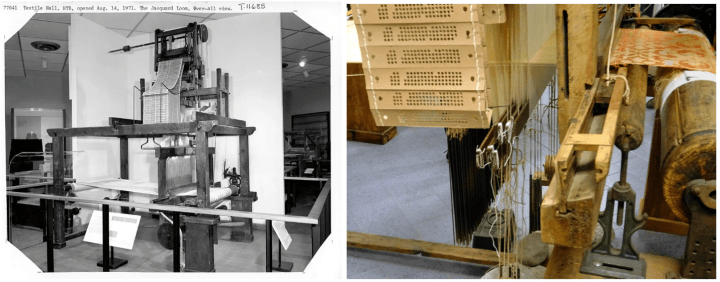
The Jacquard Loom (1804): The industrial leap from manual execution to programmable logic using perforated punch cards, establishing the separation of logic from physical mechanics.
Modern Relational Databases (21st Century): Advanced software applications utilized by modern researchers, such as paleoanthropologist Genevieve von Petzinger, to decode the 32 recurring geometric signs found in Stone Age cave art.
These historical touchpoints underscore a singular reality: data has always been the fundamental medium through which humanity negotiates its survival, codifies its environment, and communicates across millennia.
Chronology: The Milestones of Data Civilization
To trace the lineage of data processing is to witness humanity’s persistent drive to externalize memory. Across thousands of years, the tools have shifted from bone and clay to punch cards and relational software, but the core objective remains unchanged: to recount, sort, and figure out the world.
Phase I: The Biological Dawn and the First Tally (c. 35,000 BCE)
Picture a woman from a Stone Age tribe in southeastern Africa sitting quietly on an elevated rock. Night after night, she observes the lunar cycle. She notices that the glowing orb shifts its shape, waning and waxing in a predictable rhythm. Wanting to track this cadence so she can anticipate the full moon’s return, she picks up a discarded baboon fibula bone and carves a notch for each passing night.
For years, archaeologists cataloged artifacts like the Lebombo Bone—unearthed in the Border Cave of the Lebombo Mountains—as simple hunting tallies. However, modern anthropological re-evaluations suggest a much more profound origin. With 29 distinct notches carved along its edge, the bone served as an early lunar calendar. This shifts our understanding of data history: data did not originate from commerce or military campaigns; it originated from biology, reproduction, and the rhythms of the natural world.
By externalizing memory onto bone, early humans initiated the "data civilization." They moved from passive observation to active recording, building an external storage system that allowed future generations to build upon recognized patterns.
Phase II: The Birth of the Spreadsheet in Sumeria (c. 3300–3200 BCE)
As human societies transitioned into urban settlements, the scale of resources demanded structural innovation. If the bone tally was the first diary entry of data, the Sumerian clay tablet was its first corporate spreadsheet.
Discovered in the ancient city of Uruk in modern-day Iraq, a small proto-cuneiform clay tablet—now permanently housed in the Louvre Museum in Paris—dates back over five thousand years. Deciphered by archaeologist Robert K. Englund, the tablet records the delivery of barley groats and malt from two distinct individuals for the production of beer.
What makes this artifact revolutionary is its format: rows and columns. The ancient Sumerian executive who scored this clay used a tabular layout to demonstrate the peculiarities and interconnections of raw commodities. This grid structure became the ultimate readable format for correlated data, predating the modern spreadsheet by millennia while proving just as crucial to civilization as the invention of the wheel.
Phase III: The Architecture of Retrieval at the Library of Alexandria (c. 305–30 BCE)
As human output expanded, recording information was no longer enough; finding it became the primary bottleneck. In the scholarly hub of Ptolemaic Egypt, the Great Library of Alexandria housed over half a million papyri rolls. Navigating this vast mountain of knowledge required an entirely new conceptual framework: physical indexing.
Callimachus of Cyrene, a brilliant bibliographer, poet, and researcher, solved this crisis by developing the pinakes—a 120-tablet cataloging system that hung near the storage containers. These tablets provided the title, author’s name, birthplace, lineage, educational background, and a brief bibliographical summary of every scroll.
This system transformed unstructured collections into navigable databases. By assigning a physical address and descriptive metadata to each unit of information, Callimachus laid the conceptual foundation for modern library science and digital storage architecture.
Phase IV: Programmable Logic and the Industrial Revolution (1705–1890)
For centuries, human computational processing was largely performative—exhibited through the intricate choreography of cathedral clocks and mechanical automata that staged order in public squares. However, the Industrial Revolution transformed this spectacle into a production infrastructure.
In 1725, Lyon textile worker Basile Bouchon used perforated paper tape to control weaving patterns, an idea refined in 1804 by Joseph-Marie Jacquard into a fully automated loom. By stringing together chains of punched cards, Jacquard encoded complex textile designs into binary sequences.
The Jacquard loom redefined the boundary between art and engineering. For the first time, instructions were treated as independent data, separating abstract logic from physical mechanics. This direct lineage inspired Charles Babbage’s Analytical Engine and eventually led Herman Hollerith to employ punch cards to process the 1890 United States Census in a fraction of the traditional time, igniting the modern age of automated data processing.
Supporting Data and Technical Analysis
The evolution of data processing is quantitatively supported by recent archaeological and computational findings:
The Lebombo Bone Dimensions: A baboon fibula featuring precisely 29 distinct notches, mirroring the lunar synodic month (approximately 29.5 days).
The Uruk Tablet Parameters: Excavated in Uruk (Warka), dated 3300–3200 BCE, utilizing proto-cuneiform symbols where full-round figures represented barley groats and sector lines delineated malt allocations.
Alexandrian Scale: The Great Library housed over 500,000 papyri rolls, managed by just 120 pinakes (tablets) acting as a comprehensive directory.
Paleolithic Sign Systems: Paleoanthropologist Genevieve von Petzinger’s relational database analysis of 146 French rock art sites spanning 35,000 to 10,000 BCE revealed exactly 32 distinct non-figurative geometric symbols, proving that prehistoric humans utilized a standardized visual lexicon long before the advent of formal writing.
Official Perspectives and Academic Insights
The re-examination of early data systems has sparked vibrant discussions across the academic community, bridging the gap between classical humanities and modern digital science.
Speaking on the shift in anthropological perspectives, curators and historians emphasize that the marginalization of women in early technological histories was an artifact of patriarchal historiography rather than historical reality. As bioarchaeology and forensic techniques advance, the narrative of early human innovation is becoming more inclusive.
Furthermore, modern researchers highlight the profound impact of computational tools on traditional disciplines. In an interview reflecting on her work with Paleolithic cave art, Genevieve von Petzinger noted that the application of relational database software was the ultimate game-changer. Without modern computing power, processing the spatial and temporal distributions of 32 abstract geometric symbols across nearly 150 European sites would have remained an insurmountable task.
As Alexey Pomigalov, curator of the DataArt IT Museum, points out in the Retrospect project:
"Data is what we invented and encoded to transmit through millennia without even knowing the recipient."
This perspective reframes historical artifacts not as static relics of the past, but as active, trans-generational messages designed to be unpacked by future descendants.
Implications for Modern Data Civilization
The journey from the notched baboon bone of the Lebombo Mountains to the relational databases of the twenty-first century carries profound implications for how we view our technological present and future.
The Convergence of Art and Data: Von Petzinger’s work with Paleolithic symbols demonstrates that art and data processing were birthed simultaneously. Abstract communication was humanity’s first attempt to create a shared operational reality.
The Democratization of Historiography: Modern media archaeology continues to dismantle the elitist myths of technological evolution. By recognizing that the earliest "computers" and data managers were women tracking lunar cycles and agricultural yields, we expand our cultural pedigree.
The Enduring Architecture of Information: Whether carved into bone, stamped into clay, punched into paper cards, or stored in silicon arrays, the core mechanics of data remain constant: observation, abstraction, externalization, and retrieval.
As we sit in modern offices querying massive datasets, we are participating in an unbroken human tradition that stretches back tens of thousands of years. We are simply carrying forward the ancient imperative passed down through the millennia: to recount, sort, and figure out our world.

 By Raul Delapena Setiawan



 Lina Irawan
  Nana
Nana  Nila Kartika Wati