
 By Basiran
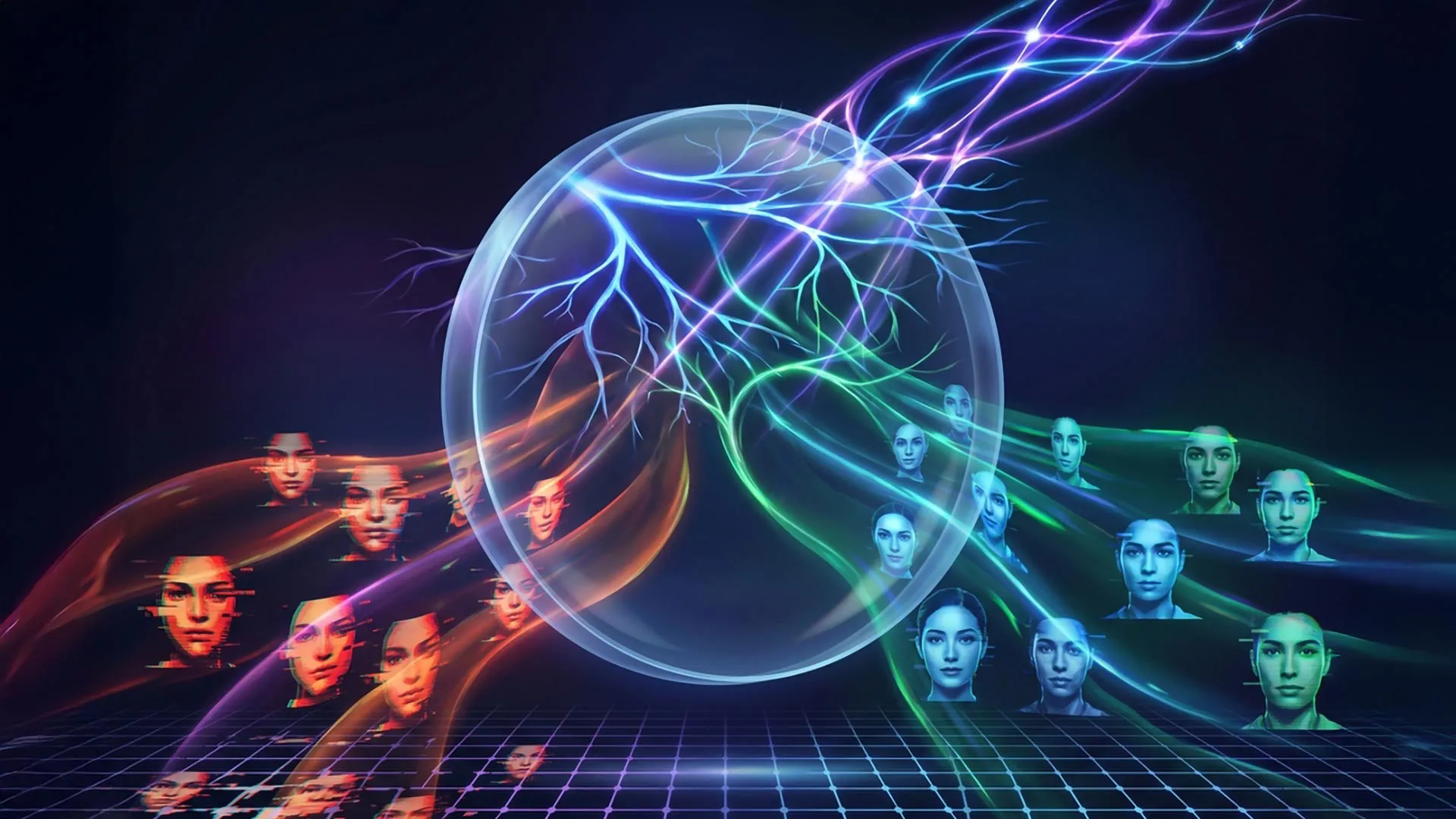
In an era where generative artificial intelligence can synthesize hyper-realistic human likenesses with terrifying precision, the integrity of digital media has become a primary security concern. As deepfakes proliferate, current detection methods—which rely heavily on power-hungry, sequential digital processing—are struggling to keep pace with the sheer volume of content flooding the internet. Now, a team of researchers at the University of California, Los Angeles (UCLA) has unveiled a radical departure from traditional computing: an optical-neural processor that uses the physical properties of light to identify manipulated videos with unprecedented speed and resilience.
Published in the journal eLight under the title "Scalable, Energy-Efficient Optical-Neural Architecture for Multiplexed Deepfake Video Detection," the study introduces a hybrid system that treats light as a computational engine, allowing for the simultaneous analysis of multiple video streams. By shifting the burden of inference from digital transistors to the physical diffraction of light, this breakthrough offers a scalable, low-energy solution to one of the most pressing technical challenges of the decade.
The Growing Crisis of Synthetic Media
The rapid evolution of generative AI has created a "cat-and-mouse" game between synthetic media creators and detection software. Early deepfakes were often marred by discernible artifacts—blinking inconsistencies, unnatural skin textures, or pixelated edges. Modern models, however, are increasingly adept at mimicking the nuanced micro-expressions and spectral signatures of real human faces.
Existing digital detection systems operate within the constraints of von Neumann architecture, where data must move between memory and processing units. A single, high-fidelity deepfake analysis can demand hundreds of billions of floating-point operations. When scaled to social media platforms processing millions of videos daily, the energy consumption and latency of these digital pipelines become prohibitive. Furthermore, digital systems are inherently vulnerable to "adversarial attacks"—subtle, pixel-level alterations designed to trick algorithms into classifying a fake as authentic.
A Chronology of the UCLA Innovation
The development of this optical-neural architecture represents the culmination of years of research into diffractive optical neural networks (DONNs).
- Conceptualization: Led by Professor Aydogan Ozcan, the team identified that the bottleneck in deepfake detection was the digital decoding layer. They sought to replace this with a "passive" optical layer that performs calculations as light propagates through space.
- Hybrid Architecture Design: The team engineered a system where a lightweight digital encoder first extracts essential spatial, spectral, and temporal features from a video. This information is encoded as a phase pattern and projected via a spatial light modulator (SLM).
- Optical Processing: The resulting wavefront passes through a free-space optical decoder. Unlike digital processors that check one video at a time, the light wave carries information for multiple videos simultaneously, effectively "multiplexing" the analysis.
- Proof of Concept: Through successive experiments, the team moved from small-scale testing to processing 15, and eventually 18, video streams in a single optical pass, proving the architecture’s scalability.
Supporting Data: Efficiency and Precision
The performance metrics reported by the UCLA team are significant. In trials using the Celeb-DF dataset, the processor demonstrated an average detection accuracy of 97.79%. Perhaps more importantly, the system achieved a sensitivity of 99.86%. In the context of deepfake detection, high sensitivity is vital; it ensures that the "false-negative" rate—the likelihood of a sophisticated deepfake slipping through the net—is kept to an absolute minimum, measured here at approximately 0.14%.
When the researchers scaled the capacity to 18 videos simultaneously, the system maintained a robust 96.13% accuracy rate. Furthermore, by adding two optimized passive diffractive layers to the decoder, the team increased detection accuracy by roughly 6.8%. Because these diffractive layers are static, physical structures, they perform these additional calculations without consuming any extra electrical power, effectively "processing for free" as the light passes through the hardware.
Testing Against Next-Generation Threats
One of the most compelling aspects of the study was the system’s performance against Google’s VEO-3 generated content. Older detection models often fail against newer AI models because they are "overfit" to the artifacts of previous-generation deepfakes. However, the UCLA optical processor, after minimal fine-tuning, achieved 94.80% accuracy and 97.61% sensitivity on these previously unseen, high-complexity videos. This suggests that the optical-neural approach is not just a static filter but a flexible foundation that can adapt as generative AI technology matures.
Official Responses and Technical Nuance
Professor Aydogan Ozcan and his team, including lead contributors Parnian Ghapandar Kashani and Dr. Shiqi Chen, emphasized that this system is not intended to replace digital AI entirely. Instead, it serves as a "high-throughput, attack-resilient first layer of defense."
"The goal is to act as a triage system," explains the research team. "Massive volumes of video content can be screened in parallel at the optical layer. Only the content flagged as suspicious is then routed to more computationally intensive digital neural networks for deeper forensic analysis."
This hierarchical approach addresses the two primary weaknesses of digital detection: throughput and security. By performing the initial screening in the physical domain, the system avoids the energy costs associated with digital computation. Furthermore, because the model’s parameters are physically encoded within the diffraction of light, the system possesses an inherent "hardware-level" security. An attacker looking to reverse-engineer the detector to craft an adversarial bypass faces the immense difficulty of measuring the complex phase-transformation properties of the diffractive layers, making the system significantly harder to fool than software-based counterparts.
Implications for the Future of Media Integrity
The implications of the UCLA study extend far beyond simple social media moderation. As society grapples with the potential for deepfakes to influence democratic processes, undermine public trust, and facilitate fraud, the need for scalable, reliable, and energy-efficient hardware becomes paramount.
Scalable Content Moderation
Current moderation teams are overwhelmed by the sheer volume of synthetic content. An optical processor capable of handling dozens of streams at once could reduce the operational costs of content moderation by orders of magnitude, allowing platforms to filter content in real-time at the edge, rather than waiting for it to be uploaded and processed in a centralized cloud server.
Surveillance and Security
In security-critical applications, such as airport screening or real-time surveillance, the ability to authenticate video feeds instantly is a matter of national security. The resilience of the UCLA system against image noise, blur, and JPEG compression—all of which are common in real-world surveillance footage—makes it a uniquely viable candidate for deployment in rugged, high-stakes environments.
The Evolution of Optical AI
This research represents a broader shift toward "optical computing," a field that seeks to overcome the limitations of Moore’s Law by using photons rather than electrons. By performing neural network operations through light diffraction, researchers are finding ways to execute complex mathematical operations at the speed of light. As this technology matures, we may see a transition where the most energy-intensive parts of AI models—the initial filtering and feature extraction—are offloaded to static, physical optical structures, leaving digital processors to handle only the most complex, high-level reasoning.
Conclusion
The UCLA team has provided a glimpse into a future where the physical properties of light serve as the first line of defense for digital truth. By proving that optical-neural processors can maintain high sensitivity and accuracy even against the most modern generative models, they have provided a viable roadmap for a more secure digital future. While the technology is currently in the experimental stage, its ability to scale, save energy, and resist adversarial manipulation positions it as a cornerstone for the next generation of AI-driven security tools. As generative AI continues to blur the lines between reality and simulation, the ability to distinguish the two at scale will not just be a technological advantage—it will be a necessity.
 Ali Ikhwan
 Reynand Wu
 Ammar Sabilarrohman
