
 By Jia Lissa
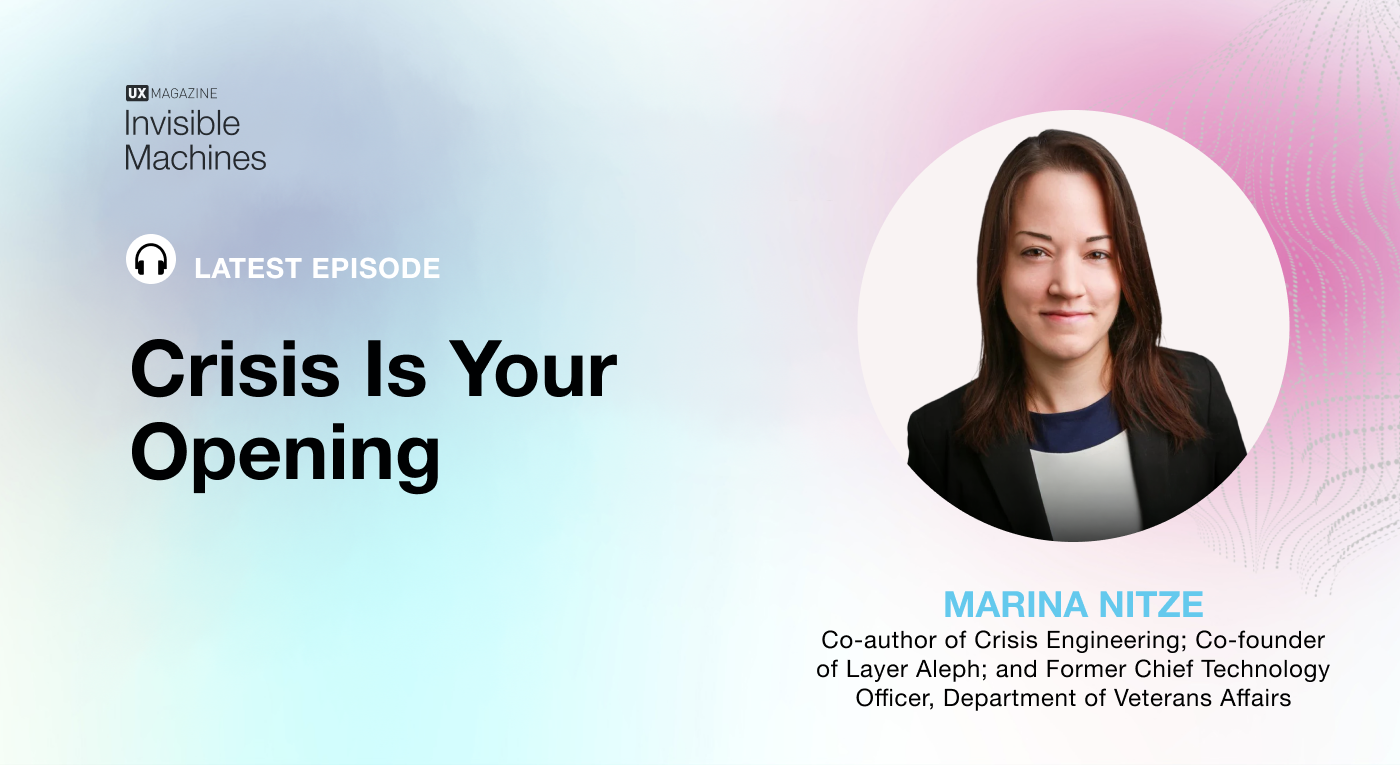
On sensemaking, the stories organizations tell themselves, and why systemic failure is sometimes the only force powerful enough to shatter comforting fictions—with insights from former VA CTO Marina Nitze.
Main Facts
In the modern enterprise, the single greatest threat to survival is not external competition, shifting markets, or disruptive technology; it is the comforting, self-sustaining fiction that organizations tell themselves about how they actually operate.
This core thesis anchors the work of Marina Nitze, former Chief Technology Officer of the Department of Veterans Affairs, co-founder of Layer Aleph, and co-author of Crisis Engineering and Hack Your Bureaucracy. According to Nitze, when organizations are forced to map their workflows from end to end—truly following a process from its inception to its final execution—they rarely discover a finely tuned machine. Instead, they discover a void.
This systemic blindness stems from what organizational psychologist Karl Weick termed "sensemaking": the continuous, automatic process by which human brains and institutions construct coherent narratives to make sense of a chaotic world. Once these stories are assembled from convenient subsets of facts, they become remarkably resistant to revision.
When a major disruption strikes—such as the unprecedented surge that hit California’s unemployment insurance system during the onset of the COVID-19 pandemic—these institutional narratives collide with reality. The resulting friction shatters old mental models, creating a narrow, highly volatile window of opportunity. Known in Crisis Engineering as a "useful crisis," this brief window is often the only moment when decades of calcified bureaucracy can be restructured in a matter of hours. As artificial intelligence begins to automate and probe enterprise workflows at an unprecedented scale, the failure to understand the difference between an organization’s fictional map and its operational territory is fast becoming an existential risk.
Chronology
To understand how institutional fiction replaces operational reality, it is instructional to examine specific case studies from Nitze’s extensive career in public-sector transformation and crisis response.
1. The Pandemic and the Phantom Call Center (California, 2020)
- The Backstory: When global lockdowns triggered mass layoffs, California’s state unemployment system buckled under historical volumes. Citizens lost jobs, homes, and financial stability, prompting intense inquiries from the governor’s office.
- The Institutional Narrative: Across every level of the state’s hierarchy—from front-line intake workers to middle managers and top executives—the official response to mounting pressure was uniform: "Don’t worry. We have the call center. People who need help can call."
- The Reality Check: When Nitze and her Layer Aleph colleagues physically investigated the "call center," they walked into a cavernous room filled with empty cubicles. A single friendly employee sat in the corner, thoroughly confused as to why anyone thought he ran a call center. He managed a team of claims processors whose phones happened to ring when citizens dialed a main public number. When those employees were sent home to quarantine, the number routed to empty desks.
- The Verdict: There was no call center. There had never been a true call center. Yet the phrase had been repeated like a talisman for years, completely unexamined because it provided psychological comfort to executives.
2. The Foster Grandparent Licensing Loop (Pre-Pandemic)
- The Backstory: Nitze tackled a notoriously sluggish six-month timeline required to license "foster grandparents"—elderly individuals caring for their own grandchildren in state custody who desperately needed monthly stipends and financial support.
- The Disconnect: Following the workflow from start to finish (a task nobody had ever officially performed), Nitze observed a caseworker pulling out a physical, carbon-copy paper form to request a grandmother’s driving record from the Department of Motor Vehicles (DMV). The caseworker complained bitterly about DMV bureaucracy.
- The Cross-Jurisdictional Discovery: Ignoring traditional bureaucratic boundaries, Nitze visited the local DMV office. The DMV clerk laughed, explaining that she simply opened an email folder, clicked a PDF, and returned records within an hour. She found the carbon-copy paper forms baffling, assuming they were an archaic child-welfare policy.
- The Resolution: Neither woman was incompetent; each operated within a localized story that blamed the other. By simply introducing them, Nitze shaved 30 days off the timeline. The redundant step was eventually eliminated entirely when no one could justify what a grandmother’s historical parking tickets had to do with her fitness to care for a child.
Supporting Data & The Anatomy of a "Useful Crisis"
Nitze’s framework asserts that not all crises are equal, nor are they merely emotional events to be panicked through. Instead, Crisis Engineering defines a "useful crisis" through five precise, empirical indicators. If an event meets these criteria, it presents a rare institutional window for structural change:
- Fundamental Surprise: The organization genuinely did not see the disruption coming.
- Disruption in Core Function: Essential operational mechanics fail—websites crash, orders stop shipping, or benefit claims freeze.
- Rigid Timeline: External pressures dictate an unyielding schedule (e.g., a major product launch or a live event like a Taylor Swift concert).
- High Visibility: Public scrutiny is intense; executive leadership is forced to answer to the media, stakeholders, or the front page of major news outlets.
- Failure of Sensemaking: The reality of what is happening completely shatters the internal narrative of how the organization believes it works.
This fifth indicator acts as the emotional and cognitive engine of transformation. Human beings—and by extension, the institutions they build—exhibit a profound, visceral aversion to cognitive dissonance. When a crisis shatters an old mental model, there is a brief temporal window (lasting hours or days) where the organization is cognitively untethered.
Drawing on the classic economic philosophy of Milton Friedman—who noted that only a crisis develops actual ideas that are lying around—Nitze emphasizes that organizations must have pre-vetted, innovative proposals ready before the disruption hits. Enterprises that fail to prepare waste these windows on endless deliberation. They form task forces, commission studies, schedule status meetings, and produce lengthy progress reports. While this behavior creates an illusion of seriousness and leadership engagement, it ultimately serves only to stall until the crisis window slams shut.
Official Responses and Industry Perspectives
The urgency of Nitze’s framework has been amplified by the rapid convergence of enterprise systems and artificial intelligence. This shift forms the core focus of discussions on programs like the Invisible Machines podcast, co-hosted by Robb Wilson and Josh Tyson.
According to Wilson and Tyson, consumer adoption of artificial intelligence has wildly outpaced enterprise adoption. Today, everyday individuals—patients, veterans, disgruntled consumers, and technically curious citizens—possess access to agentic AI tools capable of probing, testing, and stress-testing corporate systems at scales and speeds previously unimaginable.
The AI Threat Vector
The automated AI call center attack is no longer a hypothetical exercise in science fiction. It is a baseline irritant: automated bots capable of navigating complex Interactive Voice Response (IVR) phone trees, bypassing digital tripwires, locating human operators, and extracting customer service concessions autonomously.
When scaled across an angry consumer base utilizing modern AI agents, hidden system vulnerabilities are exposed instantly. Nitze’s team previewed a smaller-scale version of this phenomenon during the pandemic, when a dedicated TTY (teletypewriter) line intended for deaf and hard-of-hearing claimants was shared on online Reddit forums. Daily call volumes skyrocketed from 40 to numbers that completely crippled the infrastructure. AI will find these systemic gaps orders of magnitude faster, exposing the fatal mismatch between corporate maps and operational territories.
The Automation Trap
During their discussions with Nitze, Wilson issued a stark warning regarding enterprise knowledge management and AI deployment. Many organizations are eager to rush into AI automation to cut costs, ignoring the foundational knowledge-management layer required to give AI agents authentic institutional context and historical memory.
Wilson argues that organizations attempting to automate flawed workflows without walking the process first are essentially automating the map, not the territory. They are building highly efficient digital pipelines for tasks like generating unnecessary carbon-copy driving record requests. Without unearthing implicit knowledge—the operational truth living in the gaps between departments—AI will simply hyper-charge existing bureaucratic dysfunctions.
Implications: Preparing for the Inevitable
As enterprises face an increasingly complex technological landscape defined by autonomous agents, cloud outages, and shifting socioeconomic pressures, the lessons of Crisis Engineering offer a blueprint for survival.
1. Build Pre-Incident Infrastructure
Organizations should not wait for a catastrophic failure to design their response mechanisms. Nitze advocates for establishing dedicated crisis-engineering centers ahead of time. This includes maintaining status pages entirely separate from primary infrastructure, setting up out-of-band communication channels that remain operational when core systems fail, and clearly defining leadership roles.
2. Practice via "Known Spicy Days"
Smart organizations treat scheduled product launches, major traffic surges, and critical deadlines as "known spicy days." These events serve as live training drills to stand up crisis protocols, test communication channels, and build muscle memory before a genuine, uncontrolled emergency occurs.
3. Keep Innovation in Your Back Pocket
When a crisis hits, executives do not have the luxury of commissioning a six-month study or drafting a fresh committee proposal. The response window is measured in hours. The ideas that survive are those that have already been prototyped, piloted quietly, and backed by data.
As Nitze, Wilson, and Tyson collectively warn, the next major crisis is not a matter of if, but when. When the old stories that hold an organization together inevitably shatter, the only narrative that matters will be the one grounded close enough to the truth to become the new reality. Organizations that fail to walk their own floors today will find themselves entirely defenseless when artificial intelligence and modern disruptions come knocking tomorrow.
 Nana Muazin
 Raul Delapena Setiawan
 Suro Senen
