
 By Azzam Bilal Chamdy
By Smashing Editorial
Quick Summary
The European Union’s sweeping transparency obligations under the AI Act took effect on August 2, 2026, establishing a strict legal framework for AI-generated and artificially manipulated content. Far from being a chaotic wave of "huge fines" and "drastic measures," the guidelines are narrow, sensible, and focused on a single core objective: making artificial intelligence obvious when it matters most.
This article explores what the new rules mean for product teams, why the ubiquitous "AI sparkles" icon is no longer sufficient, when legally mandated AI labels are required, and how global organizations can achieve compliance without disrupting user experience (UX).
1. Main Facts: Demystifying the August 2026 AI Transparency Mandate
Recent weeks have seen widespread industry panic regarding the enforcement of the European Union’s AI Act transparency provisions, which officially went live on August 2, 2026. Rumors of arbitrary penalties and overreaching enforcement have circulated across designer and developer forums. However, a closer examination of Article 50 of the AI Act reveals a much more targeted, pragmatic regulatory focus.
At its core, the regulation mandates that any company serving EU citizens—regardless of whether the company is headquartered in Berlin, San Francisco, or Tokyo—must clearly and recognizably label content that has been artificially generated or manipulated. Just like the European Accessibility Act (EAA) and GDPR, jurisdictional reach is determined by user location, not corporate headquarters. Both providers (the creators of AI models and systems) and deployers (the businesses and entities utilizing them) carry direct legal responsibility. Licensing a third-party AI tool does not exempt an organization from its disclosure obligations under Article 50.
Despite the broad scope, the law does not require every single instance of AI assistance to bear a label. Routine operational tools—such as automated spellcheck, basic grammar correction, formatting adjustments, cropping, color correction, and AI-assisted language translation—are explicitly exempt from classification as AI generation.

The mandate specifically targets outputs where artificial content could easily be mistaken for human work, particularly when touching upon matters of "public interest" (health, safety, environmental policy, economic or financial advice, politics, science, and culture) or when presenting realistic depictions of people, places, and events in commercial advertising and marketing.
2. Chronology of Events: The Road to the AI Act Implementation
Understanding how the EU reached this milestone requires looking back at the deliberate, multi-year rollout of European artificial intelligence governance:
- April 2021: The European Commission tables the initial proposal for the Artificial Intelligence Act, creating the world’s first comprehensive horizontal legal framework for AI.
- December 2023: Political agreement is reached between the European Parliament and the Council of the European Union on the final text of the AI Act.
- May/June 2024: The European Parliament formally votes to adopt the AI Act, setting off a staggered timeline for enforcement based on risk tiers.
- Late 2024 – 2025: Industry stakeholders, UX groups, and legal firms begin reviewing draft guidelines. The European Commission launches drafting committees for sector-specific Codes of Practice, particularly concerning generative AI and deepfake detection.
- Early 2026: The European Commission publishes its final guidance on transparency obligations under Article 50 alongside an official set of standardized EU AI icons.
- August 2, 2026: The transparency obligations and AI content-labelling mandates officially take legal effect across all 27 EU member states, impacting global digital products accessed by European users.
3. Supporting Data & The UX Dilemma: Why AI Sparkles Fall Short
As product designers rush to implement compliance measures, a significant design challenge has emerged: How do you label AI without degrading the user experience?

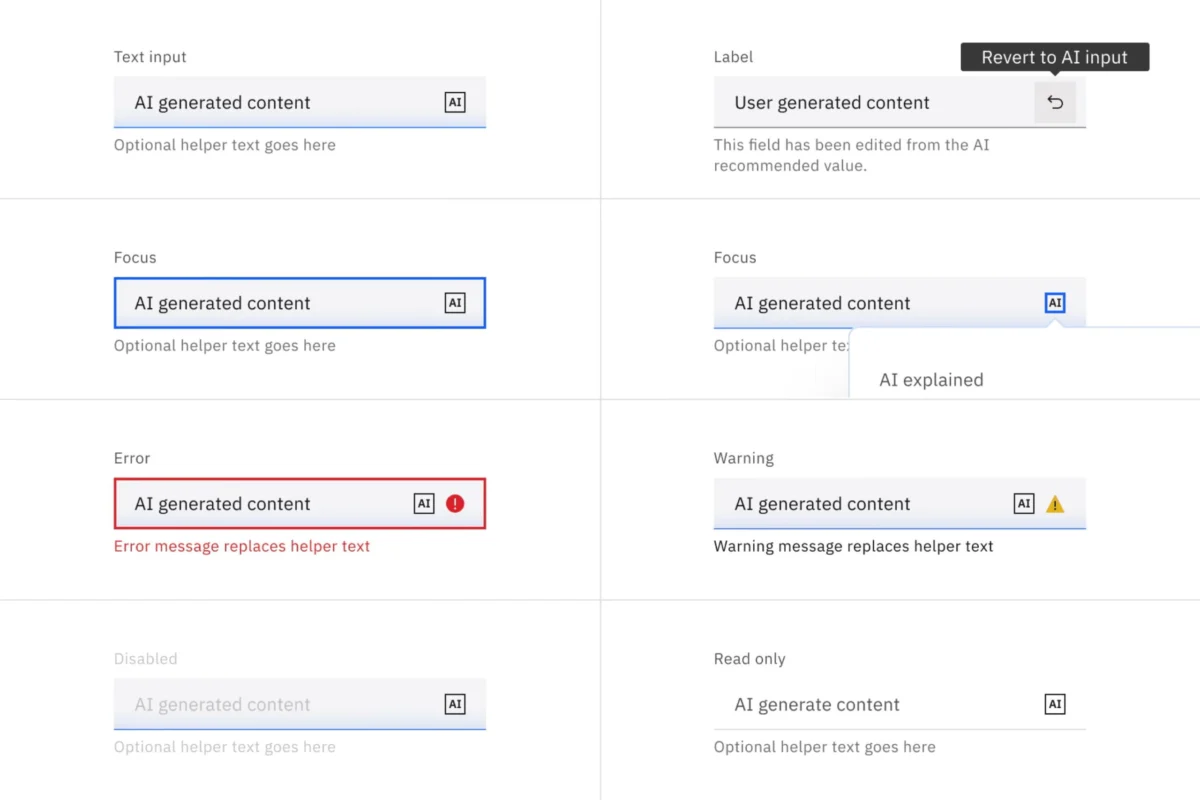
For years, the technology sector has relied on the sparkle icon ($tau$) as a universal signifier for "AI-powered features." However, according to recent usability research from organizations like the Nielsen Norman Group (NNG) and design system guidelines from enterprise frameworks like IBM’s Carbon Design System, the sparkle icon is failing.
The Ambiguity of the Sparkle
The primary flaw of the sparkle icon is semantic ambiguity. In modern software interfaces, sparkles are frequently used to denote magic, optimization, premium features, or speed, rather than explicitly signaling machine generation. A user seeing a sparkle next to a text box might assume the feature corrects grammar, translates text, or speeds up writing, without realizing the entire block of text was autonomously synthesized by a Large Language Model (LLM).
Furthermore, the European Commission’s guidance on the newly introduced EU AI Icon Set explicitly states that using an icon alone does not establish legal compliance.

- Inadequate practices: A barely visible icon, a footnote buried in a privacy policy, or a transient label that fades away after two seconds violate the principle of clear and distinguishable notice.
- Compliant practices: Icons must be paired with plain-language text (e.g., “AI-generated”), remain accessible to assistive screen technologies, and persist when content is downloaded, shared, or exported across platforms.
4. Official Responses and Regulatory Interpretations
Legal and regulatory bodies across the globe have weighed in on how businesses should interpret the new boundaries between human-edited work and machine generation.
The Fine Line Between "Edited" and "Generated"
A central point of confusion for content creators, copywriters, and PR agencies is the threshold where human editorial intervention strips away the requirement for an AI label.
Legal updates from firms such as Faegre Drinker and Davis & Gilbert LLP highlight the Commission’s stance: minor human touch-ups do not cleanse an AI output of its disclosure requirement. If an AI generates a draft article, a product description, or a marketing poster, and a human merely skims it before publishing, the disclosure rule still applies.

To be legally exempt from labelling requirements under the "human editorial control" exception, the review must be substantive, and a named person or corporate entity must take explicit editorial responsibility for the final output. If an AI writes 90% of a public-interest report and a human edits two comma splices, it remains AI-generated content in the eyes of the law. Conversely, if a human writes an original paragraph and an AI assists in rephrasing a single sentence for clarity, the threshold for mandatory labelling is generally not crossed—provided the core intellectual authorship remains human.
5. Global Implications: A Worldwide Regulatory Pattern
While digital product teams often view EU regulations as isolated bureaucratic hurdles, the August 2026 transparency mandate is part of a broader, global shift toward synthetic content accountability. Similar legislative frameworks are emerging simultaneously across major markets:
- United States: While lacking a single comprehensive federal AI act akin to the EU’s, numerous U.S. states have enacted targeted legislation. These laws regulate synthetic human performers (protecting actors’ likenesses), mandate disclosures for AI-generated political advertising during election cycles, and require transparency in specific commercial bot interactions.
- China: The Cyberspace Administration of China (CAC) enforces strict generative AI regulations that require distinct watermarking and tagging for synthetic text, audio, and video to prevent social misinformation.
- South Korea and Japan: National digital agencies have introduced voluntary and mandatory guidelines urging tech platforms to watermark AI-generated imagery and media, particularly in news media and social publishing.
This convergence indicates that AI transparency is evolving from a localized European rule into a universal design pattern for digital products worldwide.

6. Practical Takeaways for Product Teams
For designers, product managers, and developers shipping features this year, compliance requires a proactive approach. Organizations should evaluate their digital properties using the following checklist:
- Audit AI Touchpoints: Map out every instance where your application outputs text, images, code, or data summaries generated autonomously by an AI model.
- Ditch the Sparkle-Only Approach: Move away from relying solely on ambiguous sparkle icons. Pair interface icons with clear text labels like "AI-generated" or "AI-assisted modification".
- Establish Editorial Workflows: If human oversight is intended to bypass labeling requirements, ensure that editorial logs record who reviewed the content and that modifications are substantial.
- Ensure Data Persistence: Verify that AI watermarks and metadata persist when users download, export, or share content outside your closed application environment.
By treating transparency not as a penalty, but as a mechanism for user trust, product teams can build cleaner interfaces that help users effortlessly distinguish between authentic human creativity and machine-generated output.
Recommended Resources & Further Learning
For designers seeking deeper practical knowledge on implementing these interfaces, industry expert Vitaly Friedman has launched Design Patterns For AI Interfaces, a comprehensive video course featuring real-world product breakdowns, accessible design patterns, and upcoming live UX training workshops.
- Official European Commission Statement on AI Transparency
- EU Guidelines on Article 50 Transparency Obligations
- Carbon Design System AI Guidelines
- Nielsen Norman Group Research on AI Interface Icons
 Nila Kartika Wati
 Evan Lee Salim
 Reynand Wu
