
 By Pevita Pearce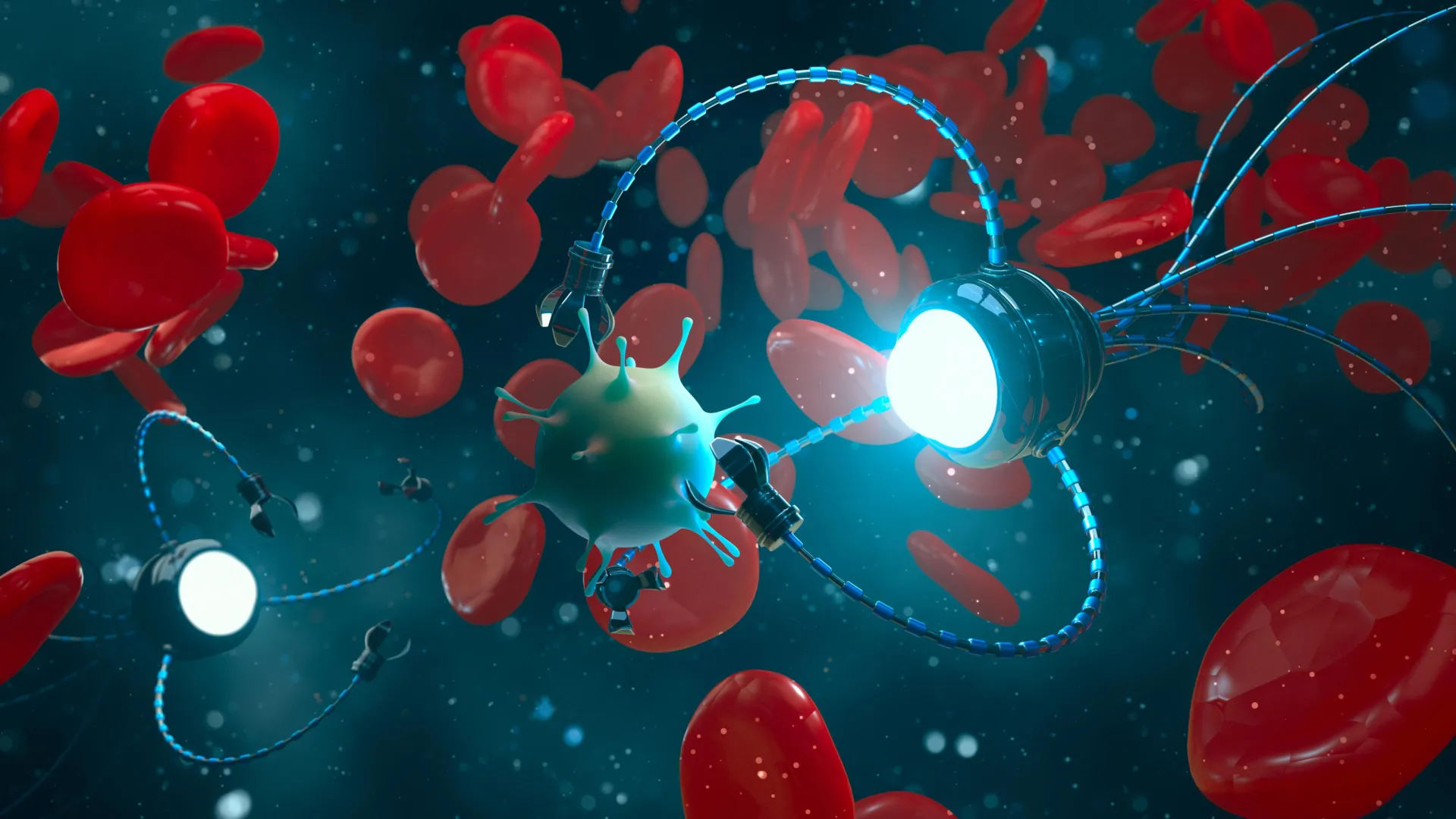
Imagine a fleet of autonomous, invisible vessels navigating the turbulent currents of the human bloodstream. They do not rely on gears, pistons, or microchips; instead, they are composed of the very code that defines life: DNA. These molecular machines, capable of identifying a malignant tumor, neutralizing a viral pathogen, or assembling a sophisticated computing device atom by atom, are no longer the stuff of science fiction. They represent the next great leap in engineering—the era of the DNA nanorobot.
While the field remains in its nascent stages, the convergence of structural biology, mechanical engineering, and computational science is rapidly turning "proof of concept" into a viable, programmable reality. As we stand on the precipice of this revolution, it is essential to examine the mechanics, the potential, and the formidable hurdles that define the future of DNA robotics.
The Core Concept: Engineering at the Molecular Scale
At its simplest, DNA nanotechnology leverages the predictable, base-pairing properties of DNA—where adenine (A) always pairs with thymine (T), and cytosine (C) with guanine (G)—to act as a programmable "construction material." By synthesizing custom sequences, researchers can "fold" DNA into intricate 3D shapes, a process famously known as "DNA origami."
The Mechanical Blueprint
To transform these static shapes into functional machines, scientists are borrowing design principles from macro-scale robotics. Just as a bridge requires rigid supports and a prosthetic limb requires flexible joints, DNA nanorobots are being engineered with:
- Rigid Frameworks: High-density DNA lattices that provide structural integrity against the chaotic thermal energy of the cellular environment.
- Compliant Components: Flexible "hinges" that allow the machine to open, close, or pivot in response to specific environmental stimuli.
- Origami Actuators: Folding patterns that allow a machine to change its shape, effectively acting as a gripper or a cargo bay for therapeutic payloads.
By integrating these features, researchers have moved beyond simple static structures, creating machines that can perform controlled, repeatable tasks at a scale measured in nanometers—billionths of a meter.
Chronology of a Revolution
The journey toward programmable DNA machines did not happen overnight. It is the result of decades of incremental discovery.
- The 1980s: The Foundation: Nadrian Seeman pioneered the idea of using DNA as a building block for nanotechnology, proving that synthetic DNA could be woven into stable, branched structures.
- The 2000s: The Origami Breakthrough: Paul Rothemund introduced "DNA origami," a method of folding long, single-stranded DNA into virtually any shape using short "staple" strands. This effectively democratized nanostructure design.
- 2010s: From Static to Dynamic: The field shifted focus toward "DNA walkers" and machines capable of autonomous movement. Biochemical control mechanisms, such as strand displacement, began to allow these machines to execute logic-based commands.
- 2020s to Present: Toward Real-World Integration: Current research is heavily focused on "in vivo" applications—testing how these robots behave within biological organisms and developing methods to protect them from the body’s natural immune response.
Controlling the Invisible: The Physics of Nanorobotics
The primary challenge in nanotechnology is not building the machine, but controlling it. At the molecular level, the environment is dominated by Brownian motion—the erratic, constant jiggling caused by the collision of molecules. In this "viscous soup," a nanorobot is constantly buffeted by surrounding fluids, making precise movement incredibly difficult.
Biochemical Programming
To navigate this chaos, scientists utilize DNA strand displacement. In this process, a "fuel" strand of DNA binds to a target site, displacing a previously bound strand and triggering a mechanical shift. This allows researchers to write "software" for the robot using DNA sequences. By designing specific sequences, scientists can program the machine to remain dormant until it detects a specific "key"—such as a protein marker on a cancer cell—at which point the machine unfolds to release its payload.
External Signal Modulation
Beyond internal chemical programming, researchers are testing the use of external fields:
- Magnetic Fields: By attaching magnetic nanoparticles to DNA structures, researchers can use external magnets to steer robots through bodily fluids.
- Photonic Control: Using specific wavelengths of light, scientists can induce conformational changes in DNA, essentially providing a remote-control switch for the machine’s operation.
Implications: The Nano-Surgeon and the Molecular Factory
The implications of successful DNA robotics span across medicine, manufacturing, and data science.
Medicine: Precision Intervention
The "nano-surgeon" concept is the most widely discussed application. By engineering robots that recognize the unique molecular "signature" of a virus or a tumor, we could move toward a form of medicine that is perfectly targeted, eliminating the systemic toxicity associated with current chemotherapy or broad-spectrum antivirals. Recent experiments have already explored using DNA cages to "trap" viruses like SARS-CoV-2, physically preventing them from infecting host cells.
Advanced Manufacturing and Computing
Beyond healthcare, DNA robots act as programmable templates for molecular assembly. By positioning nanoparticles or quantum dots with sub-nanometer accuracy, these machines could facilitate:
- Molecular Computing: Building logic gates that operate faster and with less energy than silicon-based transistors.
- Nanophotonics: Creating advanced lenses and light-filtering devices that could revolutionize high-speed telecommunications and imaging technology.
The Path Forward: Challenges and Necessary Evolution
Despite the optimism, the field faces significant hurdles before DNA robotics becomes a staple of modern technology.
The Knowledge Gap
We currently lack a comprehensive "mechanical database" for DNA. While we understand the chemical properties of DNA, our understanding of its mechanical fatigue, wear-and-tear at the nanoscale, and long-term stability in complex biological environments remains limited.
Simulation and Standardization
Current simulations often struggle to account for the stochastic (random) nature of the nanoscale. To move forward, the field requires:
- Standardized Parts Libraries: Just as electrical engineers use standard resistors and capacitors, biological engineers need a universal library of DNA "parts" that behave predictably across different labs.
- AI-Driven Design: Artificial intelligence and machine learning are becoming essential. AI can predict how a specific DNA sequence will fold and how it will interact with external signals, saving years of trial-and-error laboratory work.
- Bio-Manufacturing: We must scale up the production of high-purity DNA nanostructures to move from milligram-scale experiments to industrial-grade production.
Official Perspectives: The Future is Biological
The consensus among leading researchers is clear: the future of robotics will not be confined to silicon and steel. As one prominent research team noted, "The robots of tomorrow won’t just be made of metal and plastic. They will be biological, programmable, and intelligent. They will be the tools that allow us to finally master the molecular world."
This transition marks a shift in how humanity interacts with the fundamental building blocks of matter. By working with biology rather than against it, we are gaining the ability to intervene in the processes of life with unprecedented delicacy.
Collaborative Interdisciplinary Efforts
The success of this field depends on "boundary-crossing." It requires the chemist to understand the mechanical engineer, and the computer scientist to speak the language of the molecular biologist. The integration of AI into structural DNA nanotechnology is already showing promise in accelerating the development of machines that can operate autonomously in complex, real-world environments.
Conclusion: Mastering the Molecular World
We are witnessing the early stages of a fundamental transformation. While DNA robots are currently confined to the laboratory—often operating in isolation and facing the persistent challenges of Brownian motion and environmental unpredictability—the trajectory of the field is undeniable.
The promise of DNA robotics lies in its ability to bring order to the molecular chaos. Whether through the delivery of life-saving therapeutics or the creation of the next generation of high-performance materials, these tiny machines are poised to solve problems that were previously thought to be insurmountable. As we refine our ability to design, build, and deploy these biological agents, we are not merely observing the molecular world; we are learning to command it. The robots of the future may be invisible to the naked eye, but their impact will be felt on a global scale.
 Sagoh
Sagoh  Asro
Asro  Siti Muinah