
 By Sagoh
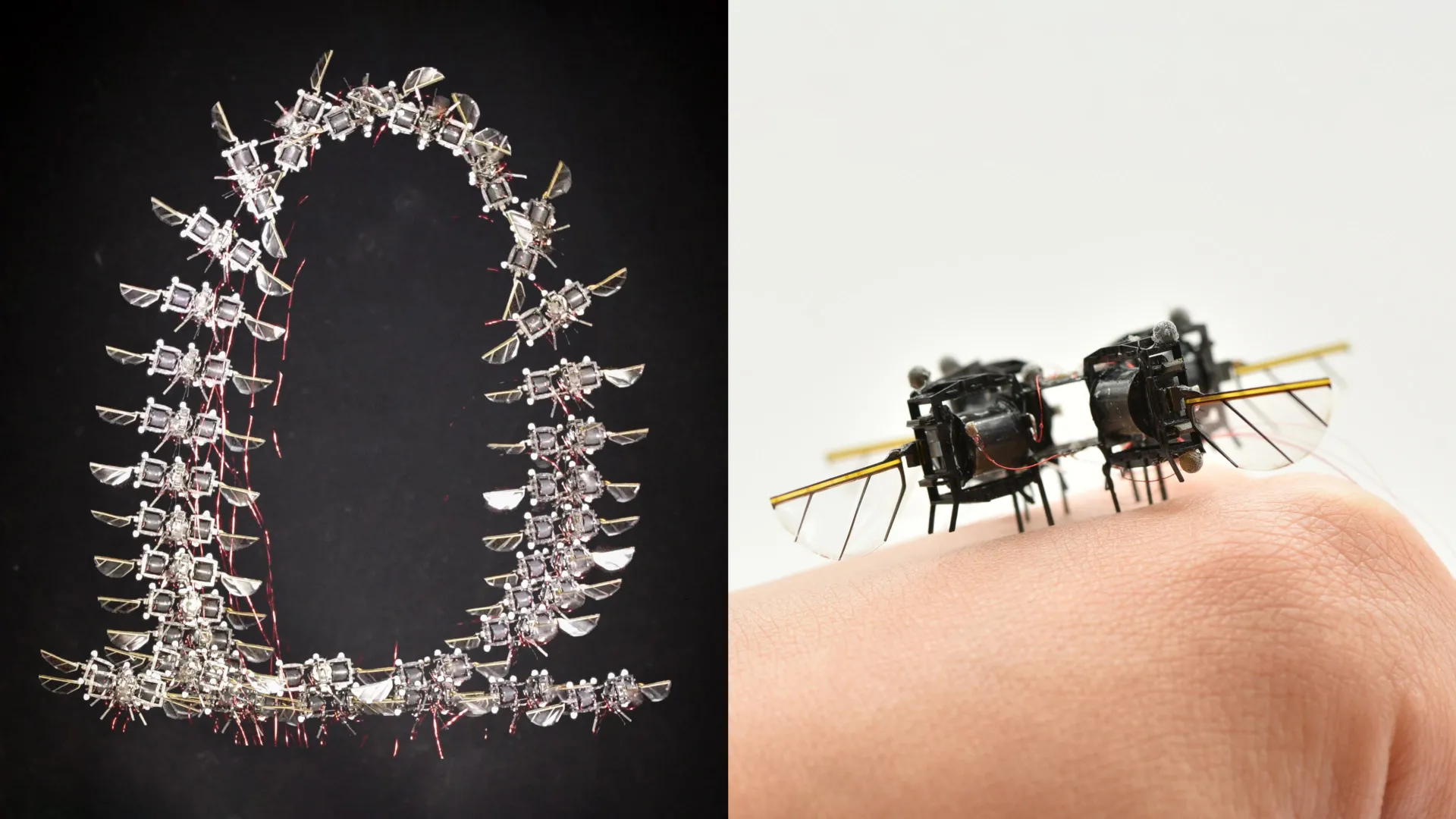
In the aftermath of a catastrophic earthquake, every second is a race against time. First responders face the harrowing reality of navigating unstable, collapsed structures where traditional heavy machinery and standard-sized drones are often useless. However, a breakthrough from researchers at the Massachusetts Institute of Technology (MIT) suggests that the future of disaster relief may lie in the realm of the minuscule.
MIT engineers have unveiled a new breed of insect-scale flying robots capable of aerial maneuvers that were previously thought impossible for machines of their size. By integrating a sophisticated, two-part artificial intelligence control system, these robotic bugs can now perform high-speed flips, rapid-fire somersaults, and complex navigational feats, finally bridging the gap between mechanical limitations and the innate agility of the natural world.
The Evolution of Microrobotics: From Static to Dynamic
For years, the field of aerial microrobotics has been hampered by a "performance ceiling." While researchers have successfully mimicked the physical form of insects, the "brains" of these machines—the flight controllers—were chronically underdeveloped. Earlier iterations were sluggish, prone to instability, and restricted to simple, linear flight paths. They lacked the reflexive grace of a bumblebee or a dragonfly, rendering them ineffective for the chaotic, wind-swept, and debris-filled environments of a disaster zone.
The MIT team, led by Kevin Chen, an associate professor in the Department of Electrical Engineering and Computer Science (EECS), spent over five years working to overcome these barriers. The project required a holistic redesign: first, upgrading the hardware to be more durable yet lightweight, and second, revolutionizing the software to handle the immense computational burden of high-speed, insect-like flight.
Chronology of the Development
- The Early Years (2019-2021): Initial research focused on the basic physical construction of the robots, utilizing soft artificial muscles to flap wings. These early models were limited by human-tuned controllers that could not handle the complexity of erratic movement.
- The Hardware Pivot (2022): The team developed a more robust iteration of the robot, roughly the size of a microcassette and weighing less than a paperclip. By increasing wing surface area and optimizing the contraction speed of the soft artificial muscles, the physical performance potential was finally unlocked.
- The Software Breakthrough (2023): Realizing that hardware improvements were only half the battle, Chen’s lab collaborated with Professor Jonathan P. How’s team at the Laboratory for Information and Decision Systems (LIDS). Together, they developed the two-step, AI-driven control architecture that would transform the robot’s flight capability.
- The Validation Phase (2024): Extensive testing in controlled environments proved that the robots could maintain stability even under artificial wind disturbances, leading to the landmark study recently published in Science Advances.
Decoding the "Brain": How AI Enables Insect-Scale Flight
The fundamental challenge in controlling a robotic insect is the sheer complexity of its aerodynamics. At such a small scale, air does not behave like a fluid in the way it does for a jumbo jet; it is thick and unpredictable. Furthermore, the robot’s controller must make thousands of decisions per second to maintain balance.
To solve this, the MIT team implemented a "two-part control system." The first part utilizes a model-predictive controller (MPC). This system functions as a high-level strategic planner. It uses complex mathematical models to predict how the robot will react to various forces, allowing it to plan ahead for difficult maneuvers like sharp turns or flips. While highly accurate, the MPC is computationally "heavy"—it requires too much power to run on a tiny, battery-operated robot in real-time.
To bridge this gap, the team turned to imitation learning. They used the expert planner (the MPC) to train a "policy"—a deep-learning neural network. This policy effectively distills the complex, slow decision-making of the MPC into a streamlined, high-speed algorithm that can operate on the robot’s onboard hardware in real-time.
"The robust training method is the secret sauce of this technique," explains Professor Jonathan P. How. By training the AI on a vast array of simulated and physical flight scenarios, the robot learns how to "think" like an expert pilot, instinctively correcting for wind and trajectory errors without needing to pause for heavy computation.
Supporting Data: By the Numbers
The results of this new control architecture have been nothing short of transformative. In rigorous laboratory testing, the performance metrics of the microrobot saw staggering increases:
- Speed: A 450% increase compared to previous laboratory benchmarks.
- Acceleration: A 250% improvement in how quickly the robot could shift its velocity.
- Agility Testing: The robot successfully executed 10 consecutive somersaults in a span of 11 seconds.
- Precision: Despite intentional wind disturbances designed to push the robot off-course, it maintained a flight path within 4 to 5 centimeters of its target trajectory throughout the aerial flips.
These metrics demonstrate that for the first time, a human-engineered device of this scale possesses the agility required to survive in the "real world" of tight gaps, shifting debris, and unpredictable airflow.
Official Perspectives: The Path to Autonomy
The implications of this technology extend far beyond the laboratory. Professor Kevin Chen emphasizes that the goal is not just to build a cool toy, but to solve a critical humanitarian problem.
"We want to be able to use these robots in scenarios that more traditional quadcopter robots would have trouble flying into," Chen stated in a recent interview. "Now, with our bioinspired control framework, the flight performance of our robot is comparable to insects in terms of speed, acceleration, and the pitching angle. This is quite an exciting step toward that future goal."
The team also highlighted the successful implementation of a "saccade"—a rapid, sharp-angle maneuver used by insects to stop suddenly and reorient themselves. This behavior is essential for future iterations that will carry onboard sensors, as it allows the robot to stop and "look" at a target without blurring its vision.
Yi-Hsuan Hsiao, an EECS MIT graduate student and co-lead author, noted, "This work demonstrates that soft and microrobots, traditionally limited in speed, can now leverage advanced control algorithms to achieve agility approaching that of natural insects."
Future Implications: The Search and Rescue Horizon
While the current results are promising, the research team is already looking toward the next phase of development: full autonomy.
Currently, the robots rely on external motion capture systems to understand their location in 3D space. The next major hurdle is shrinking sensors and cameras to fit on the tiny frame of the robot. If the team succeeds, these robots will be able to navigate disaster zones without any external infrastructure, acting as autonomous scouts that can crawl or fly through the smallest cracks in a collapsed building to locate survivors.
Furthermore, the team plans to investigate "swarm intelligence." If a group of these robotic insects can coordinate their movements, they could cover a collapsed structure much faster than a single unit, sharing map data and avoiding one another in the dark.
As the technology continues to mature, the vision of a "robotic search-and-rescue team" seems increasingly tangible. By mimicking the biological brilliance of insects and combining it with the relentless processing power of modern AI, MIT’s researchers have moved us one step closer to a world where a disaster victim trapped beneath rubble is only ever a few minutes away from being found.
This research was supported by the National Science Foundation (NSF), the Office of Naval Research, the Air Force Office of Scientific Research, MathWorks, and the Zakhartchenko Fellowship. The full findings were published in the journal Science Advances.
 Reynand Wu
 Ammar Sabilarrohman
 rifanmuazin
