
 By rifanmuazin
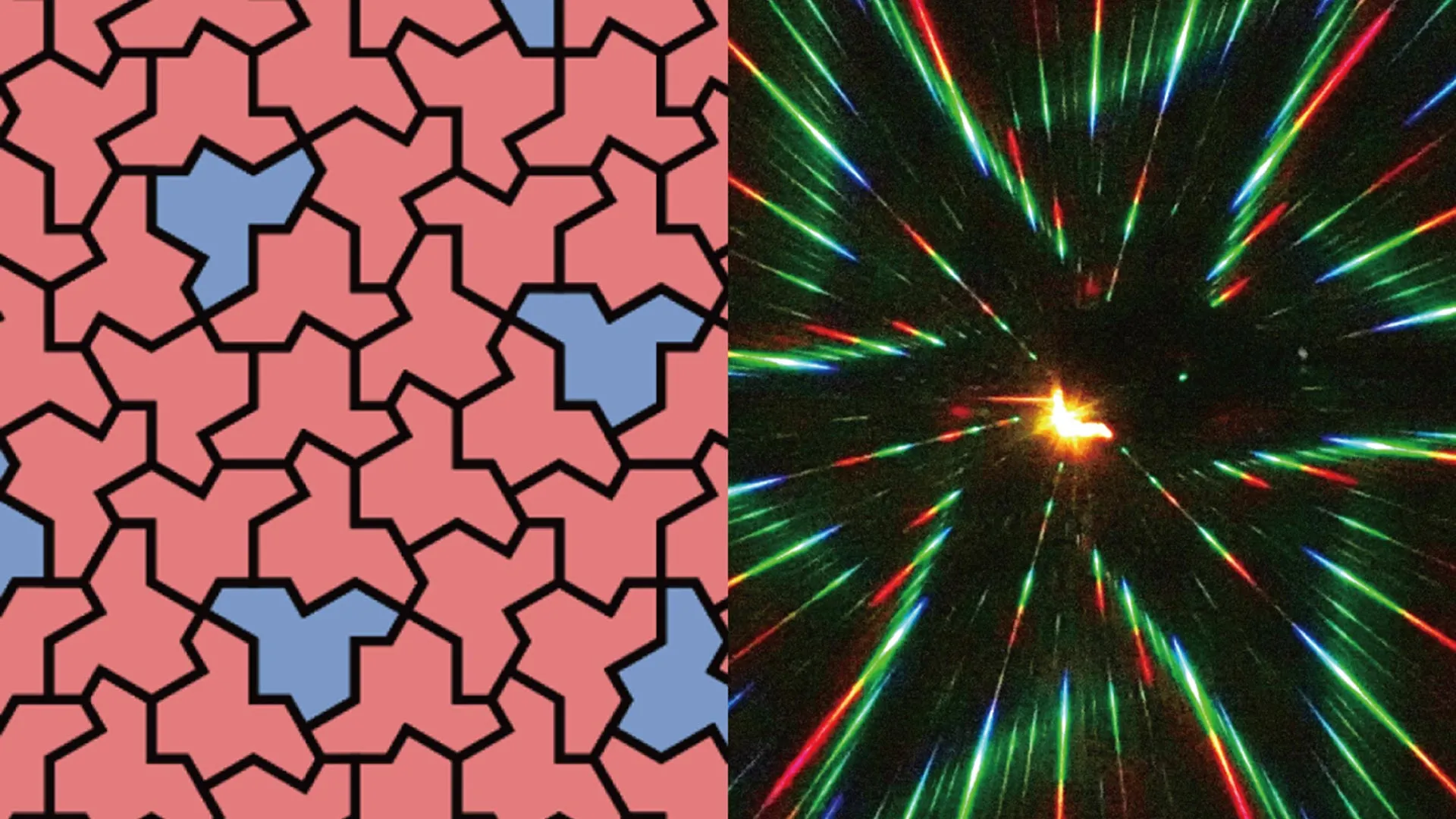
In the rarefied world of mathematics, certain problems haunt researchers for decades, standing as silent sentinels of the unknown. For years, the "Einstein problem"—a quest to find a single shape that could tile a plane aperiodically—was one such enigma. In 2023, the mathematical community was electrified when the "Smith hat" monotile finally provided an answer. Now, in a striking leap from abstract geometry to applied physics, researchers have discovered that this very shape is capable of manipulating light in ways previously thought impossible, opening a new frontier in optical science.
A collaborative study published in Nature Communications by the Institute of Industrial Science at the University of Tokyo, alongside international partners, has demonstrated that nanoscale structures patterned after the Smith hat induce unique, chiral diffraction patterns in laser light. This breakthrough suggests that the intrinsic geometric properties of aperiodic tiles can serve as a powerful new tool for controlling the fundamental behavior of light.
The Einstein Problem: A Mathematical Odyssey
To understand the magnitude of this discovery, one must first appreciate the history of the Einstein problem. The term "Einstein" here is a play on the German phrase ein Stein, meaning "one stone." For decades, mathematicians sought a single, simple shape that could cover an infinite two-dimensional surface without ever repeating its pattern.
While periodic tilings—such as the simple squares of a checkerboard or the hexagonal cells of a beehive—are common in nature and architecture, they are inherently predictable. Aperiodic tilings, however, defy such regularity. Until the discovery of the Smith hat, scientists had to rely on complex sets of multiple shapes to create such non-repeating patterns.
The breakthrough came when a team of researchers identified the "hat"—a 13-sided polygon that, when tiled, creates a complex, non-repeating surface. The discovery was not merely a puzzle solved; it was the identification of a fundamental geometric building block. "What is especially fascinating about the hat tile is that, although the resulting pattern appears irregular at first glance, it is actually constructed from the honeycomb lattice," notes Yuto Moritake, lead author of the study. This hidden structural lineage from a simple honeycomb provided the team with the perfect candidate to test how such geometry might influence physical reality.
Chronology of a Scientific Bridge
The transition from theoretical mathematics to experimental physics was a deliberate, multi-year process that bridged two distinct scientific disciplines.
- 2023 (The Mathematical Breakthrough): The discovery of the Smith hat by a team led by David Smith, Joseph Samuel Kaplan, Craig S. Kaplan, and Chaim Goodman-Strauss captures global headlines, providing the first solution to the long-standing monotile puzzle.
- Early 2024 (Conceptualization): Researchers at the University of Tokyo begin investigating the potential physical properties of the hat tile. They hypothesize that the "aperiodic" nature of the tile, combined with its lack of mirror symmetry, might generate unique optical signatures.
- Mid-2024 (Fabrication): Using advanced electron beam lithography, the team fabricates nanoscale structures based on the Smith hat pattern onto silicon nitride films. This allows them to interact with light at the wavelength scale.
- Late 2024 (Experimental Validation): The team illuminates the fabricated patterns with laser light. The resulting diffraction patterns reveal unexpected "pinwheel" effects, confirming that the geometry is actively shaping the light’s behavior.
- Current Status: The team is now exploring the integration of these patterns into functional optical devices, seeking to move the technology toward commercial and research-grade applications.
Nano-Engineering: Turning Mathematics into Matter
The physical implementation of the Smith hat required extreme precision. Because the effects of the geometry on light occur at the scale of light’s wavelength, the researchers utilized electron beam lithography—a process that uses a focused beam of electrons to "write" patterns at the nanometer scale.
By etching these hat-tile motifs onto silicon nitride films, the researchers created a "metasurface"—a material engineered to have properties not found in nature. When laser light struck these surfaces, it did not scatter in the diffuse, predictable ways seen in conventional crystals or random surfaces. Instead, it formed sharp, pinwheel-like diffraction patterns.
These patterns are a direct visual representation of "chirality." In the context of physics, chirality refers to an object’s handedness—its inability to be superimposed on its own mirror image. Human hands are chiral; a right glove cannot be worn on a left hand. By demonstrating that a non-repeating geometric pattern could impose this "handedness" on light, the researchers proved that the Smith hat is not just a pattern, but a tool for controlling the orientation and polarization of electromagnetic waves.
Official Responses and Theoretical Implications
The implications of this study are significant, as they challenge existing models of how aperiodic structures interact with energy. Senior author Masaya Notomi emphasizes the novelty of the findings: "We found that the diffraction patterns themselves become chiral because the structure lacks mirror symmetry. This kind of optical response is fundamentally different from that observed in conventional quasicrystalline materials."
The researchers discovered that the optical response is highly sensitive to the incoming light’s polarization and direction. When the team mirrored the physical structure, the optical response mirrored accordingly, confirming a direct, predictable link between the geometry of the tile and the behavior of the light.
"These results open a new direction of research on the fusion of quasiperiodic order and chirality," says Moritake. "Monotile patterns provide a platform for exploring optical phenomena that emerge from the interplay of symmetry, chirality, and aperiodicity." The team believes that this is only the beginning of a broader field of study: "Geometry-driven optics."
The Future of Optical Technology
What does this mean for the future of technology? While the research is currently in the experimental phase, the potential applications are vast.
1. Polarization Control
Modern optical communication relies heavily on the ability to manipulate the polarization of light. Current methods often require bulky, complex prisms and filters. Using Smith hat-inspired metasurfaces, engineers could create thin, ultra-lightweight films that control light polarization with high precision, potentially miniaturizing telecommunications components.
2. Advanced Imaging and Sensing
Because the diffraction patterns are highly sensitive to the orientation of the light source, these surfaces could be used to create highly sensitive sensors. By analyzing the "pinwheel" distortions in the diffracted light, researchers can precisely determine the properties of an incoming light signal, leading to new diagnostic tools in spectroscopy.
3. Structural Color and Metamaterials
The research provides a roadmap for designing new metamaterials that possess "structural color"—color produced by physical structure rather than chemical pigments. This could lead to the development of non-fading dyes, advanced camouflage, or energy-efficient optical displays.
4. Quantum Computing
As the field of quantum optics grows, the need for precise manipulation of single photons becomes paramount. Aperiodic, chiral surfaces could provide a stable, scalable platform for guiding and splitting photons, serving as a critical component in the next generation of quantum computers.
Conclusion: A Paradigm Shift in Physics
The transition of the Smith hat from a purely mathematical curiosity to an instrument of optical physics is a testament to the unpredictable nature of scientific inquiry. It highlights a recurring theme in the history of science: that abstract puzzles, once solved, often contain the seeds for technological revolutions.
By proving that the "Einstein tile" can act as a bridge between aperiodicity and chiral optical behavior, the researchers have not only added a new chapter to the story of the Smith hat but have also provided the scientific community with a new set of rules for designing the future of light-based technology. As we look ahead, the interplay between the mathematical beauty of the hat and the physical reality of light promises to illuminate paths that were, until recently, entirely invisible.
 Ali Ikhwan
 Reynand Wu
 Ammar Sabilarrohman
