
 By Pevita Pearce
By [Author Name]
Published: May 2026
Main Facts: The Digital Native Disconnect
The modern educational landscape is facing an unprecedented credibility crisis, driven not by a lack of technology, but by a profound misunderstanding of it. Across classrooms and living rooms worldwide, a digital generation—spanning Generation Z and Generation Alpha—is actively rejecting the superficial "gamified" software handed to them by educators and EdTech corporations.
The core conflict stems from a massive experiential divide. Today’s children grow up in hyper-immersive digital ecosystems. By age eight, they have spent thousands of hours navigating the sandboxes of Roblox, coordinating complex tactical strategies on Fortnite servers, and engineering intricate automation systems using redstone and command blocks in Minecraft. They understand game design not as a theoretical concept, but as a lived language.
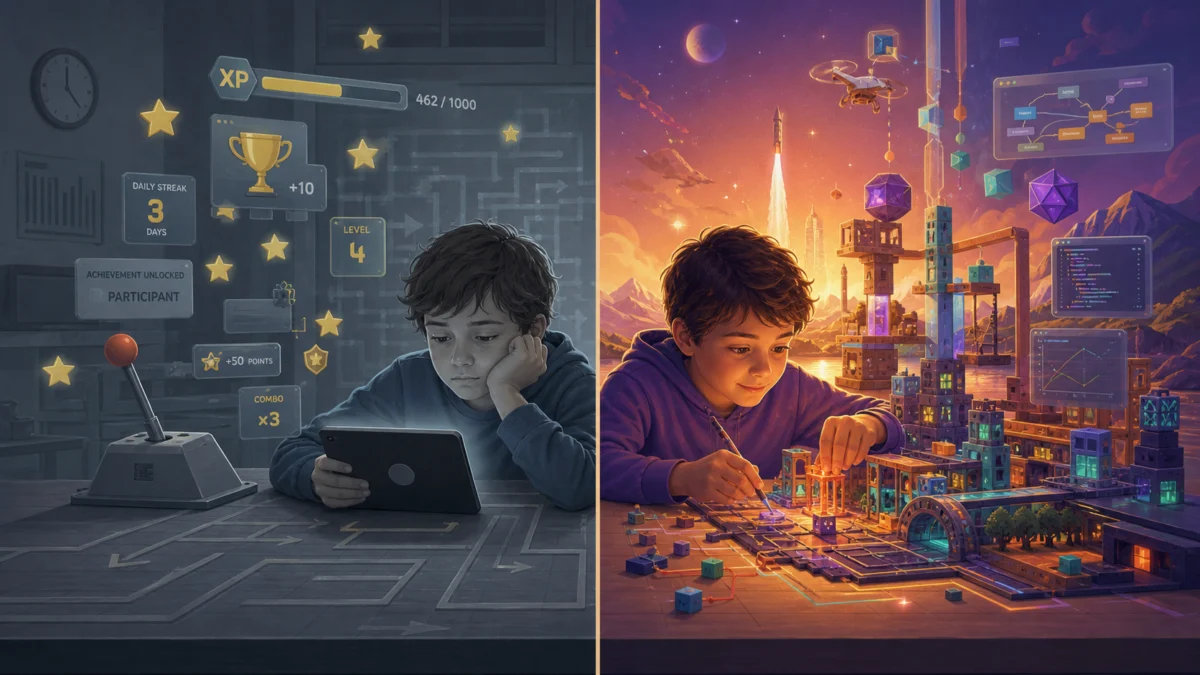
When these same children are handed "educational" applications that replace traditional worksheets with progress bars, gold stars, digital stickers, and meaningless experience points (XP), they are not fooled. As one twelve-year-old student bluntly diagnosed the practice after completing a point-based math assignment: "It’s not a game. It’s just homework with points."
This dismissive verdict highlights a systemic failure in the multi-billion-dollar EdTech industry. Rather than creating genuine interactive experiences, developers frequently rely on patronizing psychological conditioning tricks—reminiscent of the Skinner box—that modern youth have already learned to identify and discard in the predatory mobile gaming market.
Chronology: The Evolution of Digital Play and Empty Gamification
To understand how the education sector arrived at this impasse, it is necessary to examine the historical trajectory of digital tools in learning environments over the past three decades:
- Late 1990s – Early 2000s (The Edutainment Era): Educational software was largely confined to CD-ROMs like The Oregon Trail or Math Blaster. These programs attempted to wrap core curricula in adventure narratives. While often clunky by modern standards, they established a baseline premise: that learning could be explored through virtual exploration.
- Early 2010s (The Rise of Gamification): As smartphones proliferated, tech startups and corporate human resources introduced the concept of "gamification"—the integration of game mechanics (badges, leaderboards, and streaks) into non-game contexts. The underlying theory was that extrinsic rewards would automatically boost engagement and motivation.
- Mid-to-Late 2010s (The Sandbox Revolution): Simultaneously, games like Minecraft and Roblox democratized digital creation. Children stopped being passive consumers of predefined game loops and became active creators, coders, and social coordinators on user-generated content platforms.
- 2020s (The Great Awakening): Post-pandemic remote learning forced a massive expansion of digital classrooms. Schools rapidly adopted subscription-based EdTech platforms loaded with basic behavioral loops. However, a generation raised on high-agency virtual worlds immediately recognized these apps for what they were: digital busywork disguised as recreation. Today, educators and developers are forced to reckon with the reality that children possess a sophisticated, intuitive bullshit detector regarding interactive design.
Supporting Data: The Behavioral Divide in Modern Youth
While EdTech marketing departments frequently point to short-term engagement metrics—such as daily log-in streaks or total time spent on an app—independent UX research and classroom observations reveal a different reality regarding long-term learning retention and user sentiment.
- The Literacy Gap in Design: According to interactive media studies, children today are exposed to advanced systemic thinking earlier than any previous demographic. By age ten, a significant percentage of kids have experimented with basic logic gates, economy management, and collaborative server administration within virtual environments.
- The Decay of Extrinsic Motivation: Data from youth focus groups indicates that superficial rewards (such as digital trophies or streak counters) lose their motivational pull within weeks. Once the novelty fades, users resort to "gaming the system"—using automated scripts, guessing answers, or rushing through modules simply to clear notifications and accumulate dead-end XP.
- The Competitor Landscape: Developers of educational apps are no longer competing solely against traditional textbooks or rival study tools. They are competing against industry-leading entertainment properties backed by multi-billion-dollar development budgets, real-time social infrastructure, and absolute player agency. When evaluated against these standards, a standard multiple-choice quiz wrapped in a cartoon theme park aesthetic falls catastrophically short.
Official Responses and Industry Perspectives
The friction between traditional educational frameworks and modern youth expectations has sparked intense debate among learning scientists, game developers, and educational administrators.
The EdTech Developer Dilemma
Many creators of educational software defend their approach by citing the necessity of structured progression. Representatives from prominent digital learning platforms argue that foundational skill acquisition—such as multiplication tables, grammar rules, and vocabulary memorization—requires repetition and systematic pacing that cannot always mirror the chaotic freedom of an open-world sandbox.
"We have to balance the pedagogical goals with engagement," notes one senior product manager at a major K-12 software firm, who spoke on condition of anonymity. "If a child spends three hours building a castle in Minecraft, that’s wonderful for spatial reasoning, but it doesn’t automatically mean they’ve practiced long division. Points and progress bars give teachers a reliable metric to track curriculum coverage."
The Gamer-Designer Critique
Conversely, interactive designers and veteran game developers argue that this defense is a cop-out rooted in poor craftsmanship. They contend that the problem is not that math is inherently boring, but that the delivery mechanism lacks genuine problem-solving architecture.
“The people building educational technology typically aren’t gamers themselves,” explains a prominent UX researcher specializing in juvenile digital behavior. “They’ve read articles about gamification. They know games have points and levels. So they sprinkle points and levels over a digital worksheet and wonder why children tune out. They have never experienced the flow state of a masterclass puzzle design or the satisfaction of overcoming a systemic challenge in a well-built game.”
Implications: What Must Change for the Future of Learning
As Gen Z matures into the workforce and Gen Alpha populates middle and high schools, the tolerance for patronizing digital tools will continue to shrink. The implications of this shift extend far past classroom walls, impacting corporate training, productivity software, and software development methodologies at large.
1. Abandoning the "Skinner Box" Model
Software architects must realize that young users are immune to empty psychological manipulation. XP bars, arbitrary badges, and cartoon mascots offering hollow praise ("Great job!") are viewed as condescending. Moving forward, user retention must be earned through intellectual challenge, genuine agency, and meaningful accomplishments rather than manipulative behavioral loops.
2. Matching Media to Natural Genres
A critical framework for future developers is to abandon the blanket mandate of "gamifying everything" and instead ask: What genre of game does this specific cognitive task naturally resemble?
- Language Learning functions organically as an Role-Playing Game (RPG), where users build capability over time, unlock new conversational abilities, and explore uncharted communicative territories.
- Mathematical and Scientific Disciplines align naturally with puzzle or strategy games, where learners manipulate elegant variables to solve systemic problems rather than merely ticking off sequential checklist items.
- Physical Fitness and Health Tracking map effectively onto management simulations or action titles that provide immediate, satisfying biomechanical feedback.
3. The Grace of Being a "Tool"
Perhaps the most liberating realization for educational software developers is that it is entirely acceptable not to be a game.
Not every productivity suite, flashcard deck, or reference database needs to pretend it is an epic fantasy adventure. If an application is honest about being an efficient, well-designed utility tool rather than a masquerading video game, users will respect it far more. The danger lies not in straightforward utility, but in the dishonest packaging of dull busywork as "play."
Conclusion
The message from the twelve-year-old playing redstone circuits in Minecraft is clear: children can distinguish between real empowerment and artificial simulation. If developers and educators wish to capture the attention of digital natives, they must either elevate their craft to match the rich, systemic complexity of modern interactive media—or drop the pretense altogether. Anything less is simply homework with points, and today’s youth are far too smart to fall for it.
 Nana Muazin
 Raul Delapena Setiawan
 Suro Senen
