
 By Basiran
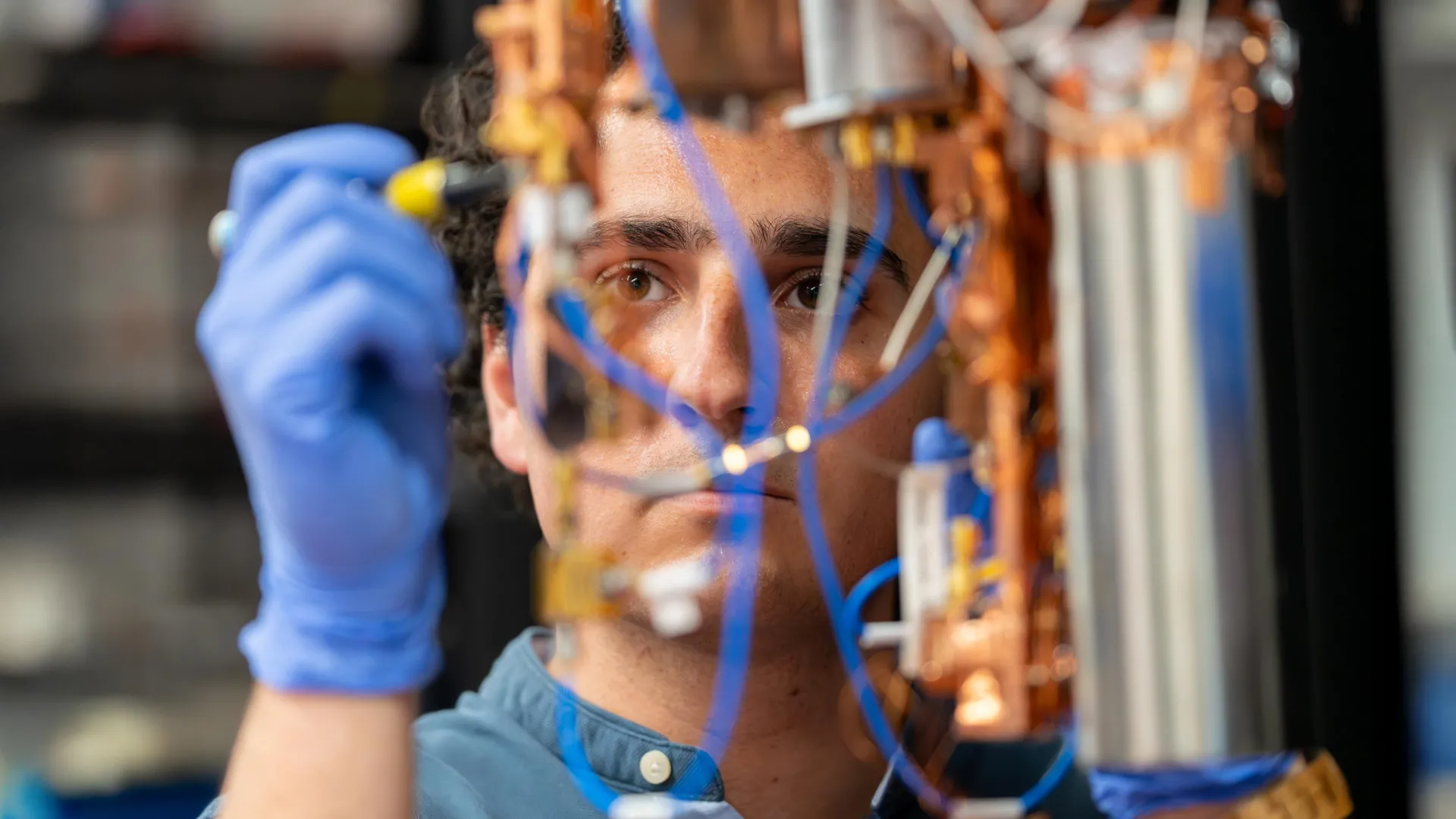
The quest to build a scalable, fault-tolerant quantum computer is, at its core, a challenge of connectivity. While individual quantum bits (qubits) have become increasingly sophisticated, the ability to link them across distances—without the fragility and complexity that currently plague quantum systems—remains a "holy grail" of physics. Now, a breakthrough from the Institute of Science and Technology Austria (ISTA) has turned a two-decade-old theoretical prediction into a tangible reality. By utilizing a "quantum bath" of correlated light, researchers have demonstrated a fully autonomous method to entangle distant qubits, potentially rewriting the roadmap for the future of quantum networking.
Main Facts: A Paradigm Shift in Entanglement
For years, the gold standard for connecting distant qubits has involved active, high-maintenance protocols. Whether it is firing a single photon from one qubit to another or attempting to match photons emitted by two separate qubits, these methods are inherently probabilistic. They rely on repeated measurements, complex post-selection processes, and a constant cycle of "try and fail" that often results in the loss of quantum coherence.
The team at ISTA, led by PhD student Alejandro Andrés-Juanes and Professor Johannes Fink, has introduced a radical alternative. Their approach shifts the burden of entanglement from the qubits themselves to their environment. By immersing two physically separated qubits in a "quantum bath"—a continuous, shared stream of correlated microwave photons—the researchers have enabled the qubits to spontaneously synchronize and entangle.
Unlike previous methods that require external oversight, this process is entirely autonomous. The entangled state is not a fleeting occurrence that must be captured within a narrow window; rather, it is a stabilized ground state. As long as the quantum bath is active, the entanglement persists, providing a reliable resource for quantum processing that remains available on demand.
Chronology: From Theoretical Prediction to Laboratory Success
The journey to this discovery spans over 20 years, rooted in a theoretical landscape that once seemed impossible to translate into experimental practice.
The Early Theoretical Framework (2000s)
At the turn of the millennium, theoretical physicists began exploring the idea of "dissipative state engineering." The core concept was to use a controlled environment to drive quantum systems toward a specific entangled state, rather than trying to manually manipulate the qubits into that state. However, the conditions required were highly idealized. Scientists struggled to create a "bath" that could provide the necessary correlation without introducing decoherence—the "noise" that destroys quantum information.
Bridging the Gap (2010–2020)
As superconducting qubit technology matured, the focus shifted to microwave engineering. Researchers began to understand how to manipulate light at the quantum level with greater precision. However, the "mismatch" remained: how to bridge the gap between "continuous-variable" entanglement (the pendulum-like, flowing nature of light) and "discrete-variable" entanglement (the 0 or 1 binary nature of stationary qubits).
The ISTA Breakthrough (2023–2024)
Working with international collaborators, the ISTA team successfully engineered a system that uses a shared source of correlated light particles. By refining the coupling between the qubits and the microwave photon bath, they overcame the previous barriers to implementation. Their findings, published in Physical Review X, represent the first experimental validation of the long-standing theory, successfully stabilizing remote entanglement without the need for active feedback loops.
Supporting Data and Technical Methodology
The experiment’s success hinges on the delicate management of quantum states. The researchers utilized microwave photons—a deliberate choice, as these low-energy particles are the workhorses of superconducting qubit technology.
The Role of Quantum Tomography
Verifying entanglement in a system that collapses upon observation is a notoriously difficult task. To confirm that the qubits were indeed synchronized, the team employed quantum tomography. This technique functions much like a medical CT scan, but for quantum information. By examining many different "slices" of the system’s behavior—taking measurements lasting between 20 and 80 nanoseconds—the researchers reconstructed the underlying quantum state.
Efficiency and Scaling
Currently, the ISTA prototype transfers approximately 10% of the bath’s available entanglement. While this is significantly lower than the theoretical maximum, the researchers note that this is a proof-of-concept. The limitation lies in the engineering of the bath’s coupling to the qubits and the unavoidable environmental interference. However, the simplicity of the method is its greatest strength. Unlike previous approaches that become exponentially more complex as more qubits are added, the "bath" approach could theoretically be scaled to synchronize multiple distant qubits simultaneously.
Official Responses: Insights from the ISTA Team
The significance of this work is not just in the entanglement itself, but in the shift in philosophy regarding how we manage quantum resources.
"In our method, the quantum bath—meaning the qubits’ environment—is the source of entanglement," explains Professor Johannes Fink. "It creates a new ground state through a continuous stream of correlated photons. This way, the entangled qubit state is stabilized, even beyond the qubits’ own ‘lifetime,’ and remains always available as a resource for further quantum processing. This makes the approach conceptually significant."
Alejandro Andrés-Juanes emphasizes the importance of overcoming the inherent "mismatch" in quantum systems. "In this work, we aimed to overcome this mismatch between the readily available and the practically useful forms of entanglement," he notes. "By stabilizing the entangled states remotely, our approach is fully autonomous and requires no active control or measurement."
Regarding the delay in implementing the 20-year-old theory, the team suggests that the experimental challenges were largely related to the "idealized" nature of the original predictions. "Our experiments helped us reveal several factors that may have prevented scientists from designing a functional quantum bath using a single source of correlated photons for distributed entanglement," Fink added.
Implications for Future Quantum Technologies
The implications of an autonomous, bath-based entanglement system are profound for several sectors of quantum research:
1. Scaling Quantum Processors
Current quantum processors are limited by the physical space on a single chip. To reach the thousands or millions of qubits required for fault-tolerant computing, modularity is essential. If we can link modular quantum processors using a shared "bath" of correlated photons, we can essentially build a distributed quantum supercomputer.
2. Quantum Networks and Fiber Optics
While the ISTA team focused on microwave photons, they are already looking ahead. The group is investigating how to translate these findings into the realm of optical photons, which are the standard for long-distance communication via fiber optics. If this autonomous stabilization can be achieved at optical frequencies, it could form the backbone of a "Quantum Internet," capable of transmitting information between distant cities with absolute security.
3. Fault-Tolerant Operation
One of the most persistent hurdles in quantum computing is the fragility of the qubit state. By offloading the stabilization of entanglement to the surrounding environment, this method creates a more resilient architecture. If the entangled state is constantly being "refreshed" by the bath, the system becomes significantly more robust against the transient errors that currently plague quantum hardware.
Conclusion: The Path Forward
The experiment conducted at the Institute of Science and Technology Austria serves as a vital bridge between theoretical physics and engineering reality. By moving away from active, measurement-heavy control schemes and toward a passive, environment-driven synchronization, the ISTA team has provided a new blueprint for quantum architecture.
While the 10% efficiency rate indicates that there is still significant work to be done in refining the hardware, the conceptual hurdle has been cleared. The "quantum bath" is no longer a theoretical abstraction; it is a proven tool. As researchers continue to optimize this process, the dream of a scalable, networked quantum computer—once a distant prospect—is moving steadily into the realm of the achievable. The next decade of quantum research will likely see this "bath" method integrated into larger systems, potentially solving the connectivity crisis that has defined the current era of quantum development.
 Ali Ikhwan
 Reynand Wu
 Ammar Sabilarrohman
