
 By Nila Kartika Wati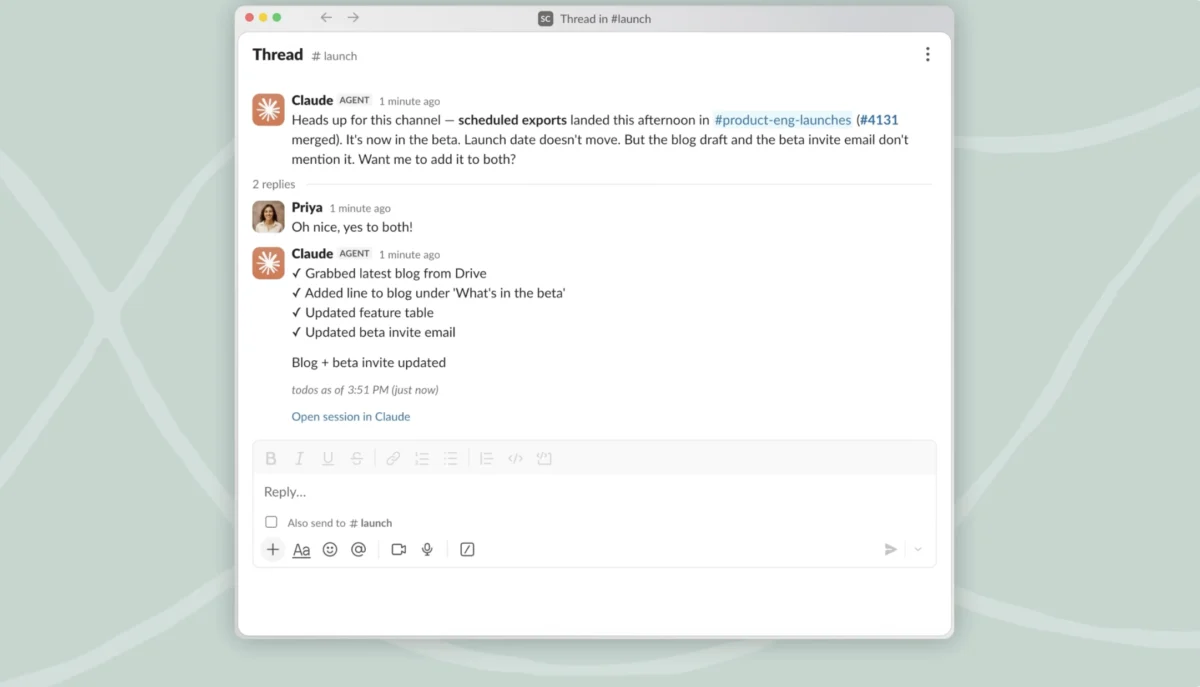
In the rapidly evolving landscape of enterprise artificial intelligence, the gap between a chatbot that simply answers questions and an agent that actively participates in organizational workflows is narrowing. Anthropic, the San Francisco-based AI research and safety company, has taken a significant leap across that divide with the launch of "Claude Tag," a new, always-on AI teammate designed to reside permanently within Slack.
By transforming the user interaction model from ephemeral, one-off queries to persistent, context-aware collaboration, Claude Tag represents a strategic shift in how Anthropic intends to embed itself into the daily operations of its Claude Enterprise and Claude Team customers.
The Core Concept: Moving Beyond the Chatbot
At its most basic, Claude Tag allows Slack users to mention "@Claude" to trigger insights, delegate tasks, or synthesize information directly within a channel. However, the innovation lies in its persistence. Unlike previous integrations where interactions were isolated, Claude Tag functions as a shared, evolving entity that remembers the history of a conversation and the broader context of the project.
"As Claude follows along with its channel, it learns ever more about the work," Anthropic stated in its announcement. This "always-on" capability means that the AI does not require a blank slate every time a user prompts it. It maintains a memory of the team’s ongoing discussions, files, and project status, effectively becoming a collaborative member of the team rather than a mere digital assistant.
Chronology: The Evolution of Anthropic’s Workplace Integration
Anthropic’s journey toward the modern workplace agent has been methodical, building upon layers of increasing complexity:
- Phase 1: On-Demand Assistance: Initially, users interacted with Claude via direct messages or ad-hoc channel tags. These interactions were functional but transient—once the thread ended, the context was often lost, requiring users to restate premises or re-upload files.
- Phase 2: Task Routing and Coding Support: The introduction of "Claude Code" in Slack signaled a shift toward utility. By routing technical tasks from channel mentions to full-scale coding sessions, Anthropic proved that its models could handle complex, multi-step workflows, with the AI posting results back into the thread for human verification.
- Phase 3: The Persistent Teammate (Current): Claude Tag represents the synthesis of these earlier efforts. By adding a layer of persistent memory and ambient intelligence, Claude now operates with an awareness of the "who, what, and why" of a project, rather than just the "how."
Supporting Data and Technical Architecture
The technical architecture of Claude Tag is designed to address the "context window" challenge—the ability of an AI to hold relevant information in its "mind" while processing a request.
Granular Permissioning and Data Silos
A critical concern for enterprise deployment is security. To address this, Anthropic has implemented strict administrative controls. System administrators define exactly which tools, data sources, and channels the Claude identity can access.
This creates a "scoped" environment. For example, a Claude identity configured for the legal department will have no access to, or memory of, the sensitive data flowing through the engineering team’s channels. This compartmentalization ensures that while Claude is "always-on," it remains confined to its professional mandate, preventing the leakage of cross-departmental information.
Ambient Intelligence
Beyond reactive task execution, Claude Tag features an "ambient mode." This allows the AI to proactively monitor channel traffic. It may jump into a thread to flag potential issues, provide updates from across the organization (if granted permission), or follow up on stalled tasks. This reduces the cognitive load on human managers who previously had to manually track project velocity or ping team members for status updates.
Official Perspectives: The "Human-Colleague" Paradigm
Anthropic is positioning Claude Tag as more than just a software tool; they are framing it as a new type of digital colleague. By operating in the public view of a Slack channel, Claude’s work is transparent and auditable.
"It feels like you’re working with a real colleague—one that can produce work in public view, with far greater context and understanding than before," the company noted. This "public-view" approach is intended to foster trust. When a team can see the AI’s thought process, how it breaks down a task into stages, and the tools it uses to arrive at a conclusion, the "black box" nature of AI becomes significantly more manageable and accountable.
The Broader Implications: The Enterprise AI Land Grab
The introduction of Claude Tag arrives at a pivotal moment in the enterprise software industry. Anthropic is operating in an increasingly crowded ecosystem where context is the most valuable commodity.
The War for Organizational Knowledge
Every major player in the tech space is currently racing to become the "intelligence layer" for the enterprise.
- Microsoft: Through Copilot and the Microsoft Graph, Microsoft has leveraged its ubiquity in the office suite to provide deep, document-level context across emails, calendars, and files.
- Data-Native Players: Companies like Snowflake and Databricks are positioning their infrastructure as the "tacit knowledge" repository. They argue that for an AI to be truly effective, it must be fed the structured and unstructured data locked within their databases.
- The Middleware Layer: Glean and other startups are carving out a niche by building a universal index that sits beneath the interface, allowing models to "read" across disparate software suites (e.g., Jira, Slack, Salesforce, and Google Drive) to provide a unified source of truth.
Anthropic’s strategy with Claude Tag is distinct because it prioritizes the interface of collaboration. By focusing on Slack—the digital "water cooler" of the modern corporation—Anthropic is betting that companies will prefer an AI that lives where they work, rather than one that requires them to switch to a dedicated enterprise AI portal.
Challenges and Future Outlook
Despite the promise, the "always-on" nature of Claude Tag raises questions regarding human-AI dynamics. As AI begins to proactively chime into threads, organizations must navigate the risk of "AI fatigue" or over-automation, where human communication becomes cluttered by algorithmic interventions.
Furthermore, the effectiveness of Claude Tag is entirely dependent on the quality of the data it is allowed to ingest. If an organization has poor data hygiene—disorganized channels, outdated documentation, or fragmented file storage—the "context" Claude provides may be flawed.
However, the trend is clear: the era of the passive chatbot is ending. We are entering the era of the autonomous, persistent agent. As Anthropic continues to refine Claude Tag, the focus will likely shift toward more sophisticated inter-agent communication, where a "Legal Claude" might eventually be able to securely query an "Engineering Claude" to resolve a compliance issue, all within the safety of the Slack ecosystem.
Conclusion
Claude Tag is not just another feature; it is a fundamental shift in the product strategy of one of the world’s leading AI companies. By prioritizing persistence, context, and collaborative transparency, Anthropic is signaling that the future of AI in the workplace is not about individual productivity tools, but about collective, team-based intelligence.
For enterprise customers, the choice is no longer just about which model is "smarter"—it is about which model is better at integrating into the messy, complex, and high-velocity reality of their daily operations. As the competition for the enterprise intelligence layer intensifies, Claude Tag provides a compelling case for why the future of work might just be a chat thread that never ends.
 Sagoh
Sagoh  Iffa Jayyana
  Lina Hope