
 By Siti Muinah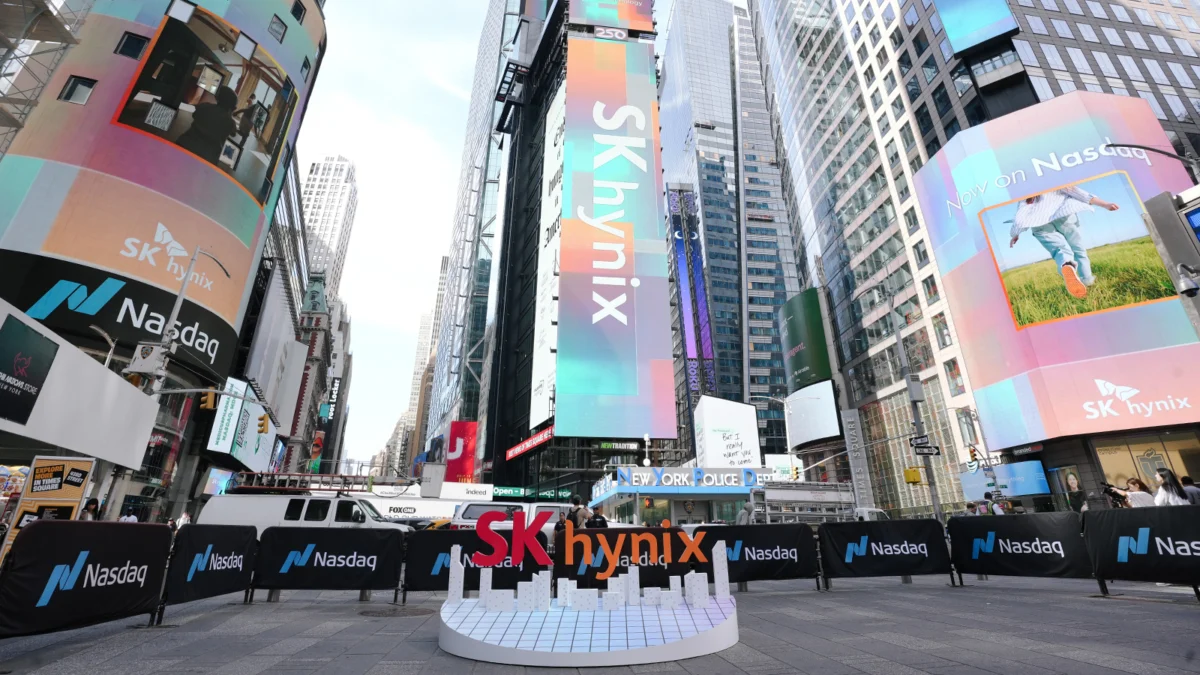
The global artificial intelligence revolution has officially hit Wall Street with unprecedented force. On Friday, July 10, South Korean semiconductor titan SK Hynix executed the largest U.S. market debut by a non-American company in history, raising a staggering $26.5 billion. The offering, which dwarfs the previous record held by Alibaba’s 2014 IPO, signals a massive shift in how global capital perceives the semiconductor supply chain—specifically, the critical role of memory chips in the age of AI.
Main Facts: A New Benchmark for Market Debuts
SK Hynix’s entry into the U.S. equity markets was nothing short of a blockbuster. The company successfully priced and sold 177.9 million American Depositary Shares (ADS) at $149 each. By structuring the offering to allow U.S. investors to purchase shares at roughly one-tenth the cost of the underlying equity in Seoul, the company effectively democratized access to its growth story for institutional and retail investors alike.
The market response was immediate and overwhelming. As of Friday morning, the stock (trading under the temporary ticker SKHYV) opened at a 14% premium over its IPO price. By the time trading moved into the midday session, the momentum had only intensified. This enthusiasm is particularly noteworthy given that the offering was priced at a 2.7% premium to the company’s three-day average on the Korea Stock Exchange. Despite this premium, reports suggest the offering was oversubscribed by more than seven times, reflecting an insatiable investor appetite for exposure to the AI hardware backbone.
Chronology: From Seoul to the Nasdaq
The journey to this historic Friday was marked by months of strategic preparation and aggressive market maneuvering.
- Early 2026: SK Hynix signals its intent to deepen ties with the U.S. financial system to support its massive capital expenditure requirements.
- Late June 2026: Reports emerge that the two South Korean semiconductor giants, Samsung and SK Hynix, have pledged a combined $550 billion in manufacturing investments to combat the global "RAMageddon"—the severe shortage of high-performance memory.
- July 8, 2026: Demand for the U.S. offering reaches a fever pitch, with reports confirming it is seven times oversubscribed.
- July 9, 2026: U.S. Commerce Secretary Howard Lutnick makes a high-profile visit to Micron, signaling the U.S. government’s intent to localize memory production.
- July 10, 2026: SK Hynix debuts on the Nasdaq under the temporary ticker SKHYV.
- July 13, 2026: The ticker will officially transition to SKHY as regular, full-scale trading commences.
Supporting Data: Defying the "Korea Discount"
For decades, South Korean corporations have struggled against the so-called "Korea Discount"—a market phenomenon where companies trade at a lower valuation relative to global peers. Analysts typically attribute this valuation gap to a confluence of factors: opaque corporate governance, historically low shareholder returns, a complex regulatory environment, and the persistent geopolitical shadow cast by North Korea.
SK Hynix’s performance this week suggests that the "AI effect" is powerful enough to dismantle these long-standing market biases. The company is not merely a memory manufacturer; it is a critical bottleneck in the AI supply chain. As a primary supplier for Nvidia’s high-performance GPUs, SK Hynix provides High-Bandwidth Memory (HBM), the "fuel" that enables generative AI to process massive datasets in real-time. Investors are clearly willing to overlook traditional geopolitical risks when faced with a company that is essentially an indispensable utility for the modern AI economy.
The capital raised ($26.5 billion) is already earmarked for aggressive expansion. According to the company’s filings, the funds will be deployed across three strategic pillars:
- New Fabrication Facilities: Construction of a state-of-the-art fab in South Korea to address the global supply deficit.
- Advanced Packaging: Investments in specialized facilities to enhance the performance and density of HBM modules.
- Next-Gen Lithography: The acquisition of advanced EUV (Extreme Ultraviolet) scanners, the most expensive and complex machines in existence, which are essential for producing the next generation of sub-nanometer chips.
Official Responses and the Geopolitical Landscape
The U.S. government is watching this influx of capital and technology with intense interest. On Thursday, U.S. Commerce Secretary Howard Lutnick delivered a pointed message at a Micron-hosted event. While Micron remains a domestic champion and a direct competitor to SK Hynix, the Commerce Department’s goals are broader: domesticating the semiconductor supply chain.
Lutnick confirmed he is in active, ongoing negotiations with both Samsung and SK Hynix regarding the establishment of new, large-scale manufacturing facilities on U.S. soil. The geopolitical implication is clear: the United States is no longer content to allow the global semiconductor industry to be dominated by a single geographic region. The Biden administration, and federal leadership in general, views the concentration of chip production in South Korea and Taiwan as a national security risk.
Micron, for its part, is leaning into this domestic push. The company recently announced a massive $250 billion commitment to new U.S. manufacturing projects, promising the creation of 90,000 jobs. The race is on, and the U.S. is using both carrots—tax incentives and infrastructure support—and the stick of supply chain security to lure Asian giants to build "Made in the USA" memory chips.
Implications: A New Era for Global Tech
The success of SK Hynix’s IPO sends a signal that transcends the balance sheet. It confirms that the AI arms race is moving into a phase of massive capital intensity.
1. The HBM Supercycle
The demand for High-Bandwidth Memory is projected to continue growing exponentially as AI models transition from text-based LLMs to multi-modal systems that require even higher data throughput. SK Hynix has effectively positioned itself as the gold standard in this niche, insulating itself from the cyclical volatility that has historically plagued the "commodity" memory market.
2. The Fragmentation of Supply Chains
The push by the U.S. Department of Commerce to force firms like Samsung and SK Hynix to build stateside will fundamentally change the cost structure of the industry. While it creates jobs and enhances security for the U.S., it introduces new operational complexities for the Korean firms, who must now manage a split manufacturing footprint.
3. Investor Sentiment Shift
If SK Hynix can sustain its valuation premium, it may trigger a re-rating of other South Korean technology companies. If global investors conclude that the "Korea Discount" is no longer applicable to AI-centric firms, we could see a massive rotation of capital into the KOSPI index, provided those firms can demonstrate similar alignment with the global AI value chain.
Conclusion
As the ticker SKHY begins its permanent life on the Nasdaq on Monday, it represents more than just a successful IPO. It is a testament to the fact that the semiconductor industry has become the new oil industry—the primary resource upon which the global digital economy depends. Whether the U.S. can successfully pull the manufacturing of this vital resource within its borders remains to be seen, but one thing is certain: the investors who bet on SK Hynix today are betting on the fundamental infrastructure of the 21st century.
As the industry moves forward, the synergy—and the friction—between South Korean technical prowess and American capital markets will likely define the trajectory of the AI boom for the remainder of the decade.
 Sagoh
Sagoh  Iffa Jayyana
  Lina Hope