In the fast-paced world of digital product design, user experience (UX) researchers are constantly searching for the ultimate method to uncover usability flaws before a product hits the market. Traditionally, teams rely on general population (gen pop) participants to evaluate website flows, button placements, and copy clarity. However, a groundbreaking exploratory study conducted in the summer of 2024 reveals a compelling truth: if you want deeper insights, higher-volume feedback, and a clearer path to intuitive design, you need to include testers with cognitive disabilities.
Led by accessibility experts and researchers from Fable—in collaboration with the University of California, Irvine—a comprehensive usability study demonstrated that participants with cognitive accessibility needs identified 1.8 times more issues and offered 1.8 times more actionable suggestions than general population participants.
This deep dive explores the mechanics, data, and profound implications of prioritizing cognitive inclusion in modern UX research, proving that designing for the cognitive margins ultimately elevates the digital experience for everyone.
Main Facts: The Core Discovery of the Cognitive Usability Study
Cognitive disability is an umbrella term encompassing conditions that affect how individuals process information, typically impacting memory, focus, and learning. According to the Centers for Disease Control and Prevention (CDC), cognitive disabilities represent the most prevalent form of disability in the United States, affecting roughly 13.9% of the population, with rates continuing to climb rapidly.
To understand how digital products serve this massive demographic, researchers initiated a rigorous multi-step project:
The Methodology: Thirty remote user interviews were conducted across three distinct, AI-generated prototype websites.
The Demographics: Participants were split evenly—15 with self-identified cognitive challenges (including neurodivergence such as ADHD, autism, and dyslexia) and 15 from the general population.
The Evaluation Metric: Sessions utilized the Accessible Usability Scale (AUS), a standardized 10-question survey measuring digital product usability.
The Findings: Cognitive participants logged 197 distinct usability issues and 93 suggestions for improvement, compared to just 113 issues and 54 suggestions from gen pop participants.
When usability issues compound into overwhelming cognitive load, they transform from minor annoyances into hard accessibility barriers. By examining these barriers, product teams can unlock vast improvements in content clarity, predictability, and user retention.
Chronology: How the Research Unfolded
The insights shared in the study are the culmination of a systematic, iterative research lifecycle spanning product development, pilot testing, and final execution.
Summer 2024: Fable formed a specialized working group focused on establishing industry best practices for accessibility testing with individuals with cognitive disabilities.
Screener Development and Literature Review: Researchers drafted targeted screeners to recruit participants self-identifying with memory, focus, and learning challenges. They simultaneously reviewed existing literature on cognitive testing best practices.
The Pilot Phase: A pilot study was conducted with 25 testers to refine the interview protocols. This phase yielded a specialized guide for conducting cognitive user interviews and a quantitative survey model.
The Joint Study Launch: Partnering with Syed Fatiul Huq at the University of California, Irvine, alongside Fable researchers Pranav Pidathala, Ali Brown, and Michael Fagan, the team generated three unique prototype websites using AI tools to test diverse user tasks.
Testing and Data Coding: Thirty moderated sessions took place. Every video recording and transcript was meticulously audited, with every friction point, missed task, and user suggestion cataloged by a single researcher to ensure absolute consistency.
Supporting Data: Breaking Down the Prototype Performance
To test a variety of digital environments, the research team deployed three AI-generated websites with distinct designs, goals, and levels of complexity.
1. Strong Snacks (Simple & Brutalist)
Description: A high-protein recipe site featuring category filters and blog posts.
The Data: As the simplest site tested, it yielded the lowest overall issue counts and highest median AUS scores. However, cognitive participants still surfaced an average of 3.4 more issues and 2.2 more suggestions than gen pop testers, reporting an overall experience score 13.7 points lower.
2. Turning Pages (Complex & Feature-Heavy)
Description: An online bookstore featuring curated catalogs, deep genre filters, a book-matching swiping tool, a shopping cart, and a checkout flow.
The Data: Due to its heavy functionality, this site generated the highest volume of issues overall. Cognitive participants found an average of 6 more issues and 3.2 more suggestions, rating the experience 17.2 points lower on the AUS scale than gen pop users.
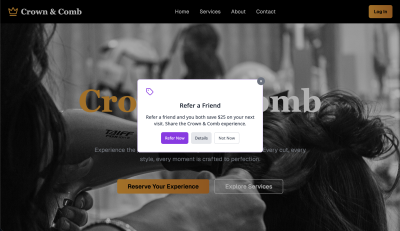
3. Crown & Comb (Intentionally Complex)
Description: A hair salon booking site featuring VIP programs, service guides, and intentionally obscured booking paths for a bridal package.
The Data: While gen pop users struggled immensely here (giving low AUS scores around 49.5), cognitive participants flagged an average of 7 more issues. Interestingly, cognitive users gave higher absolute AUS scores than gen pop users, suggesting that transparent, predictable navigation matters deeply to how they weigh their overall satisfaction versus raw friction.
Website
Gen Pop Avg Issues
Cognitive Avg Issues
Gen Pop Avg Suggestions
Cognitive Avg Suggestions
Strong Snacks
6.4
9.8
2.6
4.8
Turning Pages
11.0
17.0
5.2
8.4
Crown & Comb
5.0
12.0
3.0
5.4
When categorized, issues raised by cognitive participants clustered heavily around content clarity, button and link affordances, confusing icons or visual elements, and media/animations. Conversely, general population users were more likely to silently muddle through confusing interfaces without voicing structural complaints.
Official Responses and Participant Insights: Qualitative Realities
Quantitative data tells only half the story. The qualitative commentary gathered during the sessions reveals a striking contrast in how friction impacts different user groups. When examining the lowest-scoring sessions on the Crown & Comb website, the divergence in user sentiment was stark.
A general population participant expressed frustration with interface loops:
"As soon as you have a name of a treatment and a little explanation… as soon as you click onto that, it should be that you can interact with that service straight away… This feels not particularly engaging."
In contrast, a cognitive participant described a much deeper emotional and physical toll:
"For example, like, the mental energy aspect of it… like, okay, cookies, and then ads, pop-ups, or maybe the website has too many options to look through… It makes me, like, feel drained and less able to focus."
Industry leaders have taken notice of this phenomenon. A UX Manager at Bell Media noted:
"2 sessions with cognitive users feel like 200 because of the volume of insights we get."
Rather than simply noting that a button is hard to click, cognitive testers expose how poorly structured information drains mental bandwidth, leading to immediate abandonment and shattered user trust.
Implications: Why Cognitive Inclusion is a Business Imperative
Failing to include cognitive accessibility in UX research carries profound business consequences. As demographics shift, the necessity of cognitive-friendly design becomes even more urgent. According to U.S. Census projections, Americans aged 65 and older will increase from 17% to 25% by 2060, meaning one in four citizens will experience age-related cognitive decline.
Companies that fail to adapt will alienate not only neurodivergent users and older adults, but also the broader general population, who routinely suffer from temporary cognitive strain due to stress, fatigue, or multitasking.
Key Takeaways for Product and UX Teams:
Maximize Research Efficiency: Testing with cognitive accessibility needs yields nearly double the actionable insights, stretching limited research budgets further.
Lower Cognitive Load: Streamlining content, removing continuous animations, and clarifying interactive buttons benefits every single user, reducing bounce rates and increasing conversions.
Establish an On-Ramp to Accessibility: Cognitive accessibility serves as an approachable entry point for companies looking to mature their inclusive research practices before tackling advanced assistive technologies like screen readers.
Study Limitations to Keep in Mind
Researchers transparently note several limitations: the sample size was relatively small, making findings qualitative rather than statistically bulletproof. Different testing platforms were used for cognitive versus general population sessions (Fable Engage versus UserFeel), and interviews were facilitated by different researchers. However, to maintain integrity, a single researcher (the study author) coded and counted all issues and suggestions across every session.
Conclusion: The Future of UX
Cognitive inclusion in UX research is no longer a peripheral nice-to-have; it is a vital strategy for building efficient, clear, and resilient digital products. By designing for cognitive ease—focusing on predictability, legible text hierarchies, and straightforward workflows—product teams can ship better experiences that welcome every user through the digital front door.

 By Asro



 Nila Kartika Wati
 Evan Lee Salim
 Reynand Wu
