
 By Raul Delapena Setiawan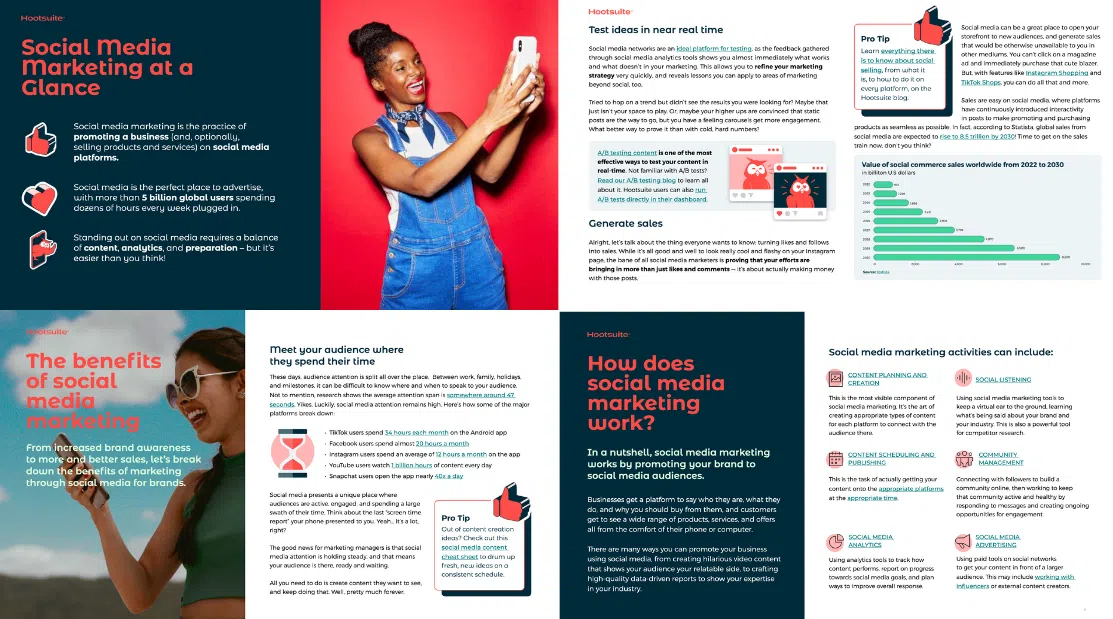
In an era where social media serves as the primary storefront, customer service hub, and brand-building engine for businesses, the "post-and-pray" method is no longer a viable path to growth. As digital landscapes become increasingly saturated, a comprehensive, data-backed social media strategy has transitioned from a competitive advantage to an absolute business necessity.
![Master your 2026 social media strategy [free template + expert tips]](https://blog.hootsuite.com/wp-content/uploads/2025/03/social-media-strategy.png)
A social media strategy is more than a content calendar; it is a holistic summary of everything a brand plans to do and hopes to achieve across digital platforms. By shifting from impulsive posting to intentional, goal-oriented engagement, organizations can transform their social presence into a measurable driver of ROI.
![Master your 2026 social media strategy [free template + expert tips]](https://blog.hootsuite.com/wp-content/uploads/2025/03/social-media-strategy-556x556.png)
The Evolution of Social Media Marketing
Social media marketing has evolved significantly from the early days of simple status updates. Today, it represents a dynamic ecosystem—spanning Instagram, TikTok, Facebook, LinkedIn, X, and YouTube—that prioritizes two-way conversation over static broadcasting. Modern brands do not just talk at their audience; they participate in communities.
![Master your 2026 social media strategy [free template + expert tips]](https://blog.hootsuite.com/wp-content/uploads/2024/10/Social-media-marketing-intro-ebook-620x345.png)
Without a formal strategy, organizations often find themselves chasing fleeting trends, running ads based on guesswork, and failing to capture the data necessary to justify their marketing spend. A well-crafted strategy serves as the bedrock for every campaign, ensuring that every comment, video, and interaction contributes to broader organizational objectives.
![Master your 2026 social media strategy [free template + expert tips]](https://blog.hootsuite.com/wp-content/uploads/2023/01/Inpost-CTA-Planner.png)
A Seven-Step Framework for Strategic Excellence
Building a winning social media strategy requires a disciplined approach. Experts recommend a seven-step framework to ensure clarity, focus, and measurable outcomes.
![Master your 2026 social media strategy [free template + expert tips]](https://blog.hootsuite.com/wp-content/uploads/2024/08/social-goals-slide-620x348.png)
1. Defining SMART Business Goals
Success begins with objectives that are Specific, Measurable, Attainable, Relevant, and Time-bound (SMART). Whether the goal is to increase lead generation, improve customer retention, or enhance brand awareness, every social effort must be tethered to a business outcome. Leadership teams are far more likely to support social initiatives when they can see a direct line between activity and bottom-line impact.
![Master your 2026 social media strategy [free template + expert tips]](https://blog.hootsuite.com/wp-content/uploads/2024/08/personas-slide-620x348.png)
2. Developing Deep Audience Insights
To target effectively, one must understand the consumer as a real person. Data-driven insights—such as age, location, and platform preference—are critical. For instance, if data indicates that a significant portion of your target demographic is active on specific platforms or uses specific devices, your resource allocation should shift accordingly. Utilizing AI-powered analytics tools can help marketers lighten the load while gaining a granular understanding of follower behavior.
![Master your 2026 social media strategy [free template + expert tips]](https://blog.hootsuite.com/wp-content/uploads/2024/08/competitors-slide-620x348.png)
3. Competitive Intelligence and Benchmarking
Your competitors are likely already active on social media. By conducting a thorough competitive analysis, you can identify industry standards and uncover "white space" opportunities. Social listening—tracking mentions, sentiment, and competitor activity—allows brands to pivot when a competitor leaves a segment underserved or when industry sentiment shifts. Monthly audits of these metrics keep your strategy sharp and responsive.
![Master your 2026 social media strategy [free template + expert tips]](https://blog.hootsuite.com/wp-content/uploads/2025/03/image-279-620x359.png)
4. Conducting a Rigorous Social Audit
Before expanding your presence, you must audit your current footprint. Which platforms are delivering ROI? Which are dormant? An audit identifies where to double down and where to cut losses. Furthermore, as social platforms increasingly function as search engines, optimizing profiles for SEO—including keyword-rich bios and consistent branding—is essential for visibility.
![Master your 2026 social media strategy [free template + expert tips]](https://blog.hootsuite.com/wp-content/uploads/2020/05/social-media-strategy-social-media-audit-spreedsheet-620x257.png)
5. Content Inspiration and Creative Curation
Consistency is the heartbeat of a successful social brand. However, consistency does not mean repetition. Successful brands look to industry leaders and award-winning campaigns for inspiration, adapting successful tactics to fit their unique brand voice. Whether it is the visual storytelling of National Geographic or the real-time customer support excellence of Nike, the goal is to provide value that answers the customer’s internal question: "What is in it for me?"
![Master your 2026 social media strategy [free template + expert tips]](https://blog.hootsuite.com/wp-content/uploads/2024/08/nat-geo-social-media-strategy-620x297.png)
6. Crafting the Content Mix
The "80-20 rule" remains a gold standard in the industry: 80% of your content should inform, educate, or entertain, while only 20% should explicitly promote your products or services. Overly self-promotional content is a primary driver of audience disengagement. By diversifying your content pillars, you build trust and authority, making your audience more receptive when you eventually do launch a sales-driven campaign.
![Master your 2026 social media strategy [free template + expert tips]](https://blog.hootsuite.com/wp-content/uploads/2024/08/nike-social-strategy-on-x.png)
7. Measuring, Refining, and Iterating
A strategy is a living document, not a static monument. Once data begins to accumulate, it must be used to refine future efforts. By utilizing UTM parameters and advanced analytics, marketers can track the customer journey from social click to website conversion. Regular reporting—at least on a weekly basis—allows for the agility required to succeed in a fast-paced digital environment.
![Master your 2026 social media strategy [free template + expert tips]](https://blog.hootsuite.com/wp-content/uploads/2022/10/Hootsuite_80-20_2-620x620.jpg)
The Role of Data in Modern Decision-Making
Supporting data underscores the necessity of this structured approach. According to recent industry reports, nearly 69% of marketers now prioritize performance metrics—such as conversion rates and click-throughs—over vanity metrics like follower counts. This pivot toward accountability reflects a maturation in the industry.
![Master your 2026 social media strategy [free template + expert tips]](https://blog.hootsuite.com/wp-content/uploads/2024/08/content-pillars-slide-620x350.png)
Furthermore, the integration of social listening tools is expanding, with the global market projected to reach $16.19 billion by 2029. This growth signals that organizations are moving beyond simple post-scheduling and into the realm of predictive analytics, using sentiment analysis to anticipate market shifts before they occur.
![Master your 2026 social media strategy [free template + expert tips]](https://blog.hootsuite.com/wp-content/uploads/2025/03/image-277-620x354.png)
Implications for Future Growth
The implications of a failed strategy are severe: wasted budget, damaged brand reputation, and lost market share to more agile competitors. Conversely, a robust strategy offers several distinct advantages:
![Master your 2026 social media strategy [free template + expert tips]](https://blog.hootsuite.com/wp-content/uploads/2024/08/progress-update-slide-620x350.png)
- Amplified Voice: A consistent, authoritative brand voice cuts through the noise of social feeds.
- Operational Efficiency: A content calendar prevents the "last-minute scramble," ensuring that team resources are utilized effectively.
- Better Crisis Management: Brands with a clear strategy and established voice are better equipped to navigate public relations challenges when they arise.
- Scalability: As a brand grows, a documented strategy provides the foundation for scaling teams and expanding into new markets without losing brand identity.
Strategic Recommendations for 2026
As we move further into 2026, the social media landscape will continue to be influenced by shifting demographics and emerging technologies. For organizations looking to optimize their performance, the following practices are recommended:
![Master your 2026 social media strategy [free template + expert tips]](https://blog.hootsuite.com/wp-content/uploads/2025/03/Screenshot-2026-06-23_AnalyticsReport-620x300.png)
- Adopt an "Always-On" Listening Strategy: Use social listening tools to monitor conversations around your brand and your industry. This allows for proactive rather than reactive engagement.
- Prioritize Social SEO: Treat your social profiles as search engines. Optimize your captions and bios to ensure your brand appears when users search for solutions within your industry.
- Invest in Video-First Content: With the rise of short-form video, static images are no longer sufficient to maintain high engagement rates.
- Build a Culture of Testing: Treat every campaign as an experiment. If a specific format, time, or topic performs well, double down on it. If it fails, document the learning and move on.
Conclusion: The Living Strategy
The most significant mistake a business can make is treating a social media strategy as a "one-and-done" task. The digital world is in a constant state of flux; new platforms emerge, algorithms are updated, and consumer preferences shift with cultural trends.
![Master your 2026 social media strategy [free template + expert tips]](https://blog.hootsuite.com/wp-content/uploads/2025/03/image-278-620x333.png)
An effective social media strategy is a living document that requires regular review. By maintaining this commitment to documentation and refinement, organizations ensure their social presence remains a vital, growth-driving asset. When you move from reactive posting to proactive, strategic management, you stop just participating in social media and start winning on it.
![Master your 2026 social media strategy [free template + expert tips]](https://blog.hootsuite.com/wp-content/uploads/2024/08/social-strategy-cover-page-620x350.png)
For those ready to implement these steps, utilizing a comprehensive Social OS can streamline the process—enabling teams to create, schedule, publish, engage, and measure all from a single, unified interface. By centralizing these functions, businesses can ensure that their team remains aligned, their brand voice remains consistent, and their results remain measurable.
 Reynand Wu
  Muslim
  Nila Kartika Wati