
 By Ali Ikhwan
In an era where digital marketing budgets are under increasing scrutiny, social media managers are no longer just responsible for "likes" and "shares." They are now expected to demonstrate how their content strategy directly correlates to revenue, customer acquisition, and long-term brand equity. According to recent industry surveys, 68% of marketers express concern over their ability to prove the return on investment (ROI) of their social efforts.
As social commerce is projected to balloon into a $908.5 billion industry by 2026—eventually surpassing the $1 trillion mark by 2028—the ability to articulate social media’s fiscal impact is not just a career asset; it is a business imperative.

The Core Mechanics of Social Media ROI
At its simplest level, social media ROI is the ratio of value generated from your social efforts compared to the total costs—time, creative resources, ad spend, and software—invested. The standard formula remains:
ROI = ((Value Generated – Costs of Investment) / Costs of Investment) x 100

However, the modern marketer knows that "value" is rarely one-dimensional. While revenue from a direct sales link is easy to track, the "soft" value of brand sentiment, community engagement, and share of voice often drives the "hard" revenue seen months down the line. To capture the full picture, organizations must fold these non-monetary metrics into their calculations by assigning them proxy values based on historical conversion data and Customer Lifetime Value (CLV).
The Evolution of ROI Attribution
The primary challenge in calculating ROI is the "last-click" bias. In a multi-touch digital landscape, a customer might interact with a brand across several channels—viewing an Instagram post, reading an email, and eventually clicking a paid search ad to convert.

Overcoming Roadblocks to Accuracy
- Multi-touch Attribution: Social media rarely acts in isolation. Advanced attribution models are now required to give social the "assisted conversion" credit it deserves.
- The Lag Effect: Particularly in B2B and enterprise sectors, the sales cycle is long. A LinkedIn thought-leadership piece may influence a decision-maker months before a contract is signed.
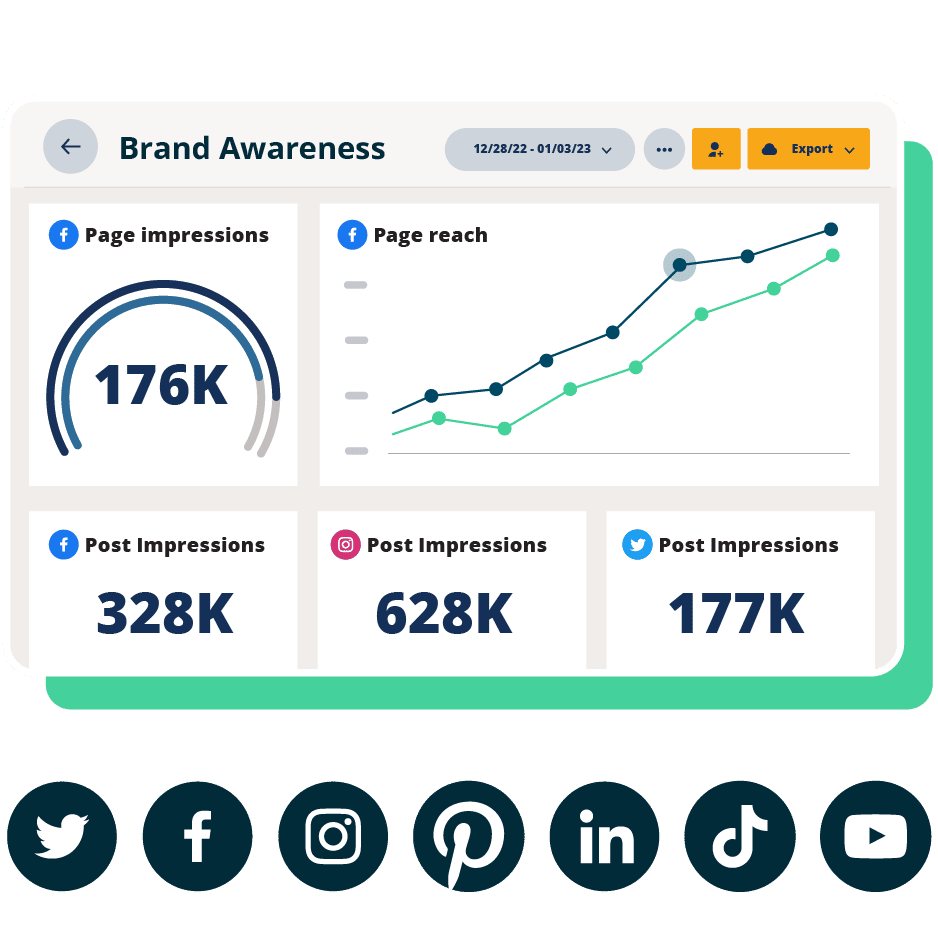
- Data Silos: Relying on disparate analytics dashboards for every platform creates manual, error-prone reporting. Centralized platforms are becoming the standard for enterprise teams to synthesize data into a single source of truth.
A Five-Step Framework for ROI Success
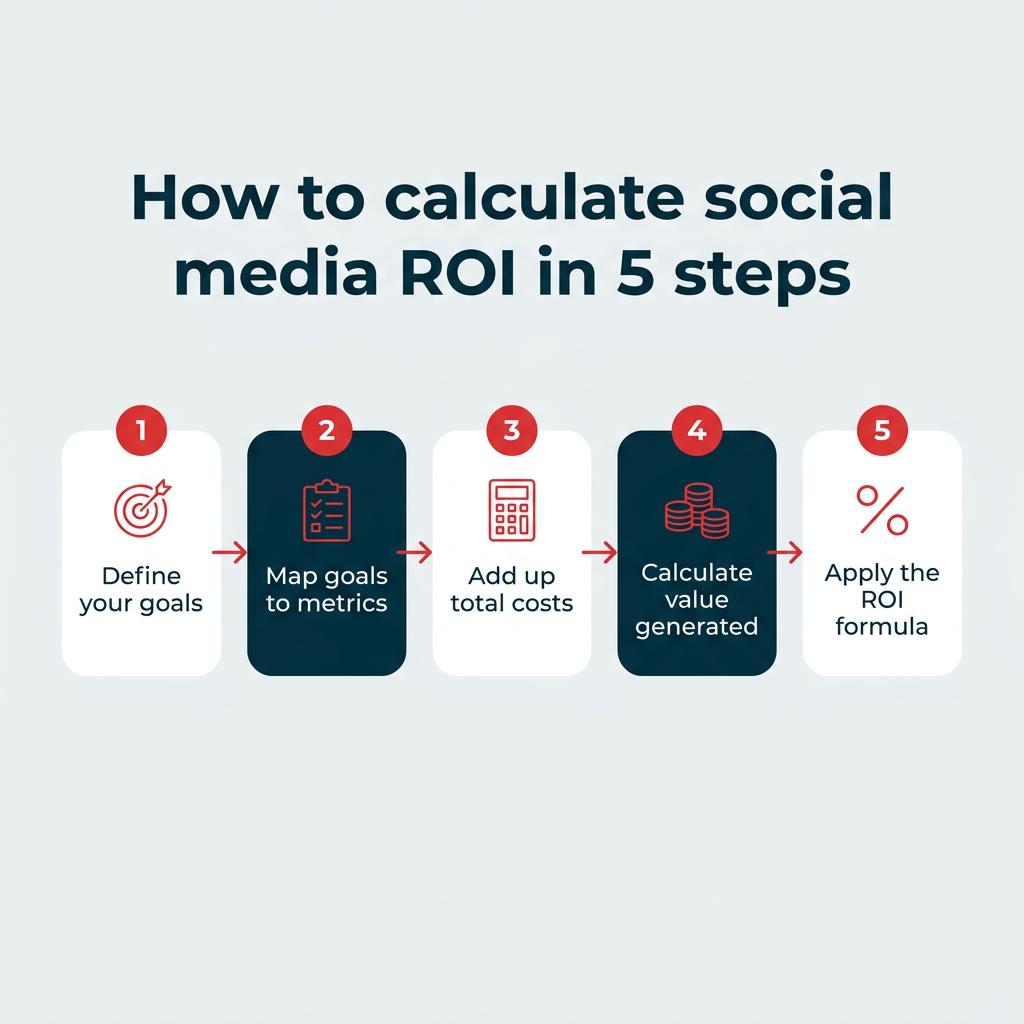
To move from anecdotal reporting to data-backed authority, marketing teams should follow this structured process:
1. Align Strategy with Business Goals
ROI cannot be measured if the goals are not defined. Whether the objective is lead generation, brand awareness, or direct sales, your metrics must serve that specific end. As industry experts note, these goals should be revisited quarterly to account for shifts in market conditions or internal business pivots.
2. Map Metrics to the Funnel
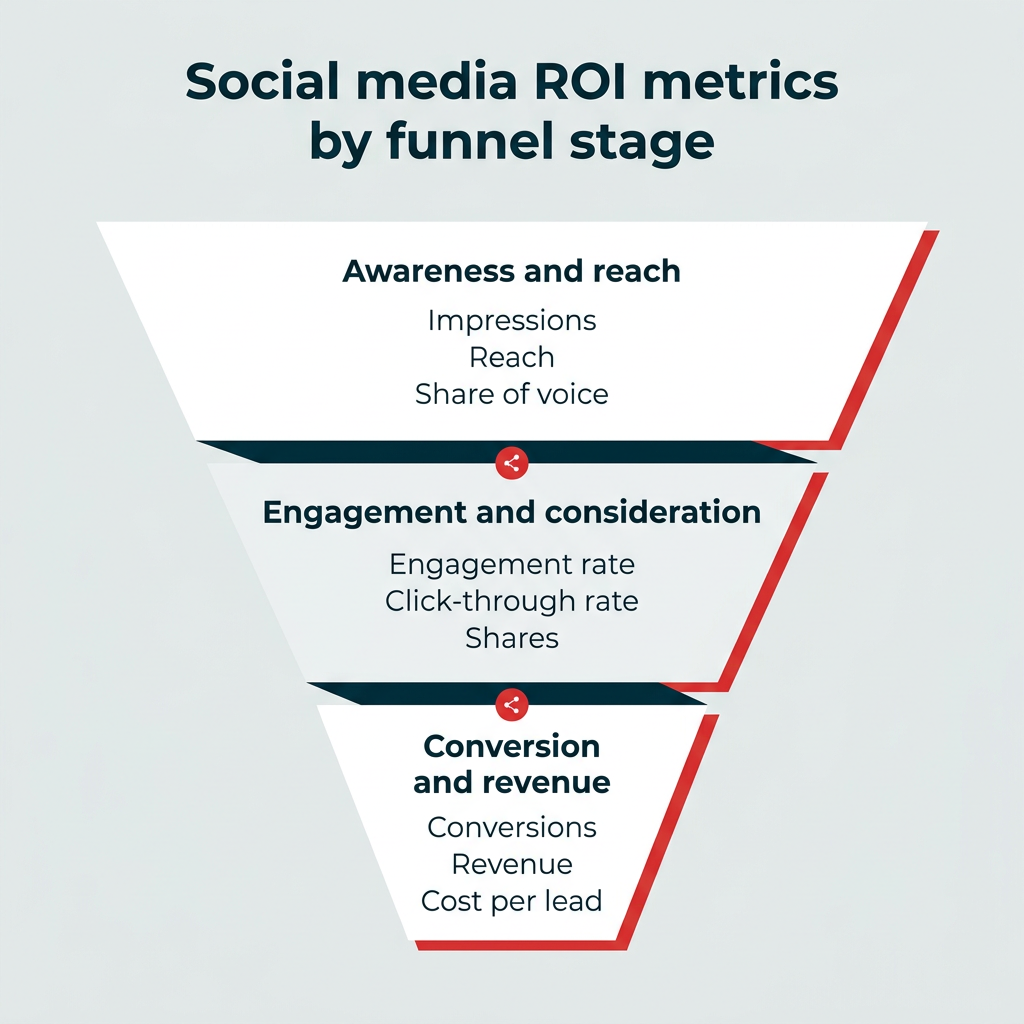
Not all metrics are created equal. Awareness (impressions, reach) belongs at the top of the funnel, while consideration (click-through rates, video views) belongs in the middle. Conversion metrics (ROAS, cost per lead, attributed revenue) belong at the bottom. By segmenting your reporting, you provide stakeholders with the data most relevant to their specific interests.
3. Aggregate Total Investment
"Costs" go beyond the monthly ad budget. A comprehensive ROI calculation must include:
- Staff salaries and contractor fees.
- Content production costs (photography, video editing, copywriting).
- Software and tool subscriptions.
- The cost of administrative time spent on community management.
4. Quantify the Value
Monetary value is straightforward—sales, subscriptions, and affiliate revenue. Non-monetary value requires creativity. By using CLV as a benchmark, you can estimate the future value of a new follower or a newsletter sign-up, allowing you to quantify growth that hasn’t yet hit the balance sheet.
5. Execute and Iterate
Once the calculation is complete, the resulting percentage indicates your efficiency. If the figure is below zero, the data acts as a diagnostic tool, signaling that it is time to pivot your content strategy, refine your audience targeting, or optimize your landing pages.
Supporting Data: Why Social Still Wins
The data supports a bullish view of social media as a revenue engine. With nearly 5.75 billion users worldwide expected by 2026, social platforms are the primary digital storefront for the modern consumer. Data shows that 46% of marketers report that social media marketing directly improves sales. When these figures are presented alongside traffic growth and lead generation stats, the argument for maintaining or expanding social budgets becomes much easier to defend to executives.
Official Industry Perspectives
Leading enterprise organizations have moved away from manual spreadsheets in favor of unified analytics platforms. By utilizing tools that integrate with Google Analytics or Adobe Analytics, firms are now able to track the entire customer journey from a social link click to the final checkout.

"Social is a place where we are continuously testing new content, features, and learning what is working," says Eileen Kwok, a veteran social media strategist. "The goals you have set at the start of the year may have already changed. Depending on the shifts your organization is making, you must be prepared to adjust."
Implications for Future Strategy
The implications for brands are clear: if you are not measuring, you are not managing. As we look toward 2026 and beyond, the brands that win will be those that treat social media as an integrated part of their sales stack rather than a peripheral marketing channel.
The Power of A/B Testing
The most effective way to improve ROI is through consistent experimentation. By running A/B tests on formats—such as comparing the engagement rates of Instagram carousels versus short-form Reels—marketers can allocate their budget toward high-performing content. Data-driven decision-making minimizes "budget waste" and ensures that creative production is focused on the formats that actually convert.
Competitive Benchmarking
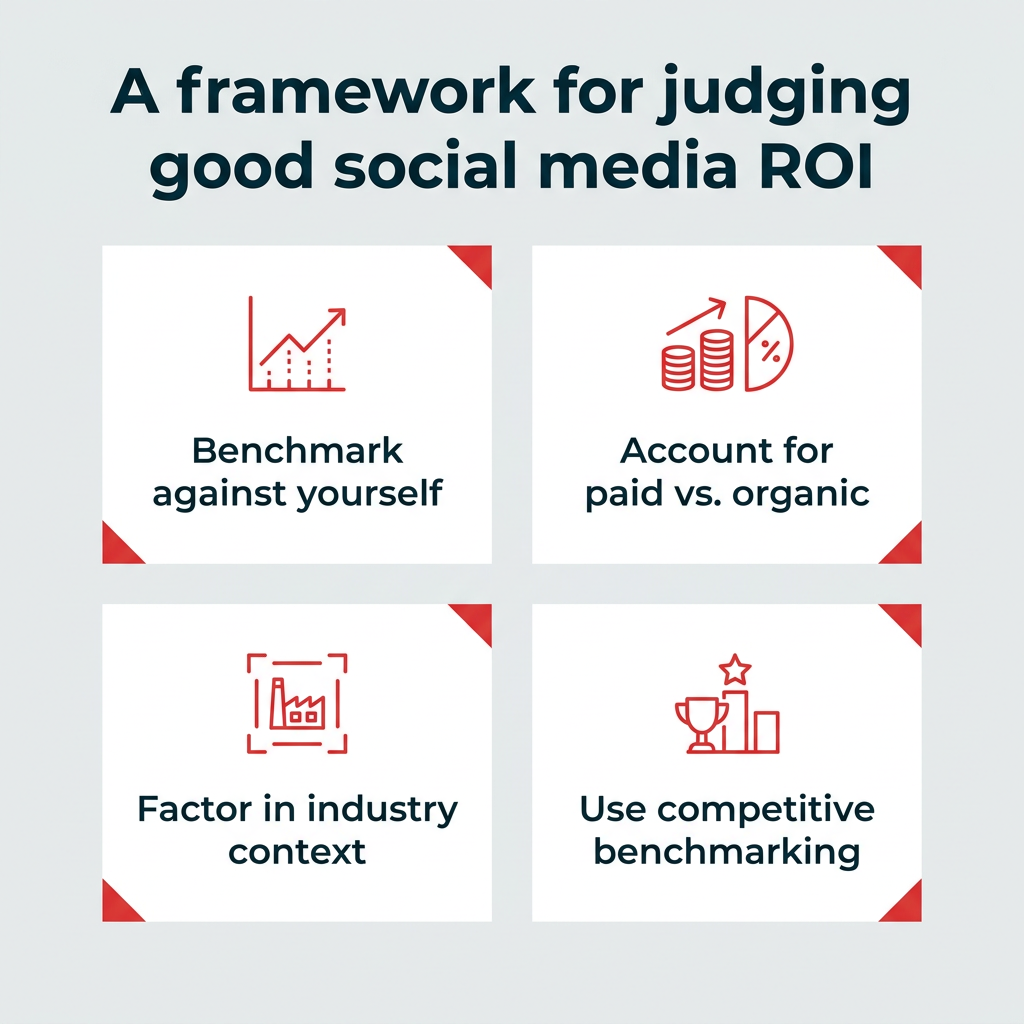
In a public-facing digital environment, you have the advantage of visibility. Using analytics tools to track competitor performance allows you to identify industry trends, popular hashtags, and successful content styles. By benchmarking your performance against industry averages, you can set realistic, growth-oriented KPIs that satisfy even the most demanding stakeholders.

The Role of Social Commerce
Perhaps the most significant shift in ROI measurement is the rise of native social commerce. Because the path from discovery to purchase occurs within a single environment, platforms like TikTok and Instagram are providing cleaner, "closed-loop" attribution. For businesses, this means the distance between a customer seeing an ad and clicking "buy" is shrinking, making ROI calculations more accurate than they have ever been.
Conclusion: Reporting to the C-Suite
When the time comes to present your findings, the "language of leadership" is paramount. Executives do not necessarily want to see vanity metrics like total impressions; they want to see the impact on the bottom line.

To be effective, your report should:
- Be Concise: Focus on trends rather than raw data.
- Show Context: Explain how the social ROI supports broader company growth.
- Be Forward-Looking: Use your findings to propose where the next budget dollar should be spent.
By adopting a disciplined approach to calculation and maintaining a rigorous focus on business outcomes, social media managers can transform their department from a cost center into a primary driver of organizational revenue. The tools exist, the data is abundant, and the path to proving your value is clearer than ever before.
 Reynand Wu
  Muslim
  Nila Kartika Wati