
 By Muslim
Main Facts: A Paradigm Shift for Enterprise Event-Driven Architecture
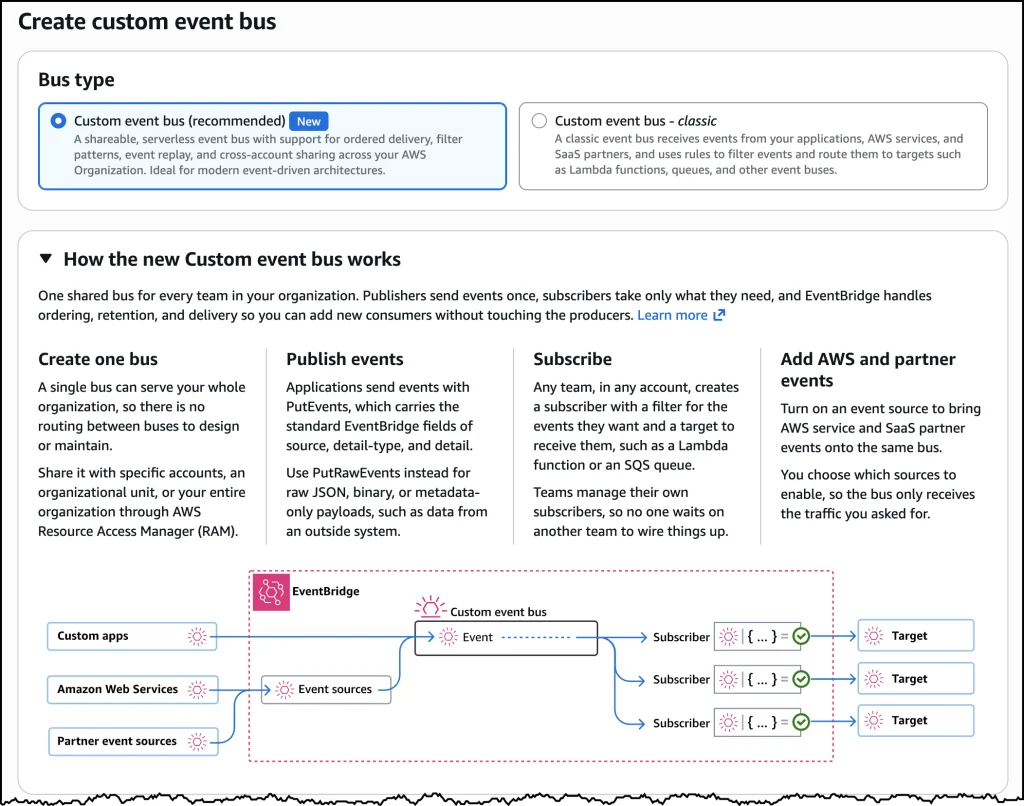
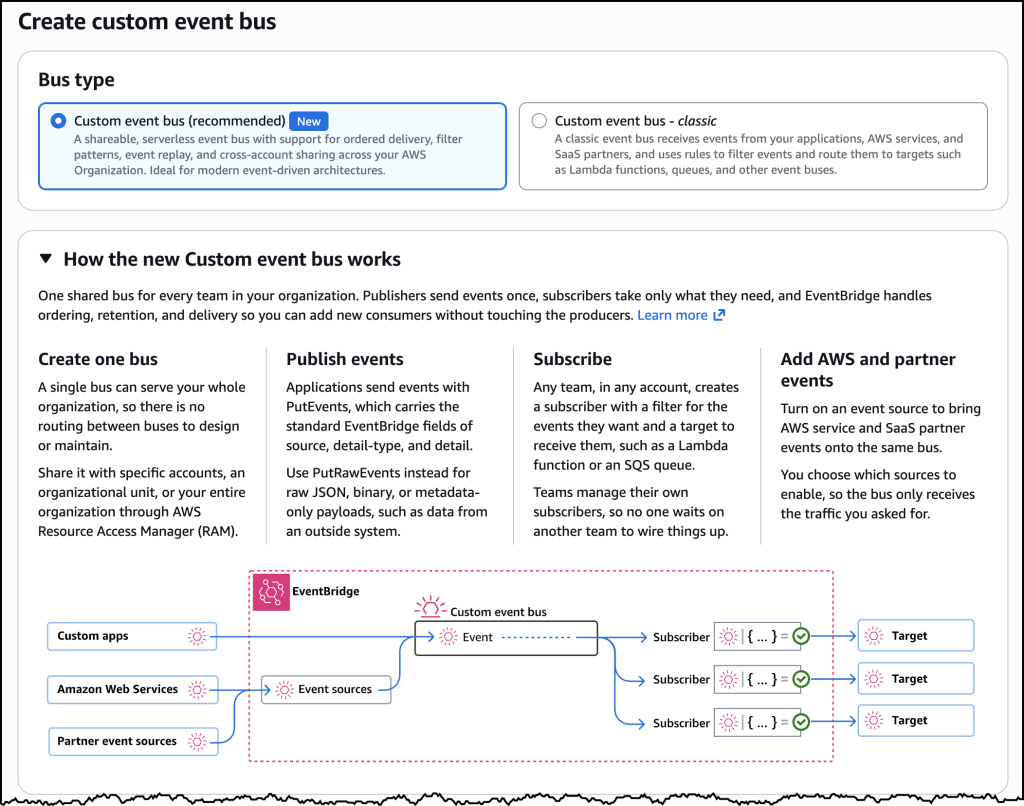
In a significant upgrade for cloud-native developers and platform engineering teams, Amazon Web Services (AWS) has announced the general availability of an enhanced custom event bus for Amazon EventBridge. Purpose-built to address the mounting operational complexity of scaling event-driven architectures across multi-account enterprise environments, this new offering introduces centralized organization-wide sharing, native event ordering guarantees, a unified Subscriber resource, and a modernized ingress-egress pricing model.
For years, organizations building event-driven applications on AWS have relied on a single custom event bus housed within a single account as their starting point. While efficient for isolated teams, this pattern inevitably fractures as cloud adoption scales. In alignment with AWS’s well-architected multi-account best practices—where every business unit or engineering team operates within its own dedicated AWS account—teams historically had to stitch together complex webs of cross-account rules and bus-to-bus configurations.
This patchwork approach introduced severe friction:
- Loss of Visibility: Platform teams lost centralized visibility into which downstream services were subscribing to specific upstream events.
- Compound Costs: Cross-account and bus-to-bus routing fees multiplied rapidly, driving up operational overhead.
- Workaround Bottlenecks: Teams requiring sequential event processing (such as logistics or financial transaction ordering) were forced to deploy auxiliary infrastructure, such as Amazon Simple Queue Service (SQS) queues, or entirely different messaging technologies to preserve event integrity.
The newly released enhanced custom event bus directly resolves these architectural bottlenecks. By enabling a single, centralized event backbone shared securely across all AWS accounts within an enterprise organization via AWS Resource Access Manager (AWS RAM), AWS has eliminated the need for manual cross-account routing configurations. Furthermore, the platform now supports native event ordering, content-based deduplication, JSONata-powered payload transformations, automatic deserialization of binary formats like Apache Avro and Protocol Buffers, and an innovative throughput-based pricing structure.
Crucially, AWS has ensured backward compatibility. Existing event buses will remain fully operational, designated as "Custom event bus — classic," allowing enterprises to migrate to the enhanced architecture at their own pace without risking disruption to legacy workloads.
Chronology: From Single-Account Simplicity to Enterprise-Scale Complexity
To understand the significance of this release, it is vital to trace the evolution of event-driven architectures (EDAs) within AWS over the past decade.
Phase 1: The Single-Bus Era
When Amazon EventBridge (originally launched as CloudWatch Events) evolved into a fully managed serverless event bus, it empowered developers to decouple applications cleanly using publish-subscribe (pub-sub) patterns. Early implementations typically involved a single custom event bus inside a single AWS account. A monolithic team or a small startup could easily manage rules, targets, and event payloads without friction.
Phase 2: The Multi-Account Explosion
As enterprises accelerated their cloud transformation, security and compliance mandates drove them toward multi-account strategies governed by AWS Organizations. Suddenly, an enterprise might operate dozens, hundreds, or thousands of isolated AWS accounts.

- To pass events between Account A (publisher) and Account B (subscriber), engineers had to write complex resource-based policies.
- When fan-out requirements grew, teams built intricate bus-to-bus forwarding chains.
- Operational overhead skyrocketed. Platform engineers found themselves blind to event dependencies, while finance departments audited unpredictable, compounding data transfer and routing bills.
Phase 3: The Architectural Workarounds
To cope with EventBridge’s historical lack of native sequencing, developers resorted to defensive engineering. If a logistics application required driver location updates to arrive in strict chronological order, engineers could not rely on EventBridge’s default at-least-once, out-of-order delivery model. Instead, they inserted Amazon SQS FIFO queues between the event bus and AWS Lambda functions, re-introducing infrastructure management tasks that serverless computing was designed to eliminate.
Phase 4: The Modern Solution
Recognizing these pain points at scale, AWS engineering teams went back to the drawing board. The result is the enhanced custom event bus. Announced and rolled out globally across major AWS Regions in late 2024 through 2026, this feature bridges the gap between decentralized team autonomy and centralized platform governance, marking the most substantial structural upgrade to EventBridge since its inception.
Supporting Data: Technical Specifications and Capabilities
The enhanced custom event bus introduces deep structural modifications across ingestion, routing, processing, and cost allocation. Below is a detailed breakdown of its core technical pillars.
1. Organization-Wide Sharing via AWS RAM
Deploying a centralized event backbone no longer requires custom permission scripts. By integrating natively with AWS Resource Access Manager (AWS RAM), platform teams can provision a single enhanced custom event bus and share it instantly across:
- Entire AWS Organizations
- Specific Organizational Units (OUs)
- Individual AWS accounts
- Specific AWS Identity and Access Management (IAM) roles or users
Each enhanced custom event bus supports a default quota of 10,000 Subscribers per bus—a threshold that can be increased upon request. This high ceiling prevents the artificial fragmentation that previously forced organizations to spin up multiple disparate buses simply to bypass subscriber caps.
2. Dual-Mode Event Ordering and Synchronous Invalidation
While asynchronous, out-of-order event processing remains the gold standard for decoupled microservices, real-world constraints often demand sequential execution. The enhanced event bus handles both paradigms simultaneously:
- Asynchronous Routing: Default consumers continue to process events concurrently and independently without ordering constraints.
- Ordered Delivery: Publishers can attach an
EventGroupIdto their event payloads. EventBridge guarantees strict sequential delivery of events sharing the sameEventGroupIdto subscribers configured for ordered processing.
To underpin this ordered workflow, EventBridge now supports synchronous invocation for targets like AWS Lambda. By confirming successful downstream processing before acknowledging the event back to the bus, this mode eliminates the need to interpose Amazon SQS queues for sequential reliability.
3. Unified Subscriber Resources
Historically, achieving robust event filtering, retry policies, and dead-letter queue (DLQ) routing required managing multiple discrete resources—combining EventBridge rules, target configurations, and individual IAM policies.

The enhanced bus introduces the Subscriber resource, a unified construct that encapsulates:
- Granular event filter patterns
- Target endpoint definitions
- Advanced retry policies
- Dead-letter destinations
- Variable start-time options for historical event replays and application hydration
4. Advanced Event Evaluation and Transformation
Data hygiene and payload shaping have been significantly streamlined at the bus level:
- Content-Based Deduplication: For event sources that lack reliable client-side idempotency tokens, EventBridge can automatically hash meaningful payload elements. If duplicate events arrive within a five-minute window due to network retries or timeouts, EventBridge collapses them, delivering exactly-once processing semantics.
- JSONata Transformations: Downstream consumers can leverage JSONata expressions directly within their subscription configuration to reshape, filter, compute, or extract specific fields before payloads hit their targets.
- Binary Deserialization: Organizations utilizing Apache Avro or Protocol Buffers can configure EventBridge to natively deserialize binary payloads into JSON, enabling deep filtering without requiring custom parsing code in consumer applications.
5. Throughput-Based Pricing Model
Breaking away from the legacy per-event pricing structure that penalized complex multi-bus routing, the enhanced custom event bus introduces an ingress and egress throughput pricing model. Publishers pay strictly for events ingested into the bus, while subscribers pay for events successfully delivered. This transparent model drastically improves cost allocation visibility in multi-tenant enterprise environments.
Official Responses and Industry Perspective
While AWS has positioned the release as a natural evolution of enterprise serverless computing, early adopters and cloud architects have expressed enthusiastic support alongside pragmatic architectural notes.
Platform engineering leads across various sectors have praised the elimination of cross-account policy maintenance. In early previews, enterprise architects highlighted the drastic reduction in CloudFormation and Terraform boilerplate code required to connect disparate AWS accounts.
"For years, our platform team spent countless cycles managing cross-account resource policies and bus-to-bus routing rules just to let a subsidiary team consume an order-placed event," noted a principal cloud architect at a global logistics firm. "With organization-wide sharing via AWS RAM and the new Subscriber resource, our developers can safely self-serve while platform operations maintain strict visibility and access boundaries."
Database and serverless analysts have similarly pointed out that native event ordering combined with synchronous Lambda invocation bridges a long-standing functional gap between message queues (like SQS) and event buses (like EventBridge). By allowing teams to mix ordered and unordered consumers on the exact same bus, AWS has removed one of the primary historical justifications for maintaining hybrid architectures comprising both SQS and EventBridge.
Furthermore, financial operations (FinOps) teams have welcomed the ingress-egress pricing separation. In legacy multi-bus topologies, indirect routing charges compounded silently as events hopped across accounts. The new throughput-based model aligns cloud expenditures directly with actual business consumption metrics, making unit economics much easier to forecast and audit.
Implications: What This Means for Developers and Enterprises
The rollout of the enhanced custom event bus has profound implications for how organizations design, scale, and govern serverless applications.
1. Simplification of Cloud-Native Topologies
Architects no longer need to compromise between loose coupling and operational simplicity. By centralizing event transport onto a single shared bus while granting decentralized teams autonomous control over their Subscriptions, organizations can streamline their infrastructure footprint. The reduction in auxiliary queues and custom forwarding scripts translates directly to fewer points of failure and reduced maintenance overhead.
2. Accelerated Developer Velocity
Application teams are frequently bottlenecked by infrastructure provisioning cycles. By leveraging organization-wide sharing, development teams in Account B can immediately discover, subscribe to, and consume events published by Account A without waiting for platform engineers to write custom IAM policies or configure routing rules. This self-service agility accelerates feature delivery across distributed engineering organizations.
3. Enhanced Compliance and Governance
For heavily regulated industries—such as fintech, healthcare, and defense—visibility is paramount. Platform teams can now maintain absolute oversight over who publishes and consumes sensitive enterprise events, all while enforcing strict schema validation, payload deduplication, and secure IAM boundaries through AWS RAM.
Global Availability
The enhanced custom event bus is available immediately across a broad footprint of global AWS Regions, including:
- North America: US East (N. Virginia, Ohio), US West (Oregon)
- Europe: Ireland, Frankfurt, Stockholm, Spain
- Asia Pacific: Hong Kong, Malaysia, Mumbai, Singapore, Sydney, Thailand, Tokyo
Engineering teams can begin provisioning enhanced custom event buses today utilizing the AWS Management Console, the AWS Command Line Interface (AWS CLI), or infrastructure-as-code (IaC) frameworks via EventBridge APIs. As enterprises continue their journey toward fully realized serverless maturity, Amazon EventBridge’s latest offering establishes a robust, scalable standard for enterprise event routing.
 Reynand Wu
 Jia Lissa
 Nana Wu
